
Lecanorchis
Lecanorchis
Lecanorchis is a genus of leafless, terrestrial orchids belonging to the subfamily Vanilloideae. These myco-heterotrophic plants are found in the mountain forests of various Asian regions and New Guinea, distinguished by their dull-colored flowers with a distinctive hairy lip. They are characterized by a cup-like calyculus and an elongated gynostemium.
Key Facts
- ›Lecanorchis are terrestrial, leafless myco-heterotrophs.
- ›They are found in mountain forests from the Himalayas to New Guinea.
- ›Flowers are typically dull brown, purple, yellow, or green with a brighter, hairy lip.
- ›A unique calyculus, a cup-like structure of bracts, is present.
- ›The gynostemium, the fused stamen and pistil, is notably elongated.
- ›The genus name is derived from Greek words meaning 'basin' and 'orchid'.

Terrestrial, Myco-Heterotroph
About Lecanorchis
Lecanorchis is a genus of orchids that stands apart due to its unique characteristics, most notably its leafless, terrestrial nature and its reliance on fungi for nutrition. Belonging to the subfamily Vanilloideae within the Orchidaceae family, these plants are scientifically named from the Greek words 'lekane' (basin) and 'orchis' (orchid), hinting at their floral structure.
Distribution and Habitat
These fascinating orchids are found in the mountain forests of a broad geographical area that spans from the Himalayas eastward through China, Japan, Korea, Southeast Asia, and extending to New Guinea. They thrive at altitudes typically ranging from 300 to 1,500 meters (approximately 980 to 4,920 feet), favoring the damp, shaded conditions of their forest habitat.
Morphology and Characteristics
Unlike many orchids, Lecanorchis species are myco-heterotrophs, meaning they are not photosynthetic and do not possess leaves in their mature state. Instead, they derive sustenance from a symbiotic relationship with soil fungi. Their root system consists of numerous long, thick, horizontal roots situated beneath a short rhizome. The stems are erect, thin, brittle, and can be either branched or unbranched, typically appearing dark in color. The flowers themselves are often described as dull, exhibiting shades of brown, purple, yellow, or green. A notable feature is the lip, which is about the same length as the sepals and is densely covered with yellow hairs, giving it a distinct appearance. Two key diagnostic characteristics for the genus are the presence of a calyculus—a cup-like structure formed by a cluster of small bracts—and an elongated, erect gynostemium, which is the fused structure of the stamen and pistil.
Related Genera
Lecanorchis is known to be related to other genera such as Clematepistephium and Eriaxis, both of which are endemic to New Caledonia, suggesting a shared evolutionary history within the Vanilloideae subfamily.
Source: Wikipedia ↗
Frequently Asked Questions
What are Lecanorchis orchids?
Lecanorchis orchids are a genus of terrestrial, leafless plants belonging to the Orchidaceae family, specifically the Vanilloideae subfamily. They are myco-heterotrophs, meaning they obtain nutrients from fungi rather than through photosynthesis.
Where are Lecanorchis orchids found?
These orchids are native to mountain forests across a wide range, including the Himalayas, China, Japan, Korea, Southeast Asia, and New Guinea. They typically grow at altitudes between 300 and 1,500 meters.
What do Lecanorchis flowers look like?
Lecanorchis flowers are generally dull in color, appearing in shades of brown, purple, yellow, or green. A distinctive feature is their lip, which is often a brighter hue and covered in dense hair.
What are the unique characteristics of Lecanorchis?
Key distinguishing features include a calyculus, which is a cup-like structure formed by small bracts, and an elongated gynostemium, the fused reproductive organ of the flower.
Are Lecanorchis orchids photosynthetic?
No, Lecanorchis orchids are leafless myco-heterotrophs. This means they lack chlorophyll and depend on a symbiotic relationship with fungi in the soil to obtain their nutrients.
Related Orchid species
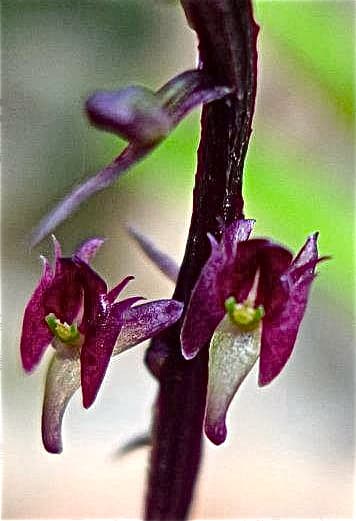
Crepidium
Crepidium, also known by its Chinese name 沼兰属 (zhao lan shu) and commonly as spur orchids, is a genus of approximately three hundred species of evergreen orchids. These plants are predominantly terrestrial, characterized by short, ground-hugging stems, large pleated leaves, and small, non-resupinate flowers with spreading sepals and petals. The genus is widely distributed across the tropics, with a significant diversity found in New Guinea.
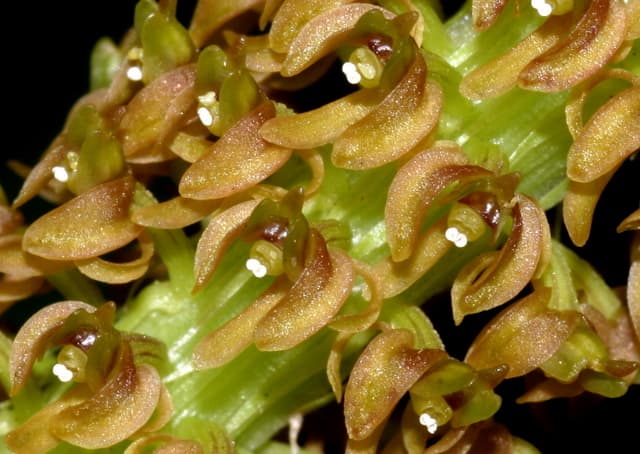
Dienia
Dienia, commonly known as snout orchids, is a genus of six species of evergreen orchids found across Southeast Asia, Australia, Micronesia, and Melanesia. These plants are characterized by their fleshy, above-ground stems, large pleated leaves, and small, non-resupinate flowers with a distinctive short, tongue-like labellum. While primarily terrestrial, some species can grow as epiphytes.
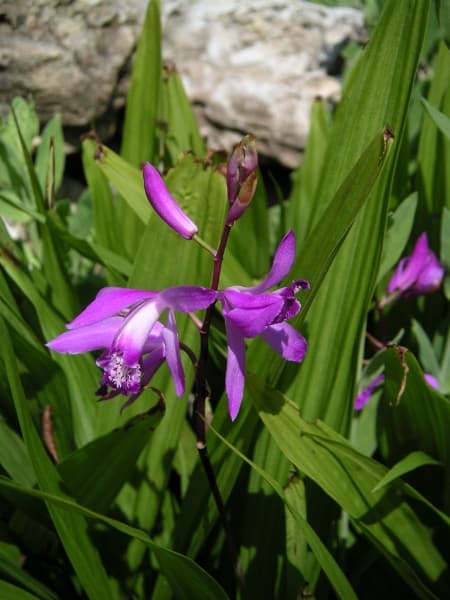
Bletilla
Bletilla, commonly known as the urn orchid, is a temperate, terrestrial orchid genus found across East Asia and Southeast Asia. Its pseudobulbs resemble spreading corms, and the plants are characterized by pleated leaves and racemes of flowers that emerge in spring and early summer, varying in color from white to purple. Bletilla striata, the most common species, is particularly noted for its hardiness and ease of cultivation.