
Cylindrolobus
Cylindrolobus
Cylindrolobus is a genus of orchids comprising approximately 80 species. These orchids are found across a wide geographic range, from New Guinea to Southeast Asia, southern China, and India. They are distinct for their slender, elongate stems that are typically not pseudobulbous, with leaves distributed along the entire length.
Key Facts
- ›The genus Cylindrolobus contains around 80 known species.
- ›These orchids are primarily epiphytic, though some can grow terrestrially.
- ›Their stems are slender and usually lack prominent pseudobulbs.
- ›Leaves are leathery, alternate, and conduplicate, found along the stem.
- ›Inflorescences are typically short, bearing only one to three flowers.
- ›Flowers are often white or cream-colored, with some species exhibiting ochre-yellow hues.

New Guinea, Wallacea, Southeast Asia, Southern China, India, Lesser Sunda Islands, Maluku, Sulawesi, Philippines, Borneo, Java, Sumatra, Malaya, Thailand, Cambodia, Vietnam, Laos, Myanmar, Assam, East Himalaya, Tibet, South Central China
Epiphytic, Terrestrial
White, Cream, Ochre-Yellow
About Cylindrolobus
Cylindrolobus is a genus of orchids that encompasses approximately 80 recognized species. These plants are native to a wide geographical expanse, extending from New Guinea through Wallacea, Southeast Asia, southern China, and into India. The genus is characterized by its slender, elongate stems that are typically not pseudobulbous, though some species may exhibit slightly swollen terminal internodes. The leaves are leathery, alternate, and conduplicate, arranged along the entire length of the stem, with the exception of some basal nodes where persistent leaf sheaths are present.
Growth and Habitat
The species within the Cylindrolobus genus exhibit a dual growth habit, being primarily epiphytic, meaning they grow on other plants for support, but also occasionally found growing terrestrially in soil. Their distribution is extensive, covering regions such as New Guinea, the Lesser Sunda Islands, Maluku, Sulawesi, the Philippines, Borneo, Java, Sumatra, Malaya, Thailand, Cambodia, Vietnam, Laos, Myanmar, Assam, the East Himalaya, India, Tibet, and South Central China.
Floral Characteristics
Inflorescences in Cylindrolobus are typically short or slender, arising laterally from numerous nodes or from the terminal node of the stem, and usually bear only one to three flowers. The floral bracts are few and spirally arranged, with some species featuring conspicuous, brightly colored, and fleshy bracts. The flowers themselves are generally medium-sized and glabrous. Their coloration predominantly ranges from white to cream, although some species display ochre-yellow flowers. The sepals are free and often recurved, while the lateral sepals contribute to a mentum formation with the column foot. The petals are smaller than the sepals, and the distinctive lip is three-lobed, hinged to a column foot, and ornamented with a papillose callus and keels. The lateral lobes of the lip are erect and tend to enclose the column, with the mid-lobe usually being smaller than the lateral lobes. The column is short, featuring a foot that is either shorter than or approximately equal in length to the column proper. Each flower contains eight rectangular pollinia arranged in pairs, with a larger and smaller pollinium in each pair, and the posterior four being notably smaller.
Source: Wikipedia ↗
Frequently Asked Questions
What is the geographic distribution of Cylindrolobus orchids?
Cylindrolobus orchids are found across a broad region spanning from New Guinea to Southeast Asia, including areas like Wallacea, southern China, and India. Specific countries and regions include New Guinea, the Lesser Sunda Islands, Maluku, Sulawesi, the Philippines, Borneo, Java, Sumatra, Malaya, Thailand, Cambodia, Vietnam, Laos, Myanmar, Assam, the East Himalaya, India, Tibet, and South Central China.
What are the typical growth habits of Cylindrolobus species?
These orchids are predominantly epiphytic, meaning they grow on other plants, usually trees, for support. However, some species are also known to grow terrestrially, in soil.
Describe the physical characteristics of Cylindrolobus plants.
Cylindrolobus plants feature slender, elongate stems that are usually not pseudobulbous, though some may have slightly swollen terminal internodes. Leaves are leathery, alternate, and conduplicate, running along the entire length of the stem, except for basal nodes with persistent sheaths. Inflorescences are typically short and bear only one to three flowers.
What colors are the flowers of Cylindrolobus orchids?
The flowers of Cylindrolobus orchids are mostly colored white or cream. Some species within the genus can also have ochre-yellow flowers.
How are the flowers of Cylindrolobus structured?
The flowers are medium-sized and glabrous, meaning smooth. They have sepals that are free and often recurved, with lateral sepals forming a mentum with the column foot. The petals are smaller than the sepals, and the lip is three-lobed, hinged to a column foot, and adorned with a callus and keels.
Related Orchid species

Holcoglossum
Holcoglossum is a genus of orchids belonging to the family Orchidaceae, native to regions spanning Assam, China, Taiwan, and Indo-China. These perennial plants are characterized by their short shoots, terete or triangular leaves with a grooved upper surface, and distinctive white flowers with a three-lobed lip and elongated spur. They are typically epiphytic or lithophytic, growing at higher altitudes and preferring cool environments.
Callostylis
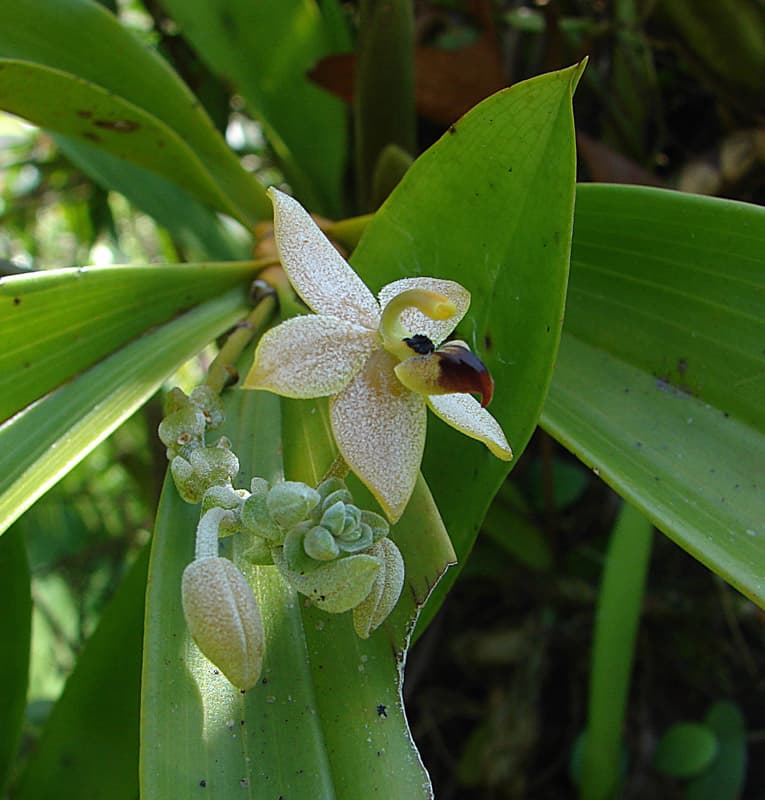
Callostylis is a genus of orchids native to Southeast Asia, ranging from Assam and southern China to Java. Previously considered a synonym of the genus Eria, it is now an accepted name. The genus is recognized for its diverse species found across various regions within its native range.
Aerides
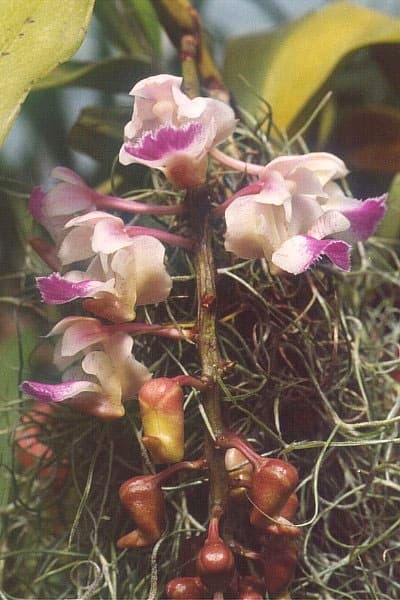
Aerides, commonly known as cat's-tail orchids and fox brush orchids, is a genus of tropical epiphytic orchids native to Asia. These orchids are highly valued in horticulture for their showy, fragrant, and long-lasting flowers, which typically appear in racemes and are often white with colorful edges.