
Aerides
Aerides, commonly known as cat's-tail orchids and fox brush orchids, is a genus of tropical epiphytic orchids native to Asia. These orchids are highly valued in horticulture for their showy, fragrant, and long-lasting flowers, which typically appear in racemes and are often white with colorful edges.
Key Facts
- ›Belongs to the orchid family (Orchidaceae) and is characterized by epiphytic growth, meaning they grow on other plants.
- ›Found naturally in the tropical lowlands of Asia, from India to southern China and as far as New Guinea.
- ›Valued for their racemes of showy, fragrant, and colorful flowers, often white with purple or pink edges.
- ›Most species are considered easy to grow and are popular in horticulture for cut flowers and potted plants.
- ›Aerides species have leathery, drought-resistant leaves and a monopodial, vine-like growth habit.
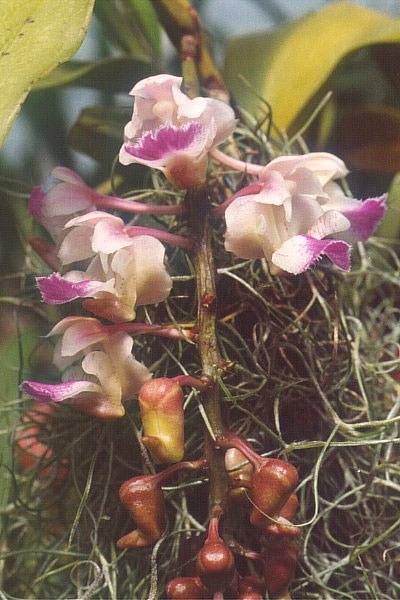
Cat's-Tail Orchids, Fox Brush Orchids
India, Nepal, Southern China, Southeast Asia, Philippines, New Guinea, Assam, Indochina, Andaman and Nicobar Islands, Sulawesi, Borneo, Myanmar, Thailand, Malaysia, Indonesia, Sri Lanka, Timor
Epiphyte, Lithophyte
June, July
Tree Fern Fibers, Fir Bark, Sphagnum Moss
About Aerides
Aerides, commonly referred to as cat's-tail orchids and fox brush orchids, is a genus within the vast orchid family, Orchidaceae. These plants are primarily tropical epiphytes, meaning they grow on other plants, typically trees, in the warm, low-lying regions of tropical Asia. Their natural distribution spans from India eastward to southern China and extends as far as New Guinea, encompassing numerous areas including Southeast Asia, the Philippines, and various islands.
Description and Characteristics
The genus is distinguished by its monopodial growth habit, forming sharp, stout, leafy stems that can grow quite large. The leaves are arranged distichously, appearing in two vertical rows, and possess bilobed margins with an emarginate apex. A notable feature of Aerides species is their pendulous racemes, which bear numerous long-lasting, waxy flowers. These blooms are often white, frequently adorned with purple or pink edges, though some species present entirely purple, pink, or even yellow flowers. Each flower is characterized by a forward-facing spur. Morphologically, Aerides species bear a strong resemblance to those in the genus Vanda.
Horticultural Value
Aerides orchids are highly prized in horticulture for their showy, fragrant, and enduring flowers. Many species are considered relatively easy to cultivate, making them popular choices for both cut flowers and potted specimens. To accommodate their epiphytic nature and allow for root aeration, they are often grown in hanging baskets, teak containers, or net pots. Successful cultivation requires well-drained media, such as tree fern fibers, fir bark, or sphagnum moss, along with full sunlight, warm temperatures, and consistent watering applied directly to the roots. It is important to note that the root systems of Aerides plants are sensitive and do not tolerate disturbance or damage well.
Species and Hybrids
As of June 2014, a number of Aerides species were recognized, with most being monopodial epiphytes, with the exception of Aerides krabiensis, which is a lithophyte. The genus also includes natural hybrids, such as Aerides × jansonii, a cross between Aerides falcata and Aerides odorata. Furthermore, Aerides has been extensively hybridized with other orchid genera, contributing to a wide array of colorful and genetically diverse horticultural specimens.
Source: Wikipedia ↗
Frequently Asked Questions
What are the common names for the Aerides genus?
The Aerides genus is commonly known as cat's-tail orchids and fox brush orchids. These names likely refer to the appearance of their flower spikes.
Where do Aerides orchids naturally grow?
Aerides orchids are native to the tropical lowlands of Asia. Their natural range extends from India eastward to southern China and westward to New Guinea.
What makes Aerides orchids popular in horticulture?
They are popular in horticulture due to their racemes of showy, fragrant, and long-lasting flowers. This makes them desirable as both cut flowers and potted plants.
What are the typical colors of Aerides flowers?
The flowers of Aerides species are often white with purple or pink edges. Some species can also have entirely purple or pink flowers, and a few may display yellow hues.
What is the growth habit of Aerides orchids?
Most Aerides species are epiphytes, growing on trees, but Aerides krabiensis is a lithophyte, growing on rocks. They have a monopodial, vine-like growth habit with leathery, drought-resistant leaves.
Are Aerides orchids fragrant?
Yes, Aerides orchids are known for their fragrant flowers. The fragrance is a significant factor in their popularity in horticulture.
Related Orchid species

Cylindrolobus
Cylindrolobus is a genus of orchids comprising approximately 80 species. These orchids are found across a wide geographic range, from New Guinea to Southeast Asia, southern China, and India. They are distinct for their slender, elongate stems that are typically not pseudobulbous, with leaves distributed along the entire length.
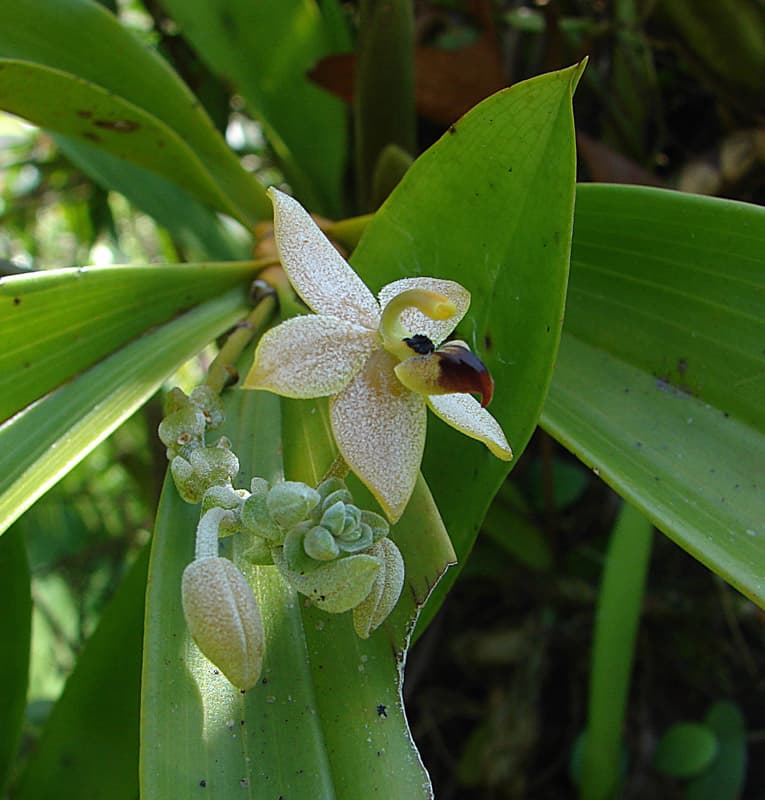
Callostylis
Callostylis is a genus of orchids native to Southeast Asia, ranging from Assam and southern China to Java. Previously considered a synonym of the genus Eria, it is now an accepted name. The genus is recognized for its diverse species found across various regions within its native range.

Arundina
Arundina graminifolia, commonly known as the bamboo orchid, is a terrestrial orchid species native to tropical Asia. It is distinguished by its reedy stems, grass-like leaves, and showy, lilac and white flowers with a purple lip. This species has also naturalized in various regions worldwide and holds medicinal value in traditional Chinese medicine.