
Dendrochilum
Dendrochilum was a genus of orchids known for their miniature, fragrant, star-shaped flowers, typically borne in two rows on pendulous racemes. These plants were found in humid rainforests across the Malesian region, with a significant number of species originating from Borneo and the Philippines. Although once recognized as a distinct genus, Dendrochilum is now considered a synonym of Coelogyne.
Key Facts
- ›Dendrochilum orchids produce small, star-shaped flowers that are often fragrant.
- ›Flowers are typically arranged in two rows along erect or arching, many-flowered racemes.
- ›These orchids are distributed in humid rainforests of the Malesian region, extending to Southeast Asia and New Guinea.
- ›The majority of Dendrochilum species are found on Borneo and the Philippines.
- ›The genus is now classified as a synonym of Coelogyne Lindl.
- ›Inflorescences can reach up to 50 cm in length, with pseudobulbs measuring 4-10 cm.
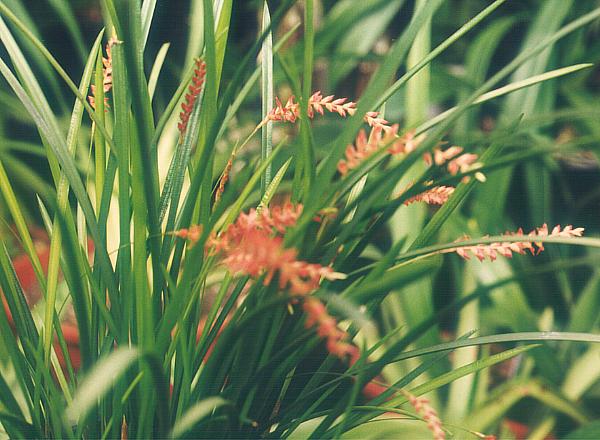
Epiphytic, Lithophytic, Terrestrial
About Dendrochilum
Dendrochilum was a genus of flowering plants belonging to the orchid family, Orchidaceae. These orchids are known for their miniature, fragrant, star-shaped flowers, which are typically arranged in two rows along erect or arching, many-flowered racemes. The genus name itself is derived from Ancient Greek words, referencing either the tree-like growth habit or the flower's prominent lip.
Distribution and Habitat
Species within the Dendrochilum genus are predominantly found in humid rainforests at higher elevations across the Malesian region, with some extending into surrounding areas. This distribution encompasses Southeast Asia, New Guinea, and notably, a significant number of species are native to Borneo and the Philippines. They exhibit a varied growth habit, occurring as epiphytes (growing on trees), lithophytes (growing on rocks), and less commonly, as terrestrial plants.
Morphology and Characteristics
The plants are characterized by ovoid to cylindrical pseudobulbs, which are striped and measure approximately 4–10 cm in length. Each pseudobulb typically supports one or two tough, erect, and lanceolate leaves, usually around 20 cm long, though species like Dendrochilum longifolium can have leaves up to 40 cm. The inflorescences, bearing the distinctive flowers, can grow up to 50 cm in length, with some notable examples like the Hay-scented Orchid (D. glumaceum) producing particularly long racemes.
Taxonomy and Classification
The precise number of species attributed to Dendrochilum has been a subject of ongoing botanical discussion, with estimates varying widely. Numerous new taxa have been identified in recent decades. Historically, some species were classified under separate genera such as Acoridium and Platyclinis, but these are now considered synonyms of Dendrochilum. The genus's type species is Dendrochilum aurantiacum, described by Carl Ludwig Blume in 1825. It is important to note that Dendrochilum is now largely considered a synonym of the genus Coelogyne Lindl. in modern taxonomic systems.
Horticultural Significance
Despite its taxonomic reclassification, Dendrochilum orchids have remained popular among orchid collectors due to their delicate beauty and fragrant blooms. Their miniature size and attractive floral displays make them sought-after specimens for cultivation.
Source: Wikipedia ↗
Frequently Asked Questions
What are Dendrochilum orchids known for?
Dendrochilum orchids are recognized for their miniature, fragrant, star-shaped flowers. These blooms are generally produced in two rows on erect or arching, many-flowered racemes, making them popular among orchid collectors.
Where are Dendrochilum orchids naturally found?
These orchids are distributed across the Malesian region, inhabiting higher elevations in humid rainforests. Their range extends from Southeast Asia to New Guinea, with a concentration of species found on Borneo and the Philippines.
What is the typical appearance of Dendrochilum flowers?
Dendrochilum flowers are described as miniature and star-shaped, often possessing a fragrance. They are typically arranged in two rows along pendulous racemes that can grow quite long, sometimes up to 50 cm.
What is the taxonomic status of Dendrochilum?
While historically recognized as a distinct genus, Dendrochilum is now considered a synonym of the genus Coelogyne Lindl. The exact number of species within the genus has been a subject of debate among botanists.
What are the plant characteristics of Dendrochilum?
Dendrochilum plants feature ovoid to cylindrical pseudobulbs that are striped and sharply reduced, typically measuring 4–10 cm long. Each pseudobulb supports one or two tough, erect, lanceolate leaves, usually around 20 cm in length.
Related Orchid species
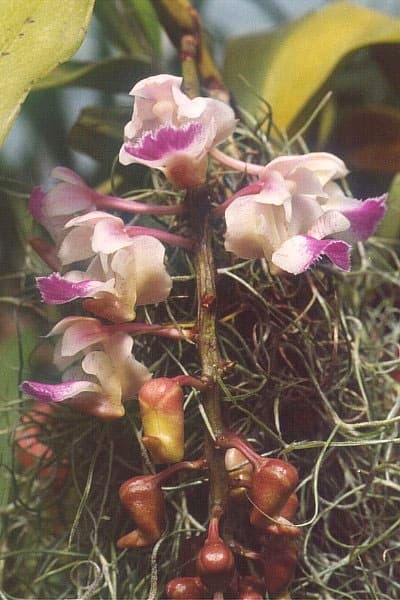
Aerides
Aerides, commonly known as cat's-tail orchids and fox brush orchids, is a genus of tropical epiphytic orchids native to Asia. These orchids are highly valued in horticulture for their showy, fragrant, and long-lasting flowers, which typically appear in racemes and are often white with colorful edges.
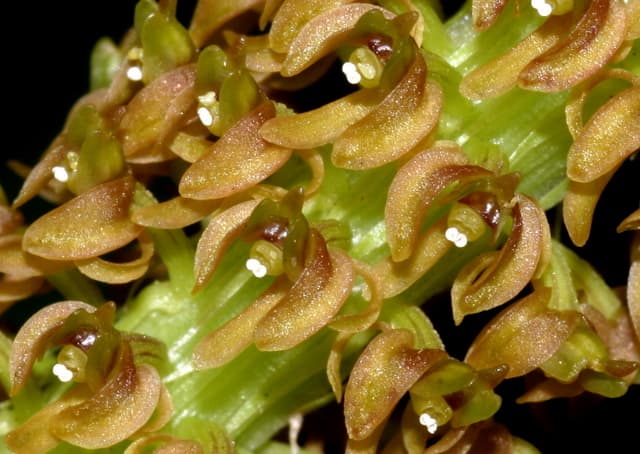
Dienia
Dienia, commonly known as snout orchids, is a genus of six species of evergreen orchids found across Southeast Asia, Australia, Micronesia, and Melanesia. These plants are characterized by their fleshy, above-ground stems, large pleated leaves, and small, non-resupinate flowers with a distinctive short, tongue-like labellum. While primarily terrestrial, some species can grow as epiphytes.

Cheirostylis
Cheirostylis is a genus of about sixty species of terrestrial orchids known for their distinctive caterpillar-like rhizomes and loose rosettes of leaves. These orchids are found across tropical regions of Africa, Asia, and Australia, producing small, white, hairy flowers as their leaves typically wither. They are often referred to as fleshy jewel orchids or velvet orchids.