
Galeola
Galeola
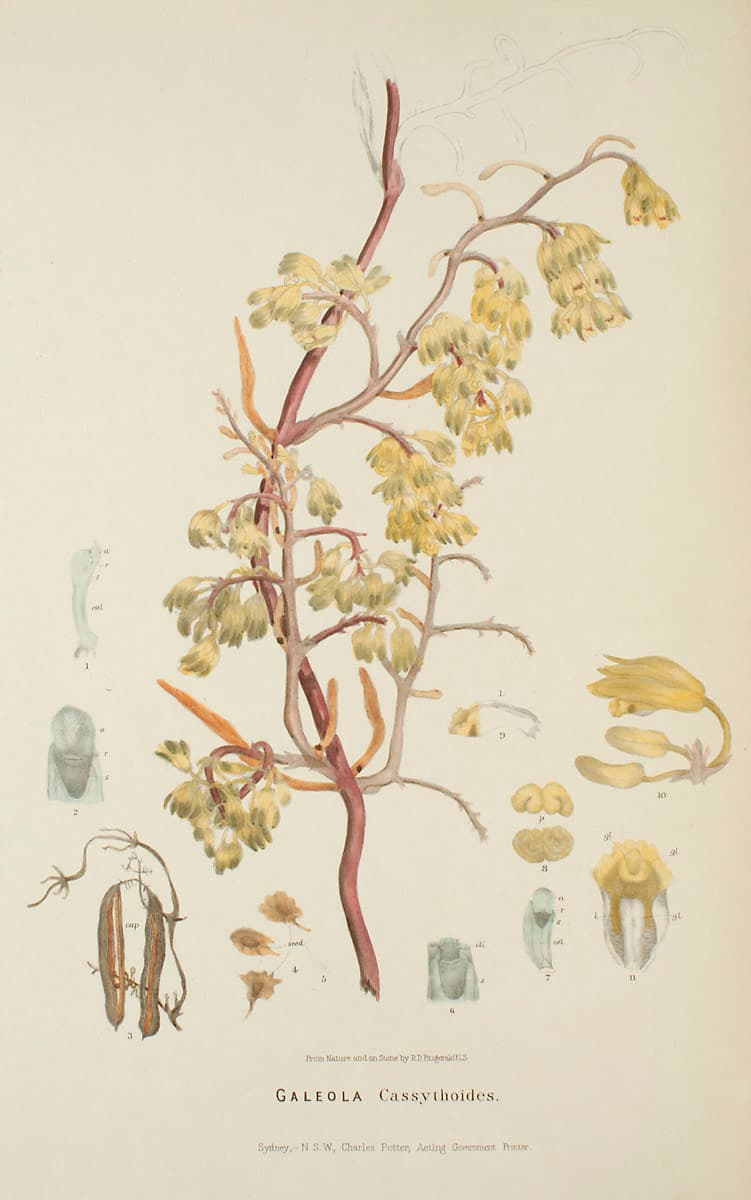
Galeola is a genus of myco-heterotrophic orchids found across Southeast Asia, Madagascar, and the Comoros. These orchids are of particular biological interest due to their parasitic nature, relying entirely on fungi for sustenance, and their exceptionally large, winged seeds, which are the biggest among all orchid seeds.
Key Facts
- ›All species within the Galeola genus are myco-heterotrophic, meaning they are parasitic on fungi.
- ›Galeola orchids are distributed throughout Southeast Asia, including regions from India to China and New Guinea, as well as Madagascar and the Comoros.
- ›The genus is notable for possessing the largest orchid seeds in the world.
- ›Galeola seeds are characterized by wings, an unusual trait for orchids.
- ›There are currently six recognized species within the Galeola genus.

Southeast Asia, India, China, New Guinea, Madagascar, Comoros, Thailand, Myanmar, Bhutan, Vietnam, Nepal, Taiwan, Sumatra, Indonesia, Malaysia, Philippines, Laos, Cambodia, Burma
Myco-Heterotrophic
About Galeola
Galeola is a genus of orchids characterized by their unique myco-heterotrophic nature, meaning they derive all their nutrients by parasitizing fungi rather than through photosynthesis. This makes them biologically distinct and a subject of scientific interest. The orchids in this genus are distributed across a wide range in Southeast Asia, from India and China eastward to New Guinea, and also extend to the islands of Madagascar and the Comoros.
Key Biological Features
The most striking feature of Galeola orchids is their seeds, which are the largest known among all orchid species worldwide. Adding to their unusual characteristics, these seeds are winged, a trait that is rare within the orchid family. The genus currently comprises six recognized species, each with specific geographical distributions within the broader regions mentioned.
Distribution and Species
The known species of Galeola include Galeola cathcarthii, found in Thailand, Myanmar, India, and Bhutan; Galeola faberi in China, Assam, Nepal, Vietnam, and Sumatra; Galeola falconeri across India, Bhutan, Nepal, Taiwan, Thailand, Vietnam, and China; Galeola humblotii in Madagascar and the Comoros; Galeola lindleyana in Bhutan, China, India, Sumatra, Vietnam, Nepal, and Taiwan; and Galeola nudifolia, which has the widest distribution across China, India, Indonesia, Malaysia, the Philippines, Thailand, Vietnam, Laos, Cambodia, Burma, and New Guinea.
Source: Wikipedia ↗
Frequently Asked Questions
What makes Galeola orchids biologically interesting?
Galeola orchids are biologically interesting due to their exclusive myco-heterotrophic nature, meaning they are parasitic on fungi. They are also known for having the largest orchid seeds in the world, which are uniquely winged.
Where are Galeola orchids found geographically?
The genus Galeola is spread throughout Southeast Asia, with species found from India to China and New Guinea. It also extends to Madagascar and the Comoros islands.
What is unusual about Galeola orchid seeds?
Galeola orchid seeds are extraordinary because they are the largest orchid seeds globally. Furthermore, these large seeds are winged, a characteristic that is also uncommon among orchids.
What is myco-heterotrophy in orchids?
Myco-heterotrophy is a nutritional strategy where plants, like Galeola orchids, are parasitic on fungi. This means they obtain all their nutrients from the fungi they associate with, rather than through photosynthesis.
Related Orchid species

Anthogonium
Anthogonium is a monotypic genus of orchids, meaning it contains only one species, Anthogonium gracile. This orchid is native to a wide range of regions across Asia, including India, Nepal, Bhutan, and Southeast Asian countries. Its distinctive characteristic is being the sole representative of its genus.

Collabium
Collabium is a genus of flowering plants belonging to the orchid family, Orchidaceae. These terrestrial orchids are found growing in shaded forest conditions across Southeast Asia, with a distribution spanning from the Himalayas in India and Burma to China and extending to various island groups in Malaysia and the Pacific.
Erythrorchis
Erythrorchis, also known as bootlace orchids or by its Chinese name 倒吊兰属 (dao diao lan shu), is a genus of two species of climbing, leafless orchids in the Orchidaceae family. These myco-heterotrophic vines cling to tree trunks with small roots and produce densely crowded flowers on branched stems, distinguished by their fleshy sepals and petals and a wide labellum.