
Erythrorchis
Erythrorchis
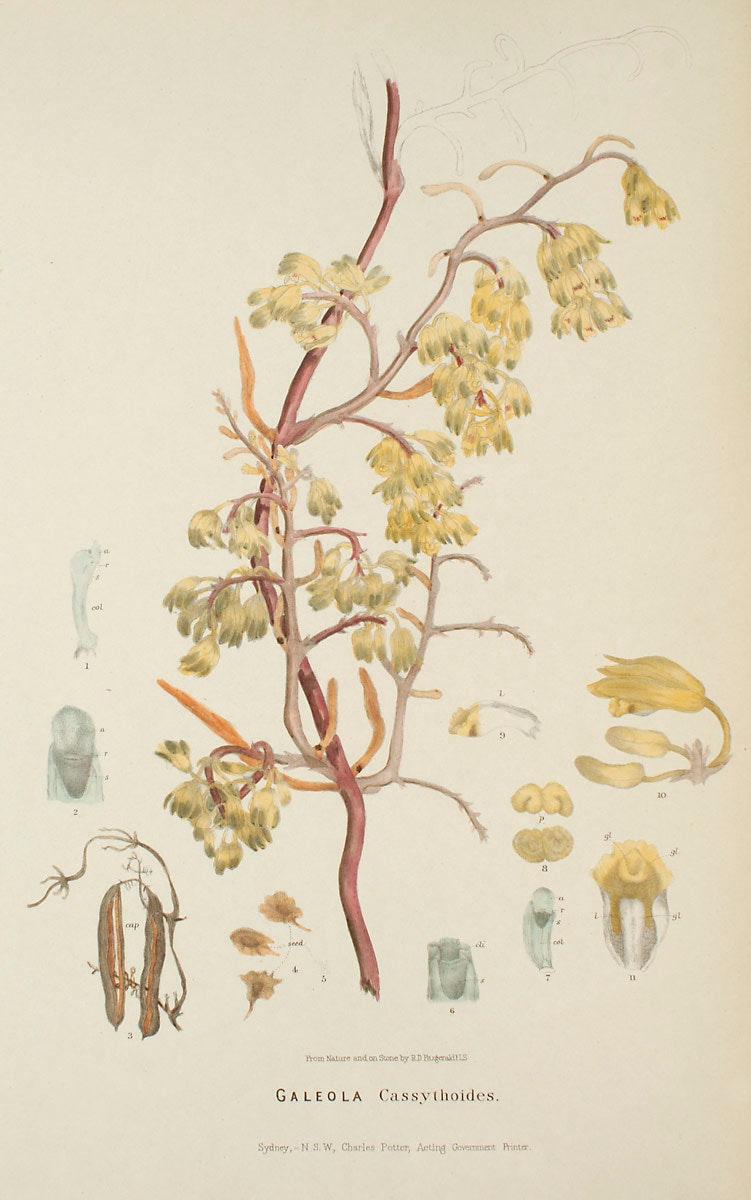
Erythrorchis, also known as bootlace orchids or by its Chinese name 倒吊兰属 (dao diao lan shu), is a genus of two species of climbing, leafless orchids in the Orchidaceae family. These myco-heterotrophic vines cling to tree trunks with small roots and produce densely crowded flowers on branched stems, distinguished by their fleshy sepals and petals and a wide labellum.
Key Facts
- ›Erythrorchis are climbing, leafless, myco-heterotrophic orchids.
- ›They cling to surfaces, typically tree trunks, using small roots.
- ›Flowering stems are highly branched and bear many densely crowded flowers.
- ›Flowers have fleshy sepals and petals, often fused, and a wide, crinkled labellum.
- ›The genus comprises two species: Erythrorchis altissima and Erythrorchis cassythoides.
- ›Fruits are long, thin capsules.
Bootlace Orchids, 倒吊兰属
Climbing, Scrambling, Myco-Heterotrophic
About Erythrorchis
Erythrorchis is a genus of orchids recognized for its distinctive climbing, leafless growth habit. Commonly known as bootlace orchids, and referred to by the Chinese name 倒吊兰属 (dao diao lan shu), this genus belongs to the Orchidaceae family and comprises two species. These plants are myco-heterotrophic, meaning they obtain nutrients from fungi in the soil rather than through photosynthesis, a characteristic that contributes to their leafless nature.
Description and Growth
These orchids are characterized as climbing or scrambling vines that anchor themselves to surfaces, most typically tree trunks, with small, unbranched roots. Their flowering stems are highly branched, bearing a multitude of densely crowded flowers. The individual flowers possess fleshy sepals and petals, which are often fused and spread widely. The petals are generally narrower than the sepals. A notable feature is the labellum, which is relatively wide, has crinkled edges, and closely surrounds the column. Following flowering, the plants produce long, thin capsules as fruits.
Taxonomy and Distribution
The genus Erythrorchis was first formally described by Carl Ludwig Blume in 1837. The name is derived from Greek words, 'erythros' meaning "red" and 'orchis' meaning "testicle" or "orchid." The genus is divided into two species with distinct geographic distributions. Erythrorchis altissima is found across a broad swathe of Asia, including Hainan, Taiwan, Cambodia, Assam, Indonesia, the Ryukyu Islands, Laos, Malaysia, Myanmar, the Philippines, Thailand, and Vietnam. In contrast, Erythrorchis cassythoides is native to Australia, specifically occurring in Queensland and New South Wales.
Source: Wikipedia ↗
Frequently Asked Questions
What are bootlace orchids?
Bootlace orchids, also known by the scientific genus name Erythrorchis, are a group of climbing, leafless orchids. They are characterized by their vine-like growth habit, clinging to trees with small roots.
What makes Erythrorchis orchids distinctive?
These orchids are notable for being leafless and myco-heterotrophic, meaning they derive nutrients from fungi rather than photosynthesis. They also produce numerous, densely packed flowers on highly branched stems.
Where are Erythrorchis species found?
The distribution of Erythrorchis species varies. Erythrorchis altissima is found across Southeast Asia, including Hainan, Taiwan, Cambodia, and parts of Indonesia and Malaysia, while Erythrorchis cassythoides is native to Queensland and New South Wales in Australia.
How do Erythrorchis orchids grow?
Erythrorchis orchids are climbing or scrambling vines. They typically ascend tree trunks, using small, unbranched roots to cling to the surface.
What do the flowers of Erythrorchis orchids look like?
The flowers are densely crowded on branched stems and are resupinate. They feature fleshy sepals and petals that are often fused and spread widely, with petals usually narrower than the sepals. The labellum is wide with crinkled edges and closely encircles the column.
Related Orchid species

Geodorum
Geodorum is a genus of eight deciduous, terrestrial orchid species found across southern Japan, tropical Asia, Australia, and the southwest Pacific islands. These orchids are distinguished by their underground pseudobulbs, broad pleated leaves, and small to medium-sized, bell-shaped or tube-shaped flowers that hang downwards on a drooping flowering stem.

Holcoglossum
Holcoglossum is a genus of orchids belonging to the family Orchidaceae, native to regions spanning Assam, China, Taiwan, and Indo-China. These perennial plants are characterized by their short shoots, terete or triangular leaves with a grooved upper surface, and distinctive white flowers with a three-lobed lip and elongated spur. They are typically epiphytic or lithophytic, growing at higher altitudes and preferring cool environments.

Galeola
Galeola is a genus of myco-heterotrophic orchids found across Southeast Asia, Madagascar, and the Comoros. These orchids are of particular biological interest due to their parasitic nature, relying entirely on fungi for sustenance, and their exceptionally large, winged seeds, which are the biggest among all orchid seeds.