
Isabelia
Isabelia
Isabelia is a genus of orchids comprising three species and one natural hybrid, found from northeastern Brazil to Argentina. These tiny orchids are closely related to the genus Constantia and are distinguished by their unifoliated pseudobulbs, linear or acicular leaves, and erect inflorescences bearing one to a few flowers. Their flowers feature petals, sepals, and labellum of the same color, ranging from white to pale pink or magenta, and they bloom from early autumn to early winter.
Key Facts
- ›Isabelia orchids are native to the Atlantic Forest of Brazil, extending to Paraguay and northern Argentina.
- ›They are typically epiphytic, growing on trees, but can also be rupicolous (growing on rocks).
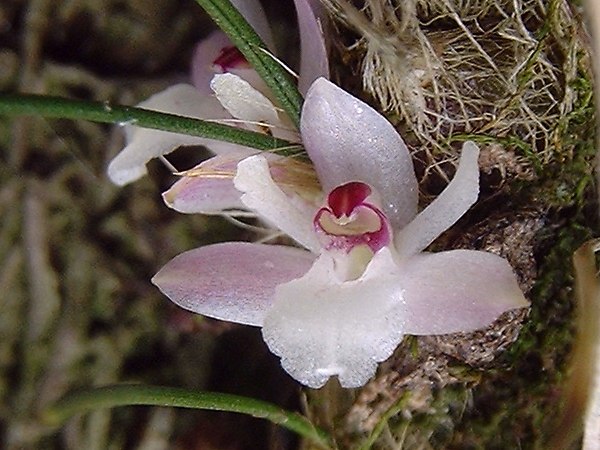
- ›The flowers of Isabelia species have petals, sepals, and labellum of a uniform color, which can be white, pale pink, or magenta.
- ›All species in the Isabelia genus bloom from early autumn to early winter, with individual flowers lasting about a week.
- ›Cultivating Isabelia orchids requires ample humidity, ventilation, and moderate to high luminosity, with morning waterings preferred.
- ›The genus name Isabelia is an homage to Isabel, Princess of Brazil.
Epiphytic, Rupicolous
Early Autumn, Early Winter
Vegetable Plaques
About Isabelia
Isabelia is a genus of orchids recognized for its small size and delicate beauty. The genus currently includes three distinct species and one natural hybrid, with a natural distribution spanning from the northeastern regions of Brazil down to Argentina. Historically, Isabelia was a much smaller genus, initially containing only one species before undergoing taxonomic revisions that incorporated species from the genera Neolauchea and Sophronitella.
Distribution and Habitat
These orchids are predominantly epiphytic, meaning they grow on other plants, typically trees, but are occasionally found as rupicolous species, growing on rocks. They are native to the Atlantic Forest of Brazil and can be found in diverse habitats, from the humid slopes of the Serra do Mar to the drier forests of the Brazilian Plateau. Their altitudinal range extends from sea level up to fifteen hundred meters. One species, Isabelia virginalis, also extends its range into Paraguay and northern Argentina.
Botanical Description
Isabelia orchids are characterized by their unifoliated pseudobulbs, which are ovoid to fusiform in shape. They possess linear or acicular leaves and produce erect apical inflorescences that bear one or a few flowers. The flowers themselves are notable for having petals, sepals, and a labellum of uniform color, which can vary from white to pale pink or magenta. The sepals are widely elliptical to ovate, while the petals can be narrower and oblong or wider elliptic. The labellum is entire and oblong, and may be partially fused to the column, sometimes forming a nectary. The column is stout and usually darker than the rest of the flower.
Flowering and Cultivation
All species within the Isabelia genus share a common blooming period, occurring from early autumn to early winter. Individual flowers typically last for about a week. While their pollinators are not well-documented, Isabelia orchids are appreciated for their horticultural value. Cultivating them can be challenging, as they require ample humidity and ventilation, along with moderate to high luminosity. They are often grown mounted on vegetable plaques, and it is recommended to water them in the morning to prevent prolonged moisture on the roots overnight. Due to their sensitivity to frequent repotting, it is advisable to allow ample space for several years of development.
Taxonomic History
The genus name, Isabelia, was established in homage to Isabel, the Princess of Brazil. The taxonomic journey of this genus has seen several species initially described under different genera before being consolidated. Isabelia virginalis was the first species discovered, collected in 1837, though it remained without a formal scientific description until 1877. Sophronitis violacea, now Isabelia violacea, was described in 1840 and later suggested for reclassification into the new genus Sophronitella due to its small size. Neolauchea pulchella, now Isabelia pulchella, was first described in 1897 and later described again under a different name. In 2001, phylogenetic studies led to the combination of these genera into Isabelia, recognizing their close evolutionary relationship within the subtribus Laeliinae.
Source: Wikipedia ↗
Frequently Asked Questions
Where are Isabelia orchids found in the wild?
Isabelia orchids are predominantly found in the Atlantic Forest of Brazil, with their range extending from the Northeast of Brazil down to Argentina. They can be found from sea level up to fifteen hundred meters of altitude, inhabiting diverse environments such as humid slopes and drier forests.
What are the typical characteristics of Isabelia flowers?
Isabelia flowers have petals, sepals, and a labellum that are all the same color, typically white, pale pink, or magenta. The sepals are widely elliptical to ovate, and the petals can be narrower and oblong or wider elliptic. The labellum is entire and oblong, and may be partially fused to the column.
When do Isabelia orchids bloom?
All species within the Isabelia genus bloom from early autumn to early winter. The flowers are relatively short-lived, typically lasting for about a week once they open.
How should I care for Isabelia orchids in cultivation?
Isabelia orchids are not very easy to cultivate and require specific conditions. They grow well mounted on plaques and need plenty of humidity and ventilation, along with moderate to high luminosity. It is advisable to water them in the morning to ensure their roots do not remain humid overnight.
What makes the different Isabelia species distinct?
Although grouped under the same genus, the three Isabelia species are quite distinct. Isabelia pulchella is noted for its elongated rhizome and narrow, long leaves. Isabelia violacea is the largest species, can produce multiple flowers per inflorescence, and has more open flowers. Isabelia virginalis has terete leaves and pale pink, almost white flowers.
Related Orchid species

Leptotes
Leptotes is a genus of nine small orchid species native to the dry jungles of south and southeast Brazil, Paraguay, and Argentina. These epiphytic plants are characterized by their thin, terete leaves and delicate, often showy flowers, some of which are used as a vanilla substitute. While some species are widely cultivated, many remain rare and recently described.
Lankesterella
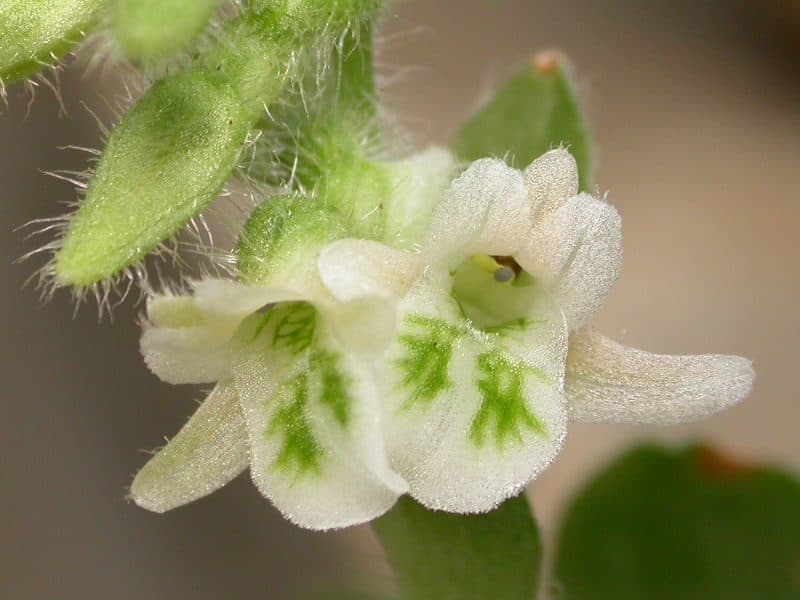
Lankesterella is a genus of flowering plants belonging to the orchid family, Orchidaceae. Primarily found in South America, several species extend their range northward into the Caribbean and Central America. The genus is distinguished by its diverse geographical distribution and numerous recognized species.
Cyanaeorchis
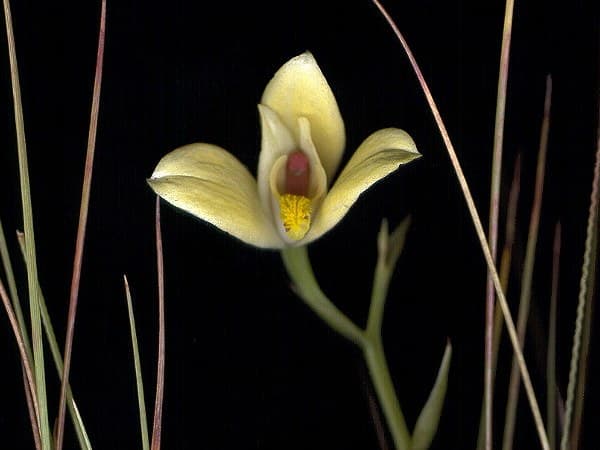
Cyanaeorchis is a genus of flowering plants within the orchid family, Orchidaceae, comprising three species all endemic to South America. These orchids are distinguished by their South American origin and their classification within the Orchidaceae family.