
Leptotes
Leptotes is a genus of nine small orchid species native to the dry jungles of south and southeast Brazil, Paraguay, and Argentina. These epiphytic plants are characterized by their thin, terete leaves and delicate, often showy flowers, some of which are used as a vanilla substitute. While some species are widely cultivated, many remain rare and recently described.
Key Facts
- ›Leptotes orchids are small epiphytic plants with thin, cylindrical leaves.
- ›They are found in the Atlantic Forest of Brazil, extending to Paraguay and Argentina.
- ›Flowers are generally greenish, white, or shades of pink, with a distinctive trilobed labellum.
- ›Some species, like Leptotes bicolor, have fruits used as a vanilla substitute.
- ›The genus is closely related to Loefgrenianthus.
- ›Five of the nine known species have been described since the year 2000.

Lpt
Epiphytic
Vegetal Fiber Plaques, Tree Cork
Bees, Hummingbirds
About Leptotes
The genus Leptotes, abbreviated as Lpt in the horticultural trade, encompasses nine small orchid species found in the dry jungles of south and southeast Brazil, as well as Paraguay and Argentina. These orchids are characterized by their caespitose growth habit, small pseudobulbs that prolongate into one or rarely two thin, terete, fleshy leaves, and showy flowers that are often partially bent and can appear in clusters.
Distribution and Habitat
Originally discovered in the Atlantic Forest of Brazil, Leptotes species are exclusively epiphytic. While their distribution is centered in the southeastern Brazilian states, with the highest number of species and abundance, two species have been found beyond Brazil: L. unicolor in Argentina and L. bicolor in Paraguay. Three species exhibit a high degree of endemism in the southern part of Bahia State. Species with wide-open flowers, such as L. tenuis and L. pauloensis, are more commonly found in montane cloud forests, while L. bicolor has a broader range, adapting to both cloud forests and drier woods. Leptotes unicolor thrives in cooler areas above 700 meters, often growing on Araucaria and Podocarpus trees.
Description and Taxonomy
Leptotes orchids possess short, cylindrical rhizomes and pseudobulbs that almost imperceptibly extend into one or two terete, fleshy leaves. These leaves can vary in length, orientation, and color, often featuring a wrinkly surface and a deep ridge. The inflorescence is apical, typically short, and bears up to seven flowers, though fewer are more common. The flowers, which are relatively large for the plant's size, are fragrant and their perfume can last for ten to twenty days. Sepals and petals are elongated, with petals being slightly narrower. Flower colors range from greenish and white to various shades of pink, and the labellum can be spotted with pale yellow, light purple, or lilac. The labellum is trilobed, with small lateral lobes and a larger, variable intermediate lobe. The column is short, thick, and erect, bearing six pollinia in a unique arrangement. The fruits are rounded, succulent, and have a vanilla-like scent.
The genus was first described by John Lindley in 1833, named Leptotes from the Greek for 'mild' or 'delicate.' Several species have been described and revised over time, with some initially thought to be distinct species later recognized as variations of others, such as L. serrulata and L. glaucophylla being considered variations of L. bicolor, and L. minuta a variation of L. tenuis. More recently, there has been an increase in new species descriptions, with five of the nine known species described since 2000, reflecting ongoing discoveries and taxonomic work.
Cultivation
For successful cultivation, Leptotes orchids are best mounted on plaques of vegetal fiber or tree cork, as their roots are susceptible to rot from excessive humidity. Watering and fertilization should be increased during active growth periods and reduced during dormancy. Ideal growing conditions involve intermediate temperatures and exposure to filtered sunlight.
Significance
Beyond their ornamental value, some Leptotes species, notably L. bicolor, have practical uses. Their flowers and fruits are known to be used as a substitute for vanilla in various culinary applications, including milk, ice cream, tea, and candies, highlighting their unique contribution beyond the horticultural realm.
Source: Wikipedia ↗
Frequently Asked Questions
What are the main characteristics of Leptotes orchids?
Leptotes orchids are small, epiphytic plants with thin, terete leaves and a short rhizome. They produce short inflorescences bearing relatively large flowers compared to the plant's size. The flowers are typically greenish, white, or pink, with a trilobed labellum.
Where are Leptotes orchids found naturally?
These orchids are native to the Atlantic Forest of Brazil, with some species also found in Paraguay and Argentina. They are most abundant in southeastern Brazil, which is considered the center of their distribution.
Are Leptotes orchids difficult to grow?
While some species are widely cultivated and display showy blooms, they are not among the easiest orchids to grow. They require specific conditions, such as mounting on plaques to avoid root rot from excessive humidity and filtered sunlight.
What is the origin of the name Leptotes?
The genus name Leptotes was given by botanist John Lindley in 1833. It is derived from the Greek word 'leptotes,' meaning mild or delicate, referencing the appearance of the plant's flowers.
How are Leptotes flowers pollinated?
The natural pollinators of Leptotes orchids have not been directly observed. However, based on flower morphology and color, some orchidologists suggest bees are the primary agents, while others suspect pollination by hummingbirds.
Are any Leptotes species used for commercial purposes?
Yes, the flowers and fruits of Leptotes bicolor have been recorded as being used as a substitute for vanilla. They are utilized in milk, ice cream, tea, and candies.
Related Orchid species
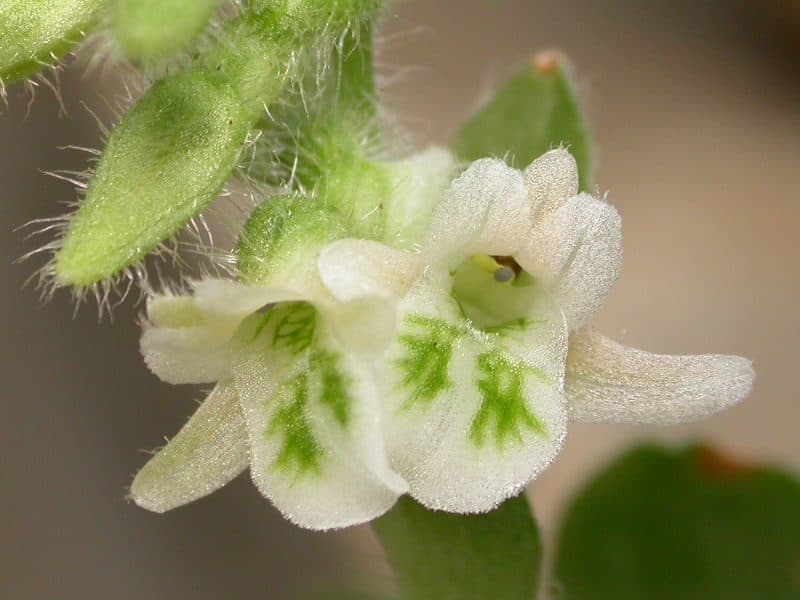
Lankesterella
Lankesterella is a genus of flowering plants belonging to the orchid family, Orchidaceae. Primarily found in South America, several species extend their range northward into the Caribbean and Central America. The genus is distinguished by its diverse geographical distribution and numerous recognized species.
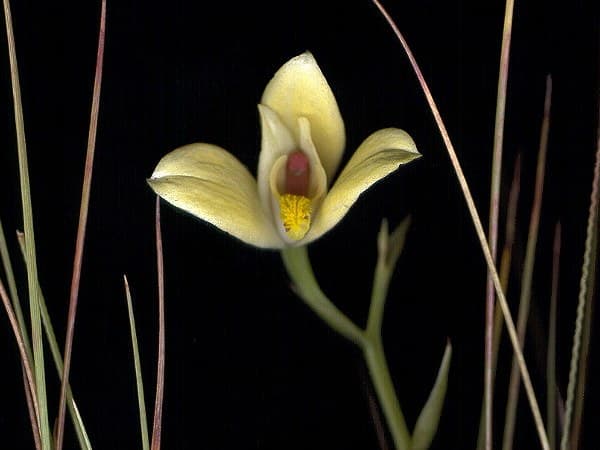
Cyanaeorchis
Cyanaeorchis is a genus of flowering plants within the orchid family, Orchidaceae, comprising three species all endemic to South America. These orchids are distinguished by their South American origin and their classification within the Orchidaceae family.
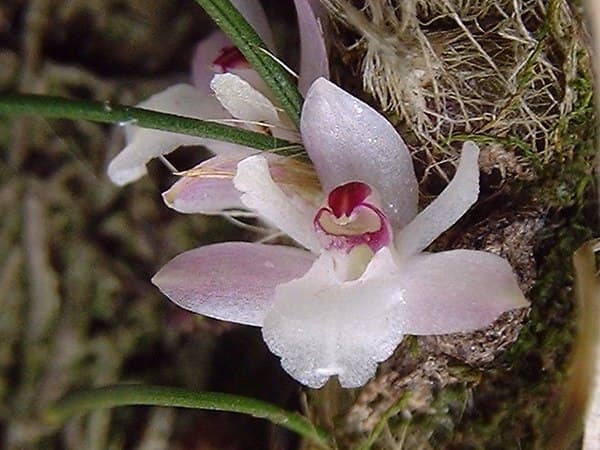
Isabelia
Isabelia is a genus of orchids comprising three species and one natural hybrid, found from northeastern Brazil to Argentina. These tiny orchids are closely related to the genus Constantia and are distinguished by their unifoliated pseudobulbs, linear or acicular leaves, and erect inflorescences bearing one to a few flowers. Their flowers feature petals, sepals, and labellum of the same color, ranging from white to pale pink or magenta, and they bloom from early autumn to early winter.