
Arabian eagle-owl
The Arabian eagle-owl is a true owl species endemic to the Arabian Peninsula, found in coastal and slightly inland areas of southwestern Saudi Arabia, Yemen, Oman, and the United Arab Emirates. This medium-sized owl is distinguished by its prominent feather tufts, which enhance its already acute hearing, and its bright yellow eyes, setting it apart from similar eagle-owl species.
Key Facts
- ›Endemic to the Arabian Peninsula, including Saudi Arabia, Yemen, Oman, and the UAE.
- ›Nests in wadis, cliffs, canyon walls, and large trees.
- ›Possesses prominent feather tufts on its head that aid in hearing.
- ›Features bright yellow eyes.
- ›Primarily preys on rodents and other small animals.
- ›A nocturnal hunter with excellent night vision.

Arabian Eagle-Owl
Wadis, Cliffs, Canyon Walls, Large Palms, Other Trees
Arabian Peninsula, Southwestern Saudi Arabia, Yemen, Oman, United Arab Emirates
Rodents, Small Animals
About Arabian eagle-owl
The Arabian eagle-owl (Bubo milesi) is a true owl species belonging to the family Strigidae. This owl is endemic to the Arabian Peninsula, with confirmed sightings in southwestern Saudi Arabia, Yemen, Oman, and the United Arab Emirates. It primarily inhabits coastal regions and areas slightly inland, generally avoiding the most arid desert interiors of the peninsula.
Description and Adaptations
Visually, the Arabian eagle-owl is a medium-sized owl, sharing similarities with the Eurasian eagle-owl (Bubo bubo) and the Pharaoh eagle-owl (Bubo ascalaphus). A distinctive feature is the presence of prominent feather tufts on its head, often referred to as 'ear'-tufts, which are crucial for its exceptional hearing. While similar to other eagle-owls, this species is typically smaller and exhibits a darker plumage. Its eyes are a notable bright yellow.
The Arabian eagle-owl is a nocturnal hunter, equipped with superb night vision. Its specialized feather tufts serve to funnel faint sound waves towards its ears, enhancing its ability to detect the subtle noises of scurrying or digging small animals, even from a significant distance. Furthermore, the rounded facial feathers, known as facial discs, are highly efficient at filtering light, particularly at night, which aids the owl in focusing on potential prey.
Habitat and Behavior
The species constructs its nests in diverse locations, including wadis, on cliff faces, along canyon walls, and within the branches of large palm trees and other arboreal vegetation. Its diet predominantly consists of rodents and other small animals, for which its acute senses are ideally suited.
Source: Wikipedia ↗
Frequently Asked Questions
Where is the Arabian eagle-owl found?
The Arabian eagle-owl is endemic to the Arabian Peninsula. It is known from southwestern Saudi Arabia, Yemen, Oman, and the United Arab Emirates, primarily in coastal areas and slightly inland.
What are the distinctive physical features of the Arabian eagle-owl?
This medium-sized owl is visually similar to the Eurasian and Pharaoh eagle-owls but is smaller and has darker plumage. It is recognizable by its prominent feather tufts on its head, which resemble ears, and its bright yellow eyes.
How does the Arabian eagle-owl hunt?
As a nocturnal hunter, the Arabian eagle-owl relies on its superb night vision and enhanced hearing. Its feather tufts direct sound waves to its ears, allowing it to detect small animals moving underground, while facial discs help focus light for prey detection.
What does the Arabian eagle-owl eat?
The primary diet of the Arabian eagle-owl consists of rodents and other small animals. Its hunting adaptations are well-suited for locating and capturing such prey.
Where does the Arabian eagle-owl typically nest?
The Arabian eagle-owl nests in various locations, including wadis, cliffs, canyon walls, and in large palm or other trees.
Related Owl species

Andaman scops owl
The Andaman scops owl is a small owl species native to the Andaman Islands of India, characterized by its predominantly brown plumage with white speckles and striking yellow eyes. First described in 1873, this nocturnal hunter inhabits semi-open areas and is known for its distinctive pulsating hoot. Despite some population decline due to deforestation, it is currently listed as 'Least Concern' by the IUCN.

Bare-shanked screech owl
The bare-shanked screech owl is a large owl found in the mountain forests of Costa Rica, Panama, and northwestern Colombia. It is distinguished by its bare lower legs and yellowish-pink toes. This species primarily hunts at night for large insects, shrews, and small rodents.
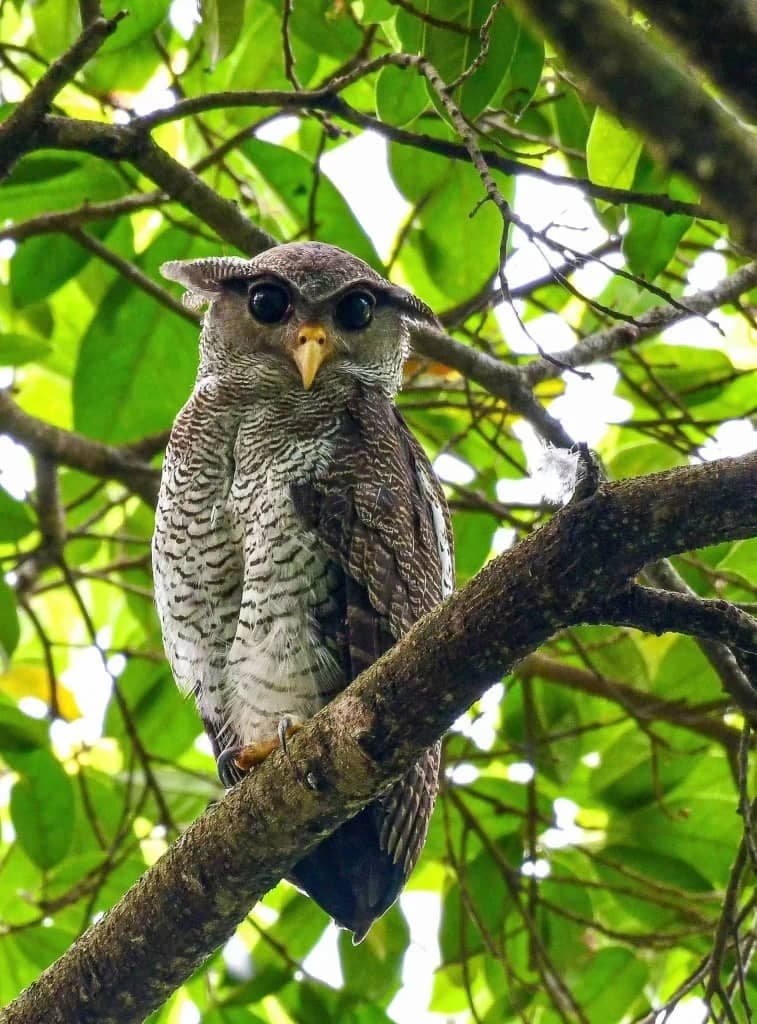
Barred eagle-owl
The barred eagle-owl is a species of eagle owl native to Southeast Asia, found from the Malay Peninsula to Borneo. This owl is notable for its barred underparts, large ear tufts, and a distinctive white stripe above its eyes. It inhabits moist lowland forests and can adapt to areas with tall trees, often near human settlements.