
Barred eagle-owl
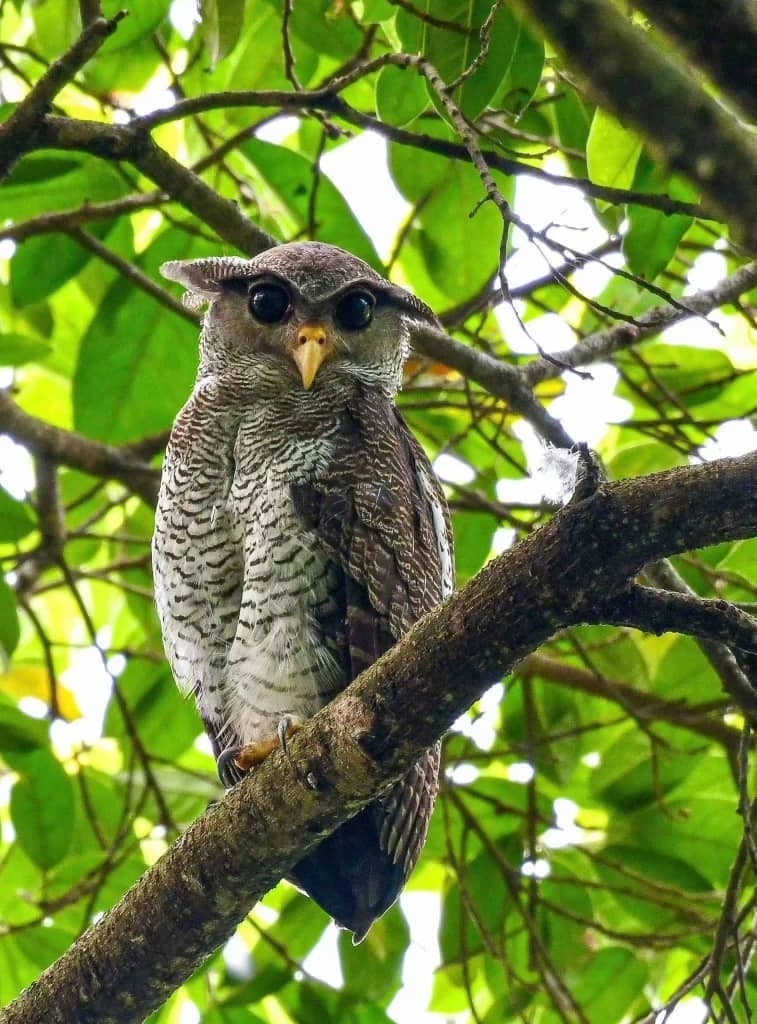
The barred eagle-owl is a species of eagle owl native to Southeast Asia, found from the Malay Peninsula to Borneo. This owl is notable for its barred underparts, large ear tufts, and a distinctive white stripe above its eyes. It inhabits moist lowland forests and can adapt to areas with tall trees, often near human settlements.
Key Facts
- ›Inhabits subtropical or tropical moist lowland forests.
- ›Distinguished by barred underparts and large, slanting ear tufts.
- ›Diet includes insects, birds, small mammals, and reptiles.
- ›Eggs are laid one at a time and are white and oval-shaped.
- ›Known for its deep hooting calls, sometimes described as 'whooa-who'.
- ›Forms a superspecies with the larger spot-bellied eagle-owl.
Malay Eagle-Owl
- Subtropical or tropical moist lowland forests
- Evergreen forests with pools or streams
- Large gardens with tall, densely foliated trees
- Wooded groves in cultivated country
Brunei, Indonesia, Malaysia, Myanmar, Singapore, Thailand, Sumatra, Java, Bali, Borneo
Large Insects, Birds, Small Mammals, Rodents, Reptiles, Snakes, Crab-Eating Macaque
About Barred eagle-owl
The barred eagle-owl (Ketupa sumatrana), also known as the Malay eagle-owl, is a species of owl belonging to the large genus Ketupa. This relatively little-known species is found across Southeast Asia, ranging from the southern Malay Peninsula to several of the larger islands in the region, including Borneo. It is recognized for its distinctive barred underparts, prominent ear tufts, and a white stripe above its eyebrows.
Distribution and Habitat
This owl is found in Brunei, Indonesia, Malaysia, Myanmar, Singapore, and Thailand. Its primary habitat consists of subtropical or tropical moist lowland forests, particularly evergreen forests that feature pools or streams. The barred eagle-owl also inhabits large gardens with tall, dense trees and wooded areas within cultivated landscapes, often in proximity to human dwellings. While typically found from sea-level up to about 1,000 meters, it can extend its range to higher elevations, sometimes exceeding 1,600 meters in mountainous regions.
Description and Identification
The barred eagle-owl is a medium-sized owl, ranging from 40 to 48 cm in length. There is minimal size difference between males and females, and adjacent subspecies can vary significantly in size. Its most striking features are the barred patterns on its underparts, large sideways-slanting ear tufts, and a white eyebrow stripe. The face and lores are dirty grayish-white, with dark brown or occasionally yellow eyes. The bill and cere are pale yellow. Upperparts are grey-brown with rufous-tawny bars, and the tail is dark brown with whitish or tawny bars. The tarsi are feathered to the toe joint.
Potential confusion can arise with the brown wood owl, which lacks ear tufts, or the dusky eagle-owl, which has a warmer brown coloration and vertical barring. Fish owls can be distinguished by their unfeathered tarsi and lack of head stripes and ear tufts. The spot-bellied eagle-owl, a close relative, is similar but larger with bolder spotting on its underparts.
Behavior and Ecology
Barred eagle-owls are believed to pair for life and show strong attachment to their nesting sites, often occupying the same territory for many years. They nest in large tree cavities or on top of large ferns. Typically, only one white, oval egg is laid. Observations of eggs and young suggest breeding occurs between February and June in various parts of their range.
Diet and Vocalizations
Their diet is broad and opportunistic, encompassing large insects, birds, small mammals (including rodents), and reptiles. They are known to prey on animals as large as young crab-eating macaques. Captive individuals readily consume fresh meat. The barred eagle-owl's distinctive call is a deep hoot, often described as 'whooa-who', which tends to drop in pitch. They also produce other vocalizations like cackles and shrieks, especially at dusk.
Source: Wikipedia ↗
Frequently Asked Questions
What is the scientific name of the barred eagle-owl?
The scientific name of the barred eagle-owl is Ketupa sumatrana. It belongs to the genus Ketupa, which is found on most of the world's continents.
Where are barred eagle-owls found?
Barred eagle-owls are distributed across Southeast Asia, including Brunei, Indonesia, Malaysia, Myanmar, Singapore, and Thailand. Their range extends from the southern Malay Peninsula to islands like Borneo.
What does a barred eagle-owl look like?
This owl is characterized by its barred underparts, large ear tufts that slant sideways, and a white stripe above its eyebrows. Its upperparts are grey-brown with rufous-tawny bars, and its eyes are typically dark brown, though yellow eyes have been reported.
What do barred eagle-owls eat?
Their diet is opportunistic and broad, including large insects, birds, small mammals like rodents, and reptiles such as snakes. They are capable of preying on relatively large animals, even young macaques.
What sounds do barred eagle-owls make?
The barred eagle-owl's territorial call is a deep hoot, often transcribed as 'hoo' or 'hoo-hoo', sometimes sounding like 'whooa-who'. They also produce noisy cackles, fearful shrieks, and strangulated noises, particularly in the early evening.
How do barred eagle-owls breed?
These owls likely pair for life and are attached to their nesting sites. They nest in large tree cavities or on top of large ferns, laying a single white, oval egg. Breeding seasons vary by region, with eggs or young observed between February and June.
Related Owl species

Andaman scops owl
The Andaman scops owl is a small owl species native to the Andaman Islands of India, characterized by its predominantly brown plumage with white speckles and striking yellow eyes. First described in 1873, this nocturnal hunter inhabits semi-open areas and is known for its distinctive pulsating hoot. Despite some population decline due to deforestation, it is currently listed as 'Least Concern' by the IUCN.

Arabian eagle-owl
The Arabian eagle-owl is a true owl species endemic to the Arabian Peninsula, found in coastal and slightly inland areas of southwestern Saudi Arabia, Yemen, Oman, and the United Arab Emirates. This medium-sized owl is distinguished by its prominent feather tufts, which enhance its already acute hearing, and its bright yellow eyes, setting it apart from similar eagle-owl species.

Bare-shanked screech owl
The bare-shanked screech owl is a large owl found in the mountain forests of Costa Rica, Panama, and northwestern Colombia. It is distinguished by its bare lower legs and yellowish-pink toes. This species primarily hunts at night for large insects, shrews, and small rodents.