
Desert owl
The desert owl (Strix hadorami), formerly known as Hume's owl, is a medium-sized earless owl closely related to the tawny owl. It inhabits desert, semi-desert, and rocky areas across Israel, northeast Egypt, Jordan, and the Arabian Peninsula. Distinctive features include its paler plumage, less streaked underparts, and yellow eyes compared to the tawny owl.
Key Facts
- ›Inhabits desert, semi-desert, and rocky ravines.
- ›Found in Israel, northeast Egypt, Jordan, and the Arabian Peninsula.
- ›Diet primarily consists of voles, mice, and large insects.
- ›Medium-sized owl, with a length of 29-33 cm.
- ›Characterized by paler plumage, less streaking, and yellow eyes.
- ›Largely nocturnal and sedentary.
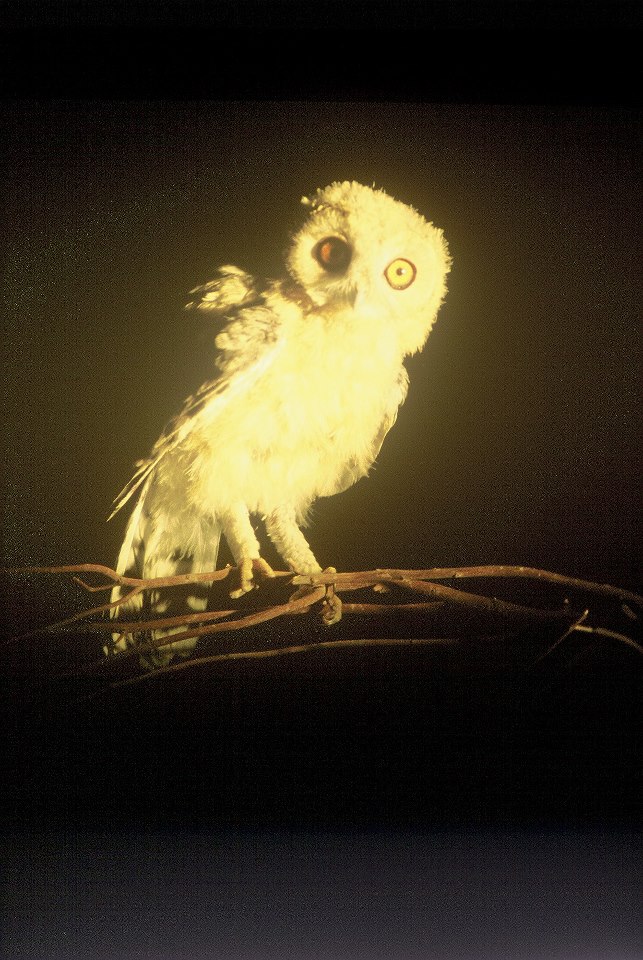
Desert Tawny Owl, Hume's Owl
Desert, Semi-Desert, Rocky Ravines, Palm Groves
Middle East, Arabian Peninsula
Voles, Mice, Large Insects
About Desert owl
The desert owl, scientifically known as Strix hadorami and formerly referred to as Hume's owl, is a distinct species of typical owl belonging to the family Strigidae. It shares close genetic ties with the more widespread tawny owl and the geographically limited Omani owl. This species is a resident of arid and semi-arid regions, making its home in deserts, rocky ravines, and palm groves.
Geographic Distribution and Habitat
The desert owl's breeding range encompasses Israel, northeastern Egypt, Jordan, and the Arabian Peninsula. Its adaptability to these challenging environments is reflected in its choice of habitat, which includes the stark beauty of desert landscapes, the rugged terrain of semi-deserts, and the shelter provided by rocky ravines and oases with palm groves. They are known to nest in natural crevices and holes found in cliff faces.
Physical Characteristics
As a medium-sized owl, the desert owl is notably smaller than its relative, the tawny owl, with a typical length measuring between 29 and 33 centimeters. Its overall appearance is characterized by a stocky build and a round head, reminiscent of a small tawny owl. However, key distinctions include its paler plumage, less pronounced streaking, especially on its underparts, and its striking yellow eyes, which set it apart visually.
Behavior and Diet
The desert owl is primarily a nocturnal species, meaning it is most active during the night. It is also a sedentary bird, remaining in its established territory throughout the year. Its diet is typical of many owls in similar environments, consisting mainly of small rodents such as voles and mice, supplemented by larger insects. The vocalizations of the desert owl are distinctive, with a call described as a 'hoooo-ho-ho-ho-ho,' a sound that bears a rhythmic similarity to that of the Eurasian collared dove. Female calls are noted to be deeper and less clear than those of the males.
Source: Wikipedia ↗
Frequently Asked Questions
What is the scientific name of the desert owl?
The scientific name of the desert owl is Strix hadorami. It was formerly known by the scientific name Strix butleri, but research in 2015 revealed that the holotype for S. butleri belonged to a different species.
Where does the desert owl live?
The desert owl breeds in Israel, northeast Egypt, Jordan, and the Arabian Peninsula. Its preferred habitats include desert, semi-desert environments, rocky ravines, and palm groves.
What does the desert owl eat?
The diet of the desert owl primarily consists of small mammals such as voles and mice. It also consumes large insects.
How is the desert owl described physically?
The desert owl is a medium-sized owl, smaller than the tawny owl, measuring 29–33 cm in length. It has a stocky body and a round head, with paler plumage and less streaking on its underparts than the tawny owl. It is distinguished by its yellow eyes.
What sounds does the desert owl make?
The call of the desert owl is described as a 'hoooo-ho-ho-ho-ho', which is similar in rhythm to the call of the Eurasian collared dove. Female desert owls have a deeper and less distinct call than males.
Related Owl species

Andaman scops owl
The Andaman scops owl is a small owl species native to the Andaman Islands of India, characterized by its predominantly brown plumage with white speckles and striking yellow eyes. First described in 1873, this nocturnal hunter inhabits semi-open areas and is known for its distinctive pulsating hoot. Despite some population decline due to deforestation, it is currently listed as 'Least Concern' by the IUCN.

Arabian eagle-owl
The Arabian eagle-owl is a true owl species endemic to the Arabian Peninsula, found in coastal and slightly inland areas of southwestern Saudi Arabia, Yemen, Oman, and the United Arab Emirates. This medium-sized owl is distinguished by its prominent feather tufts, which enhance its already acute hearing, and its bright yellow eyes, setting it apart from similar eagle-owl species.

Bare-shanked screech owl
The bare-shanked screech owl is a large owl found in the mountain forests of Costa Rica, Panama, and northwestern Colombia. It is distinguished by its bare lower legs and yellowish-pink toes. This species primarily hunts at night for large insects, shrews, and small rodents.