
Maned owl
The maned owl, also known as the Akun scops owl, is a medium-sized owl endemic to the lowland tropical rainforests of West Africa. Its most distinctive feature is the mane-like crest of long, white-tipped feathers on its crown and ear tufts. Primarily nocturnal, its diet is believed to consist mainly of insects.
Key Facts
- ›The maned owl is the sole species in the genus Jubula.
- ›Its plumage is primarily deep chestnut with wavy dark bars, contrasting with a white forehead.
- ›It inhabits closed-canopy evergreen rainforests with dense undergrowth.
- ›Diet is thought to be primarily insects due to its small feet and claws.
- ›Breeding season is believed to be between March and may, with clutches of 3-4 eggs.
- ›Juveniles have been observed in late December and January in various parts of its range.
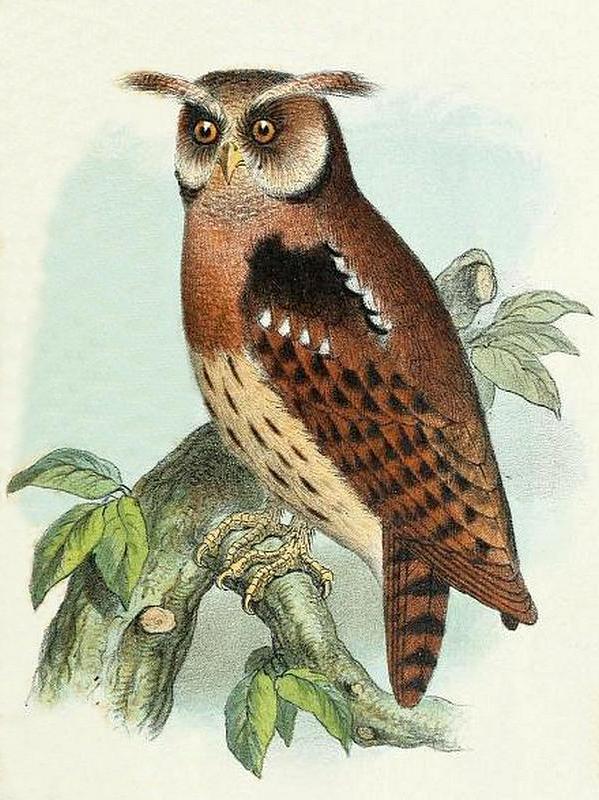
Akun Scops Owl
Closed Canopy Evergreen Rainforest, Areas With Dense Creepers
Africa
Insects, Green Plant Material
About Maned owl
The Maned Owl: An Elusive Rainforest Dweller
The maned owl, scientifically known as Jubula lettii and sometimes called the Akun scops owl, is a species of owl found exclusively in the lowland tropical rainforests of West Africa. It is the sole member of the genus Jubula, highlighting its unique evolutionary position. This medium-sized owl is most recognizable by the distinctive mane-like crest of long, white-tipped feathers adorning its crown and ear tufts, which stand out against its predominantly rufous plumage.
Description and Habitat
Characterized by a deep chestnut upper body marked with narrow, wavy dark bars, the maned owl features a contrasting white forehead and the aforementioned white-tipped ear tufts. Its facial disk is rufous, bordered by a broad blackish rim, and it possesses a white throat. The underparts transition from rufous with white bars on the upper breast to buff with dark streaks on the lower breast and belly, with pale buff vent and legs. The flight feathers and tail are adorned with broad dark bars on a rufous base. The bill is yellow, the cere greenish-yellow, and its eyes, legs, and feet are also yellow. The body length typically measures around 25 cm.
The maned owl's habitat is confined to closed-canopy evergreen rainforests, particularly favoring areas rich in dense creepers. Its distribution across West Africa, from Liberia to the Democratic Republic of Congo, is notably patchy. It avoids semi-evergreen open-canopy forests and is not found far from dense forest environments.
Behavior and Diet
Information regarding the maned owl's behavior is limited, but it is known to be a nocturnal species. During daylight hours, it roosts in dense creepers, often as low as 2 meters from the ground, emerging to an open perch at dusk. Its diet remains somewhat mysterious, though its small and weak feet and claws suggest that insects, such as grasshoppers and beetles, constitute the majority of its food intake. Intriguingly, green plant material has been discovered in the stomach contents of a young owl, hinting at a potentially varied diet in its early stages.
Breeding and Reproduction
Details about the maned owl's breeding behavior are scarce. However, observations in the Democratic Republic of Congo suggest that the species lays three or four eggs, with the nesting period occurring between March and May. Nests are typically situated within tree cavities or in the reused stick nests of other animals. Evidence of juveniles has been recorded in late December and January in Cameroon and Gabon, and the presence of adult pairs with fully grown young has been noted in Liberia in late February, providing glimpses into its reproductive cycle.
Source: Wikipedia ↗
Frequently Asked Questions
What is the maned owl's most distinctive physical feature?
The maned owl gets its name from the long, floppy, white-tipped feathers on its crown and ear tufts, which give it a mane-like appearance. These feathers contrast with its otherwise rufous plumage.
Where does the maned owl live?
This owl is endemic to the lowland, tropical rainforests of West Africa. Its distribution is patchy, ranging from Liberia in the west to the Democratic Republic of Congo in the east.
What kind of habitat does the maned owl prefer?
The maned owl prefers closed-canopy evergreen rainforests, particularly areas with dense creepers. It is not found in semi-evergreen open-canopy forests or away from dense forest environments.
What does the maned owl eat?
The exact diet is not well understood, but its small and weak feet and claws suggest that insects like grasshoppers and beetles form the largest part of its diet. Green plant material has also been found in the stomach of a young owl.
When does the maned owl breed and how many eggs does it lay?
Observations suggest that the breeding season occurs between March and May, with most species laying three or four eggs. Nests are typically found in tree cavities or old stick nests of other animals.
Is the maned owl active during the day?
No, the maned owl is a nocturnal species. It roosts by day in dense creepers and emerges onto an open perch at dusk.
Related Owl species

Andaman scops owl
The Andaman scops owl is a small owl species native to the Andaman Islands of India, characterized by its predominantly brown plumage with white speckles and striking yellow eyes. First described in 1873, this nocturnal hunter inhabits semi-open areas and is known for its distinctive pulsating hoot. Despite some population decline due to deforestation, it is currently listed as 'Least Concern' by the IUCN.

Arabian eagle-owl
The Arabian eagle-owl is a true owl species endemic to the Arabian Peninsula, found in coastal and slightly inland areas of southwestern Saudi Arabia, Yemen, Oman, and the United Arab Emirates. This medium-sized owl is distinguished by its prominent feather tufts, which enhance its already acute hearing, and its bright yellow eyes, setting it apart from similar eagle-owl species.

Bare-shanked screech owl
The bare-shanked screech owl is a large owl found in the mountain forests of Costa Rica, Panama, and northwestern Colombia. It is distinguished by its bare lower legs and yellowish-pink toes. This species primarily hunts at night for large insects, shrews, and small rodents.