
Andean parakeet
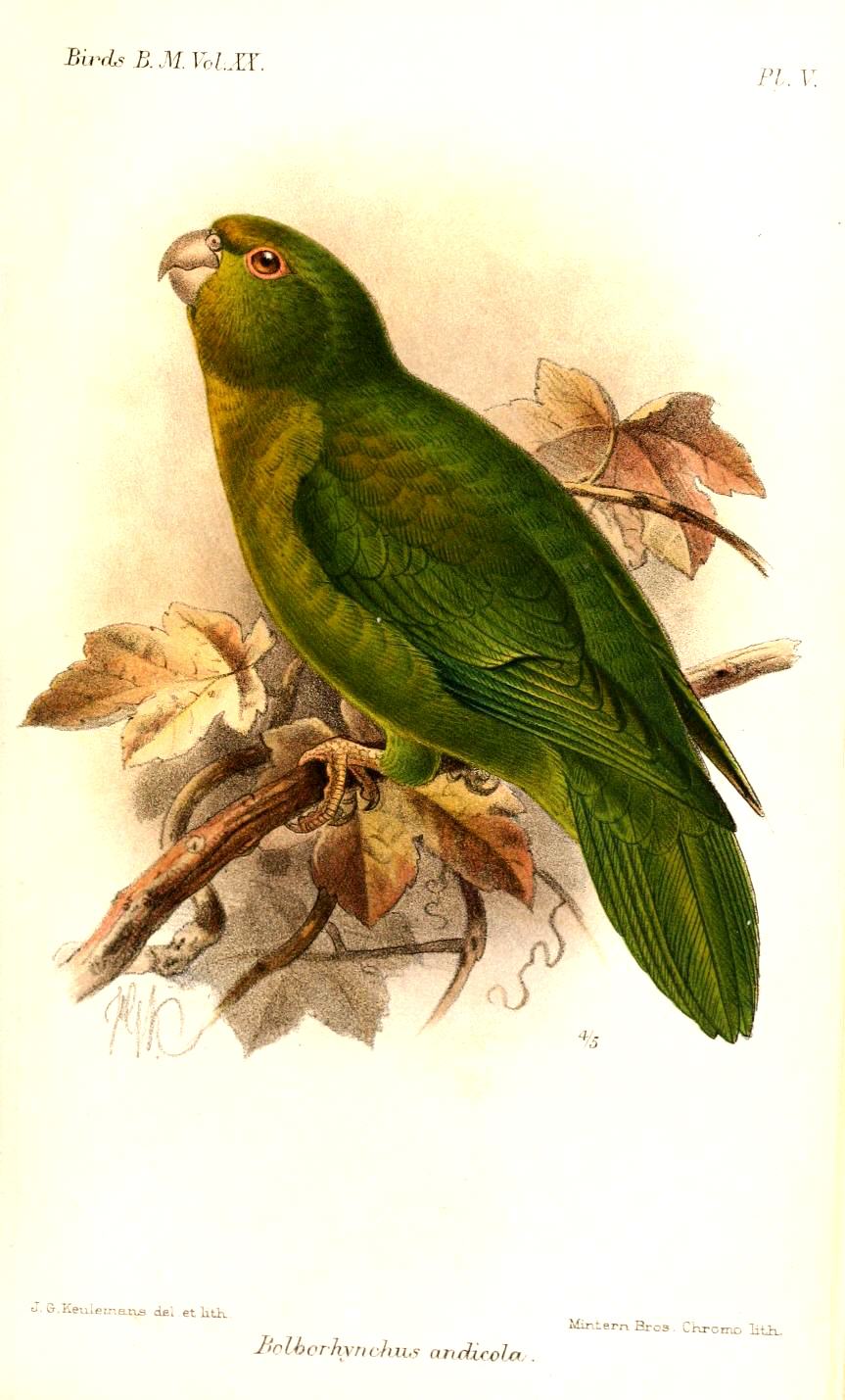
The Andean parakeet is a species of parrot found in the Andes mountains of Argentina, Bolivia, and Peru. Adults are predominantly green with a yellow tinge, and they inhabit high-altitude environments such as cloud forests and woodlands.
Key Facts
- ›Found in Argentina, Bolivia, and Peru.
- ›Typically measures 16-17 cm in length.
- ›Weighs between 48-50 grams.
- ›Inhabits elevations mostly between 3,000 and 4,000 meters.
- ›Feeds on seeds, fruits, and berries.
- ›Has a Least Concern conservation status.
Argentina, Bolivia, Peru
Semi-Arid Cloudforest, Polylepis Woodlands, Ravines With Bushy Vegetation
Yellow Tinge From Face To Belly, Teal Outer Webs of Primaries
Seeds, Fruits, Berries
Short, Dull Notes, Chuckling Pairs Or Triplets, Chattering Series
Nests In Burrows In Earthen Banks
About Andean parakeet
The Andean Parakeet
The Andean parakeet (Bolborhynchus orbygnesius) is a species of parrot found in the high-altitude regions of the Andes mountains. It inhabits parts of Argentina, Bolivia, and Peru, preferring semiarid cloudforests, Polylepis woodlands, and bushy ravines.
Description and Habitat
Adult Andean parakeets typically measure between 16 to 17 centimeters in length and weigh around 48 to 50 grams. Their plumage is predominantly green, often with a noticeable yellow tinge extending from the face to the belly, which is particularly bright on the throat and upper breast. The outer edges of their primary feathers display a teal coloration, sometimes appearing almost violet. Juveniles share the same coloration as adults but lack the yellow tinge. These birds are well-adapted to their environment, mostly found at elevations ranging from 3,000 to 4,000 meters, though they can occasionally be observed at even higher altitudes.
Behavior and Diet
Outside of the breeding season, Andean parakeets exhibit migratory behavior, moving to lower elevation valleys from their core range. Their diet consists of seeds, fruits, and berries, which they forage for on the ground, in bushes, bamboo patches, and within leguminous trees. Little is documented about their breeding biology, though it has been reported that they nest in burrows dug into earthen banks.
Vocalizations and Status
The typical call of the Andean parakeet is a short, dull note, often delivered in pairs or triplets described as a 'juh-juh-juh' sound, or sometimes as a longer chattering series. The International Union for Conservation of Nature (IUCN) assesses the Andean parakeet as Least Concern. The species has a relatively large range, and while its exact population size is unknown, it is believed to be stable. No immediate threats to the species have been identified, and they are locally common, with flocks of up to 300 birds having been observed.
Source: Wikipedia ↗
Frequently Asked Questions
What is the Andean parakeet's scientific name?
The scientific name for the Andean parakeet is Bolborhynchus orbygnesius. It has also been referred to as Bolborhynchus andicolus in the past.
Where does the Andean parakeet live?
This species is found in the Andes mountains, ranging from Peru's Department of Cajamarca south through central Bolivia into Argentina's Jujuy and Salta provinces.
What does the Andean parakeet look like?
Adult Andean parakeets are mostly green with a yellow tinge on their face and belly. They have teal outer webs on their primaries, a grayish bill, and dull pink legs.
What kind of habitat does the Andean parakeet prefer?
They inhabit semiarid cloudforest, Polylepis woodlands, and ravines with bushy vegetation in more open country, typically at high elevations.
What is the Andean parakeet's diet?
The Andean parakeet forages for seeds, fruits, and berries. They find their food on the ground, in bushes, bamboo, and leguminous trees.
What is the conservation status of the Andean parakeet?
The Andean parakeet is listed as Least Concern by the IUCN. Its population is believed to be stable, and no immediate threats have been identified.
How do Andean parakeets vocalize?
Their usual call is described as a short, dull note, often given in pairs or triplets like 'juh-juh-juh', or a longer chattering series.
Related Parrot species

Red-and-green macaw
The red-and-green macaw, also known as the green-winged macaw, is the largest parrot in the genus Ara, native to the forests and woodlands of northern and central South America. It is distinguished by its predominantly red plumage, with green upper-wing covert feathers and characteristic red lines around its eyes. This species is popular in aviculture but faces population declines due to habitat loss and illegal capture.

Australian ringneck
The Australian ringneck is a medium-sized parrot native to Australia, found in diverse environments except for extreme tropical and highland regions. It is characterized by a green basic plumage, a distinctive yellow ring around its hindneck, and variations in color across its four subspecies. This gregarious bird is known for its varied vocalizations and is generally not considered a threatened species, though some subspecies face local competition.

Bismarck hanging parrot
The Bismarck hanging parrot (Loriculus tener) is a small parrot species endemic to the forests of the Bismarck Archipelago in Papua New Guinea. It is distinguished by its predominantly green plumage, a bright red throat patch, and a black beak. This species faces threats from habitat loss and is sometimes considered a subspecies of the orange-fronted hanging parrot.