
Black-winged lory
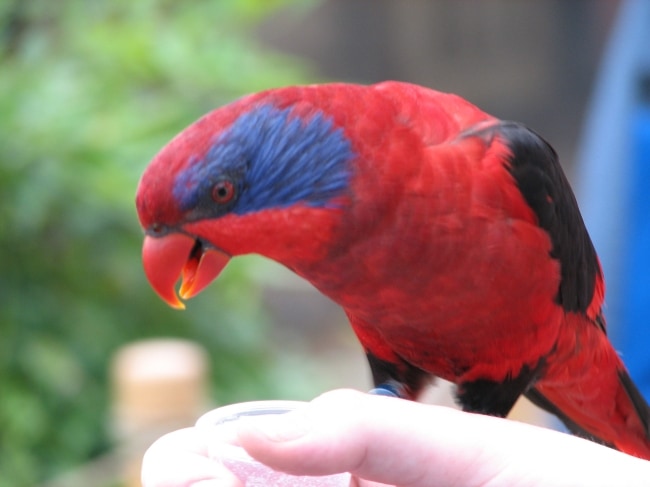
The black-winged lory, scientifically known as Trichoglossus cyanogenius, is a medium-sized parrot native to the islands of Biak, Numfoor, and Mios Num in Indonesia's Cenderawasih Bay. It is distinguished by its vibrant red plumage, contrasting black shoulders, and a striking violet ear-patch.
Key Facts
- ›Bright red plumage with black shoulders.
- ›Native to Biak, Numfoor, and Mios Num islands in Indonesia.
- ›Frequents coconut trees and coastal habitats.
- ›Evaluated as near Threatened due to habitat loss and hunting.
- ›Listed on Appendix II of CITES.
Biak Red Lory
Indonesia
Forests, Coastal Habitat, Coconut Trees
Black Shoulder, Violet Ear-Patch, Red Iris, Orange-Red Bill
About Black-winged lory
The black-winged lory, scientifically recognized as Trichoglossus cyanogenius and also known as the Biak red lory, is a medium-sized parrot measuring approximately 30 cm (12 inches) in length with a notably long tail. Its most striking characteristic is its vibrant, predominantly bright red plumage, which is dramatically contrasted by black shoulders. Additional distinct features include a red iris, an orange-red bill, and a prominent violet ear-patch situated behind the eye. The underwings are red, gradually becoming yellowish towards the tips.
This species is an Indonesian endemic, naturally occurring in the forests and coastal habitats found on the islands of Biak, Numfoor, and Mios Num, located within Cenderawasih Bay. The black-winged lory frequently inhabits and roosts in coconut trees, indicating a preference for these environments.
Unfortunately, the black-winged lory faces conservation challenges. Due to ongoing habitat loss, a relatively small population size, and the impact of hunting in some regions, the species is currently evaluated as Near Threatened on the IUCN Red List of Threatened Species. It is also afforded protection under Appendix II of CITES, which regulates international trade in endangered species.
Source: Wikipedia ↗
Frequently Asked Questions
What is the scientific name of the black-winged lory?
The scientific name of the black-winged lory is Trichoglossus cyanogenius.
Where does the black-winged lory live?
The black-winged lory is an Indonesian endemic, found in the forests and coastal habitats of Biak, Numfoor, and Mios Num islands in Cenderawasih Bay.
What are the distinctive features of the black-winged lory?
This lory is characterized by its bright red plumage, black shoulders, red iris, orange-red bill, and a violet ear-patch located behind the eye. Its underwings are red, transitioning to yellowish with black tips.
What is the conservation status of the black-winged lory?
The black-winged lory is currently evaluated as Near Threatened on the IUCN Red List of Threatened Species. This status is due to ongoing habitat loss, a small population size, and hunting in certain areas.
Are there differences between male and female black-winged lories?
No, the sexes of the black-winged lory are similar in appearance, meaning there are no readily discernible visible differences between males and females.
Related Parrot species

Green rosella
The Green rosella (Platycercus caledonicus), also known as the Tasmanian rosella, is the largest species in the rosella genus and is native to Tasmania and the Bass Strait islands. It is distinguished by its predominantly yellow head and underparts, violet-blue cheeks, and a red band above its beak. This parrot inhabits a variety of wooded environments and is primarily herbivorous, feeding on seeds, fruits, and flowers.

Guadeloupe amazon
The Guadeloupe amazon (Amazona violacea) is a hypothetical extinct species of parrot believed to have been native to Guadeloupe in the Lesser Antilles. Described by 17th and 18th-century writers, it was characterized by violet or slate-colored head and underparts, greenish back, and wings with green, yellow, and red. Its extinction is attributed to hunting by French settlers and habitat destruction.

Northern rosella
The northern rosella (Platycercus venustus) is a parrot species native to northern Australia, recognized for its distinctive dark head and neck contrasted with pale cheeks. This species inhabits woodland and open savanna, feeding primarily on seeds, flowers, and berries, and occasionally insects. It is known for being shyer and quieter than other rosellas.