
Black-winged lovebird
The black-winged lovebird, also known as the Abyssinian lovebird, is the largest species within the lovebird genus, characterized by its predominantly green plumage. Adult males are distinguished by a red forehead and eye ring, while females have an all-green head. This species is native to the high plains and mountainous regions of Eritrea and Ethiopia and is considered uncommon as a pet.
Key Facts
- ›The largest species of lovebird, measuring approximately 16-16.5 cm (6.3-6.5 inches) in length.
- ›Adult males have a distinctive red forehead and eye ring, while females have an all-green head.
- ›Native to southern Eritrea and southwestern Ethiopia, typically inhabiting high plains and mountainous regions.
- ›Diet consists of sunflower seeds, corn, apples, and mission figs.
- ›Nests are built in tree cavities, furnished with plant debris and feathers.
- ›Considered Least Concern on the IUCN Red List.
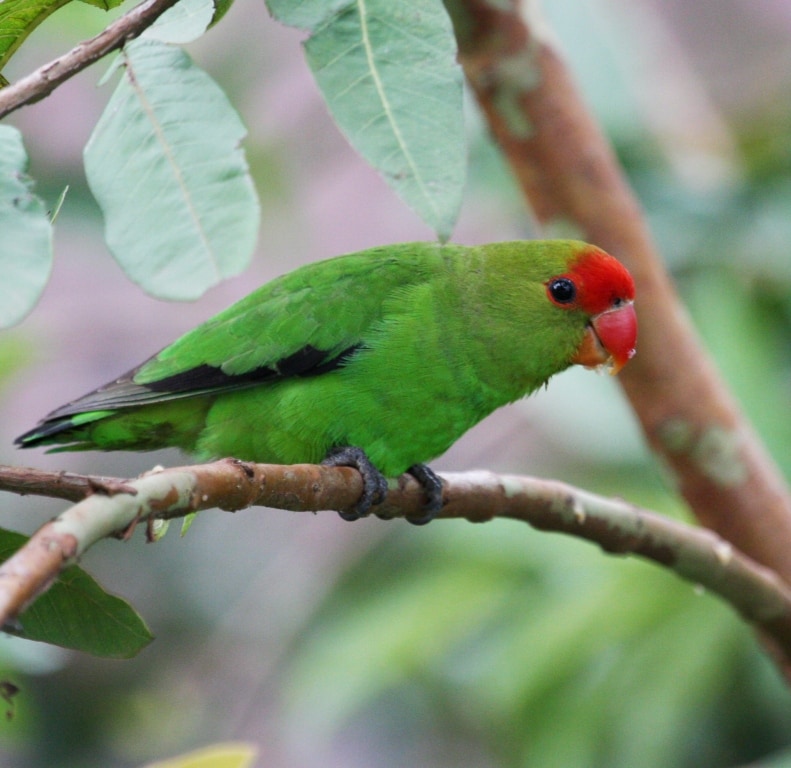
Abyssinian Lovebird
Eritrea, Ethiopia
High Plains, Mountainous Regions
- Red forehead and eye ring in adult males
- All-green head in adult females
- Black-tipped tail with yellowish feathers below
Sunflower Seeds, Corn, Apples, Mission Figs
Tree Cavities, Crevices In Walls, Furnished With Plant Debris and Feathers
About Black-winged lovebird
The black-winged lovebird (Agapornis taranta), also known as the Abyssinian lovebird, is the largest member of the lovebird genus, a group of small parrots. This species is primarily green and measures approximately 16 to 16.5 cm (6.3 to 6.5 inches) in length. A key characteristic is its sexual dimorphism: adult males are readily identified by a distinctive red forehead and a ring of red feathers around their eyes, while adult females possess an entirely green head.
Habitat and Distribution
The natural range of the black-winged lovebird extends from southern Eritrea to southwestern Ethiopia. They are typically found inhabiting high plains and mountainous regions within these countries. Their distribution is confined to these specific ecological zones.
Diet and Behavior
In the wild, the diet of the black-winged lovebird commonly includes sunflower seeds, corn, apples, and mission figs. These food items are readily available in their natural habitat. They are known to reproduce between March and November.
Breeding and Nesting
Black-winged lovebirds construct their nests in tree cavities, crevices in walls, and potentially within weavers' nests. The nests are furnished with a combination of plant debris and feathers. A clutch typically consists of three or four white eggs. The female incubates the eggs for approximately 23 days, and the chicks fledge from the nest about 45 days after hatching.
Conservation Status and Aviculture
The black-winged lovebird is classified as Least Concern on the IUCN Red List of Threatened Species, indicating it is widespread and common within its range. In aviculture, this species has not become well-established as a breeding bird. While they can tolerate cold weather, breeding is conducted on a small scale, making them an uncommon pet.
Taxonomy
The holotype specimen of Psittacus taranta, collected in Taranta Pass, Eritrea, in 1809-10 by Henry Salt, is housed in the vertebrate zoology collection of National Museums Liverpool. This specimen became part of the Liverpool national collection through the 13th Earl of Derby's bequest in 1851.
Source: Wikipedia ↗
Frequently Asked Questions
What are the distinguishing features of a male black-winged lovebird?
The adult male black-winged lovebird is easily identified by its red forehead and a ring of red feathers around its eyes. Both sexes are primarily green, but the male's red markings are a key differentiator.
Where do black-winged lovebirds naturally live?
Black-winged lovebirds are native to the high plains and mountainous regions of southern Eritrea and southwestern Ethiopia. Their natural distribution is confined to these specific areas.
What is the typical diet of a black-winged lovebird?
In their natural habitat, black-winged lovebirds feed on a diet that typically includes sunflower seeds, corn, apples, and mission figs. These food sources are common in the regions they inhabit.
How does the black-winged lovebird reproduce?
The black-winged lovebird breeds from March to November, nesting in tree cavities, wall crevices, or potentially weavers' nests. Nests are constructed with a combination of plant debris and feathers.
What is the conservation status of the black-winged lovebird?
The black-winged lovebird is evaluated as Least Concern on the IUCN Red List of Threatened Species. It is considered widespread and common throughout its natural range.
Are black-winged lovebirds common pets?
Black-winged lovebirds are uncommon as pets. While they can tolerate cold weather, they have not become well-established as a breeding bird in aviculture, with breeding occurring on a small scale.
Related Parrot species

Bismarck hanging parrot
The Bismarck hanging parrot (Loriculus tener) is a small parrot species endemic to the forests of the Bismarck Archipelago in Papua New Guinea. It is distinguished by its predominantly green plumage, a bright red throat patch, and a black beak. This species faces threats from habitat loss and is sometimes considered a subspecies of the orange-fronted hanging parrot.

Blue-fronted amazon
The blue-fronted amazon, also known as the blue-fronted parrot or turquoise-fronted amazon, is a South American species of parrot recognized for the distinctive blue or turquoise marking above its beak. It is one of the most commonly kept amazon parrots as a pet. This species exhibits significant individual variation in plumage color, particularly in the amount of yellow and red on its head and wings.

Blue-fronted parrotlet
The blue-fronted parrotlet is a small bird found in the cloud forests and mature secondary forests of Colombia, Ecuador, Panama, and Venezuela. Characterized by its predominantly green plumage, it is distinguished by a vibrant blue forehead, a white eye ring, and red markings on its wings. These birds are known for their gregarious nature and can be quite noisy in flight, though they are often overlooked due to their quiet feeding habits.