
Blue-fronted parrotlet
The blue-fronted parrotlet is a small bird found in the cloud forests and mature secondary forests of Colombia, Ecuador, Panama, and Venezuela. Characterized by its predominantly green plumage, it is distinguished by a vibrant blue forehead, a white eye ring, and red markings on its wings. These birds are known for their gregarious nature and can be quite noisy in flight, though they are often overlooked due to their quiet feeding habits.
Key Facts
- ›Found in Colombia, Ecuador, Panama, and Venezuela.
- ›Measures approximately 17-18 cm in length and weighs 59-71 g.
- ›Features a blue forehead, white eye ring, red wing markings, and bronze-green crown.
- ›Inhabits cloudforest and mature secondary forest environments.
- ›Typically found in small groups of up to 15 individuals.
- ›Diet includes small fruits and seeds, particularly from the Clusiaceae family.

Colombia, Ecuador, Panama, Venezuela
Cloudforest, Mature Secondary Forest
Blue forehead, White eye ring, Red line in front of and below eye, Red on wing's wrist, Yellow underwing coverts
Small Fruits, Seeds
Gregarious, Quiet While Feeding and Roosting, Noisy In Flight
Nasal "Chree" Call, Bisyllabic "Chu-Ree" Call, Continuous, Noisy Chattering In Flight, Soft Churring "Krr" When Perched
Excavated In Arboreal Termite Nests
About Blue-fronted parrotlet
The blue-fronted parrotlet, scientifically known as Touit dilectissimus, is a small species of parrot belonging to the family Psittacidae. It is native to the diverse ecosystems of Colombia, Ecuador, Panama, and Venezuela. This species is characterized by its predominantly green plumage, which is darker on the upper parts than below. Distinctive markings include a vibrant blue forehead, a prominent white eye ring, and a red line situated in front of and below the eye, with further blue coloration beneath.
Habitat and Distribution
This parrotlet inhabits cloudforests and mature secondary forests, typically found at elevations ranging from 500 to 2,000 meters (1,600 to 6,600 feet) in the Andes, though it can be found at lower and higher altitudes depending on the region. Its population is spread across its range, often appearing localized. They are frequently observed at the edges of forests.
Behavior and Diet
Blue-fronted parrotlets are gregarious birds, often seen in small flocks of up to 15 individuals. While they are generally quiet when feeding and roosting high in tree canopies, they can become quite vocal during flight. Their diet is not extensively documented but is known to include small fruits and seeds, with a noted observation of them feeding on seeds from fruits of the Clusiaceae family.
Breeding and Vocalization
Breeding seasons vary slightly by region, with nests observed in Panama in May and June, and in Colombia during March and June. Nests are typically excavated within arboreal termite nests, often situated several meters above the ground. The calls of the blue-fronted parrotlet are commonly described as a slightly nasal "chree" or a bisyllabic "chu-ree." In flight, flocks produce a continuous, noisy chattering, and when perched, they may emit a soft churring "krr."
Conservation Status
The International Union for Conservation of Nature (IUCN) has assessed the blue-fronted parrotlet as Least Concern. Despite an unknown and potentially decreasing population size, its extensive range and the availability of suitable habitat suggest it is relatively secure, with no immediate threats explicitly identified.
Source: Wikipedia ↗
Frequently Asked Questions
What are the key identifying features of the blue-fronted parrotlet?
The blue-fronted parrotlet is identified by its predominantly green body, a distinct blue forehead, a white eye ring, and a red line in front of and below the eye. It also displays red on the wing's 'wrist' and has black primaries with green outer edges.
Where does the blue-fronted parrotlet live?
This species is found in eastern Panama, along the Pacific slope of Colombia and Ecuador, and in the Andes and Serranía del Perijá of Venezuela. It inhabits cloudforest and mature secondary forest.
What is the typical size and weight of a blue-fronted parrotlet?
The blue-fronted parrotlet is about 17 to 18 cm (6.7 to 7.1 inches) long and typically weighs between 59 and 71 grams (2.1 to 2.5 ounces).
What is known about the diet of the blue-fronted parrotlet?
Little is definitively known about their diet, but stomach contents have revealed small fruits, with both pulp and seeds being potential targets. They have also been observed feeding on the seeds of fruits from the Clusiaceae family.
What are the vocalizations of the blue-fronted parrotlet like?
Their most common calls are a slightly nasal "chree" or a bisyllabic "chu-ree." While feeding and roosting, they are quiet, but flocks in flight produce continuous, noisy chattering. They also emit a soft churring "krr" when perched.
What is the conservation status of the blue-fronted parrotlet?
The IUCN has assessed the blue-fronted parrotlet as Least Concern. Although its population size is unknown and believed to be decreasing, its large range and the presence of much remaining habitat suggest it is relatively secure.
Related Parrot species

Bronze-winged parrot
The Bronze-winged parrot (Pionus chalcopterus) is a medium-sized parrot native to northwestern South America, inhabiting forest and woodland environments. It is distinguished by its predominantly dark plumage, a distinctive whitish chin patch, and bronze-green body feathers that shimmer with blue tips, along with short red undertail feathers.
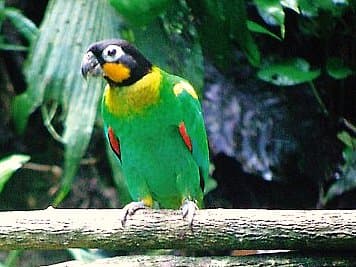
Orange-cheeked parrot
The orange-cheeked parrot, also known as Barraband's parrot, is a species of parrot native to the Amazonian Andes and humid lowland forests of the Amazon Basin in South America. Its distinctive features include an olive throat and breast, yellow thighs, and varying shades of orange on its wings and cheeks, with a notable white eye-ring. This species faces threats from habitat loss due to deforestation in its native range.

Golden-capped parakeet
The golden-capped parakeet is a species of parrot endemic to Brazil, inhabiting dry and moist lowland forests, savannas, and plantations. It is distinguished by its predominantly green plumage with a black beak, white eyerings, orange-red belly, and a face that transitions from red to yellow on its crown. This parakeet is recognized as a valuable biological indicator due to its sensitivity to habitat fragmentation and vulnerability.