
Blue-collared parrot
The blue-collared parrot, also known as the simple parrot, is a medium-sized parrot native to the higher elevations of New Guinea. It is distinguished by its predominantly green plumage, a black beak, and distinctive blue coloration on the male's collar and the female's crown. These parrots inhabit humid hill forests and are known to gather in flocks of up to 200 individuals.
Key Facts
- ›Inhabits higher elevations of New Guinea, typically between 500 and 2300 meters.
- ›Measures 23-25 cm in length.
- ›Features include a black beak, yellow wing bend, blue underwing coverts, and a pale yellow iris.
- ›Adult males are characterized by a blue collar across the upper breast and lower neck.
- ›Adult females display some blue coloration on the rear crown.
- ›Flocks can consist of up to 200 individuals.
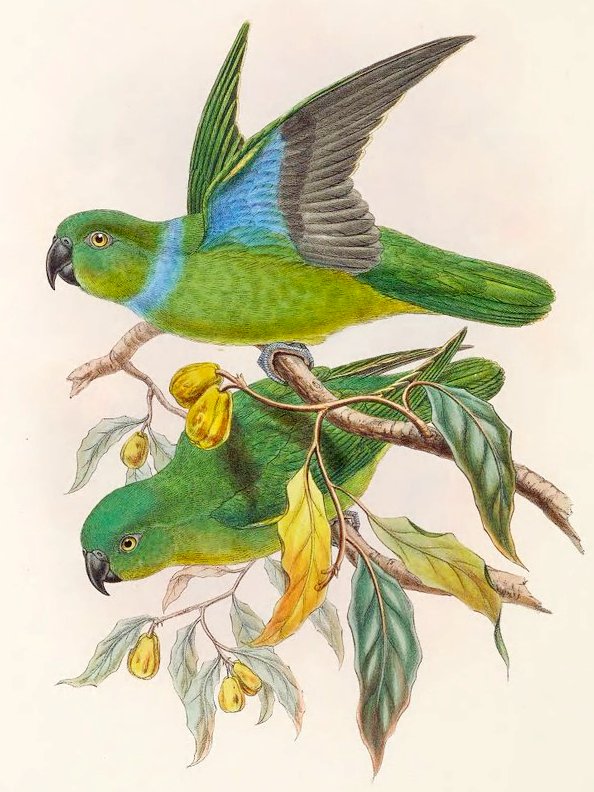
Simple Parrot, Lilac-Collared Song Parrot, Lilac-Collared Geoffroy's Parrot
New Guinea
Humid Hill Forest, Forest Edges
Blue collar on adult males, Blue on rear crown of adult females, Yellow wing bend, Blue underwing coverts, Pale yellow iris
About Blue-collared parrot
The blue-collared parrot, scientifically known as Geoffroyus simplex, is a species of parrot native to the higher elevations of New Guinea. It is also referred to by common names such as the simple parrot, lilac-collared song parrot, or lilac-collared Geoffroy's parrot, reflecting its appearance and taxonomic lineage.
Habitat and Distribution
This species is found in humid hill forests and along forest edges within New Guinea. Its preferred habitat lies at elevations typically ranging from 500 to 2300 meters, with a more concentrated presence often noted between 800 and 1900 meters. During periods of food scarcity, they may descend to lower altitudes.
Physical Description
Blue-collared parrots measure between 23 and 25 centimeters in length. Their plumage is predominantly green, complemented by a black beak, a distinct yellow wing bend, and blue underwing coverts. They possess a pale yellow iris. A key distinguishing feature is the blue collar present on the upper breast and lower neck of adult males. Adult females exhibit some blue coloration on the rear of their crown. Juveniles lack the blue markings and have a paler bill.
Subspecies
Two subspecies of the blue-collared parrot are recognized. G. s. simplex is found on Vogelkop, measuring approximately 23 cm. The second subspecies, G. s. buergersi, inhabits the remainder of New Guinea. Birds of this latter subspecies are slightly larger at 25 cm, and their males have a duller but wider blue collar at the back.
Social Behavior
These parrots are social creatures and are often observed in flocks. These groups can be substantial, sometimes comprising up to 200 individuals, particularly when foraging.
Source: Wikipedia ↗
Frequently Asked Questions
What are the different names for the blue-collared parrot?
The blue-collared parrot is also known by several other common names, including the simple parrot, lilac-collared song parrot, and lilac-collared Geoffroy's parrot. These names reflect its appearance and taxonomic classification.
Where is the blue-collared parrot found?
This species is found in the higher elevations of New Guinea. Its habitat is primarily humid hill forests and forest edges, typically at altitudes ranging from 500 to 2300 meters.
What does the blue-collared parrot look like?
The blue-collared parrot is mainly green with a black beak, a yellow wing bend, and blue underwing coverts. It has a pale yellow iris. Adult males possess a notable blue collar on their upper breast and lower neck, while adult females have a touch of blue on their rear crown.
What are the subspecies of the blue-collared parrot?
There are two recognized subspecies: Geoffroyus simplex simplex, found on Vogelkop, and Geoffroyus simplex buergersi, found on the rest of the island. The latter subspecies is slightly larger and has a duller but wider blue collar on males.
What is the typical flock size of the blue-collared parrot?
Blue-collared parrots are social birds and are often observed in flocks. These flocks can be quite large, sometimes numbering up to 200 individuals foraging together.
Related Parrot species

Budgerigar
The budgerigar, also known as the common parakeet or budgie, is a small, seed-eating parrot native to Australia. Naturally green and yellow with black markings, captive breeding has produced a wide array of colors. These nomadic, social birds are highly popular pets worldwide due to their small size, affordability, and remarkable ability to mimic human speech.

Green rosella
The Green rosella (Platycercus caledonicus), also known as the Tasmanian rosella, is the largest species in the rosella genus and is native to Tasmania and the Bass Strait islands. It is distinguished by its predominantly yellow head and underparts, violet-blue cheeks, and a red band above its beak. This parrot inhabits a variety of wooded environments and is primarily herbivorous, feeding on seeds, fruits, and flowers.

Eastern rosella
The eastern rosella (Platycercus eximius) is a vibrantly colored parrot native to southeastern Australia. Known for its distinctive red head, yellow and green body, and blue wings, this species is also established in New Zealand. They are cavity nesters and primarily feed on seeds, fruits, and insects.