
Broad-billed parrot
The broad-billed parrot, also known as the raven parrot, was a large extinct parrot endemic to the Mascarene island of Mauritius. Distinguished by its unusually large beak and a prominent frontal crest, this species was described as having multiple colors, possibly including a blue head, and was thought to be a weak flier. It became extinct in the late 17th century due to habitat loss, introduced predators, and hunting.
Key Facts
- ›Endemic to the island of Mauritius, it is now extinct.
- ›Possessed a very large beak, comparable in size to the hyacinth macaw.
- ›Exhibited significant sexual dimorphism in size and head size.
- ›Likely had a blue head, with possible red body and beak coloration.
- ›Believed to be a weak flier, but not flightless.
- ›Became extinct in the late 17th century due to human impact.

Raven Parrot, Indian Raven, Indian Crow
Africa, Indian Ocean Islands
Forests, Coastal Areas
- Large beak
- Prominent frontal crest
- Significant sexual dimorphism in size and head size
Hard Seeds, Palm Nuts, Fruits
Bad-tempered, Refused to eat in captivity, Preferred to die than live in captivity
Harsh Call
Tree Cavities, Rocks
About Broad-billed parrot
Broad-billed Parrot (Lophopsittacus mauritianus)
The broad-billed parrot, also known as the raven parrot, was a large parrot species endemic to the Mascarene island of Mauritius. This now-extinct bird is notable for its exceptionally large beak, which was comparable in size to that of the hyacinth macaw, suggesting a diet of hard seeds and nuts. Contemporary accounts indicate it possessed a distinctive frontal crest and exhibited significant sexual dimorphism, with males being considerably larger than females. The exact coloration remains uncertain, though descriptions suggest a multi-colored plumage, possibly including a blue head and red beak and body.
Taxonomy and Discovery
First documented by Dutch sailors in 1598, the broad-billed parrot was initially referred to as the "Indian raven" or "Indian crow." Early descriptions and a rediscovered 1601 sketch provided crucial information, though confusion persisted for some time, with some naturalists initially mistaking its remains for those of a hornbill. The first physical remains, a subfossil mandible, were described in 1866 by Richard Owen, who named it Psittacus mauritianus. Later, Alfred Newton placed it in its own genus, Lophopsittacus, referencing its crest.
Description and Behavior
The broad-billed parrot possessed a disproportionately large head and flattened skull. Its large beak was a defining feature, likely adapted for cracking hard seeds. While considered a weak flier, it was not flightless, with evidence suggesting it could fly with some difficulty. Captive individuals were described as ill-tempered and unwilling to adapt to captivity, with one account stating they "refuse[d] to eat" and "would prefer to die rather than to live in captivity." It may have nested in tree cavities or rock crevices.
Diet and Extinction
Morphological similarities to macaws and palm cockatoos suggest the broad-billed parrot fed on hard palm nuts and seeds abundant on Mauritius. Its large beak would have been effective in processing these tough food sources. The species faced extinction in the late 17th century. The primary drivers were deforestation, which decimated its habitat, coupled with predation by introduced invasive species and potential hunting by humans. The loss of the broad-billed parrot, along with other native fauna, significantly impacted the island's seed dispersal ecology.
Source: Wikipedia ↗
Frequently Asked Questions
What was the broad-billed parrot known for?
The broad-billed parrot was known for its extraordinarily large beak, which was comparable in size to that of a hyacinth macaw, suggesting it could crack very hard seeds. It also had a distinctive crest of feathers on its forehead.
What colors was the broad-billed parrot?
The exact coloration is not definitively known, but contemporary descriptions suggest it was multi-colored. One account mentions a blue head, and possibly a red body and beak. Other interpretations suggest a more subdued reddish-brown plumage with a pale bluish-grey head.
Was the broad-billed parrot able to fly?
While it was considered a weak flier, it was not entirely flightless. Accounts suggest it could fly with difficulty, and its wing structure, though broad, did not indicate complete inability to fly.
Why did the broad-billed parrot go extinct?
The broad-billed parrot became extinct in the late 17th century primarily due to deforestation, which destroyed its habitat. Predation by introduced invasive species and possibly hunting also contributed to its demise.
What did the broad-billed parrot eat?
Based on its large beak and comparisons to similar species like the hyacinth macaw, it is believed to have fed on hard palm nuts and seeds. It may have also played a role in seed dispersal for native plants.
Did male and female broad-billed parrots look different?
Yes, the species exhibited significant sexual dimorphism. Males were larger than females, and the difference in skull size between the sexes was the greatest observed among any living parrot species.
Related Parrot species

Cacatuini
Cacatuini refers to a tribe of birds characterized by their predominantly whitish, pinkish, or greyish plumage. This group comprises four distinct genera, and they are known for their distinct avian characteristics.
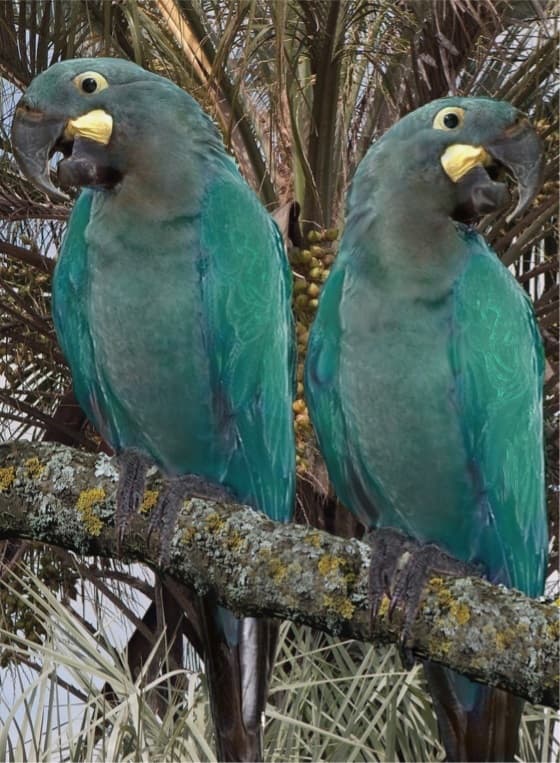
Glaucous macaw
The glaucous macaw is a large, predominantly blue and grey South American parrot, closely related to Lear's and hyacinth macaws. Its typical coloration is described as "glaucous," and it is characterized by a long tail, large bill, and a distinctive yellow eye ring. This species is critically endangered or possibly extinct, with its decline attributed to trapping for the pet trade and the destruction of its primary food source, the yatay palm.

Ochre-marked parakeet
The ochre-marked parakeet is a vibrantly colored species of parrot native to Brazil. It is distinguished by its predominantly green plumage, accented with striking red patches, a dark crown, and a bright blue bib on its chest. This parakeet primarily inhabits the canopy of lowland humid forests and forest edges, and is currently listed as Vulnerable due to habitat loss.