
Cyclopsittini
Cyclopsittini·Psittaculidae
Fig parrots, scientifically known as Cyclopsittini, are a small tribe of Australasian parrots found in New Guinea and surrounding regions. They are characterized by their small, stocky build, short tails, and large bills, with most species exhibiting distinct sexual dimorphism. Their diet primarily consists of figs, but they also consume other fruits, nectar, pollen, and insects, often targeting figs implanted with developing wasps for their nutritional value.
Key Facts
- ›Belong to the tribe Cyclopsittini within the family Psittaculidae.
- ›Native to New Guinea and surrounding islands, including parts of Indonesia, Papua New Guinea, and tropical Australia.
- ›Primarily feed on figs, supplementing their diet with other fruits, berries, nectar, pollen, insects, and larvae.
- ›Exhibit pronounced sexual dimorphism, with the exception of Coxen's fig parrot.
- ›Are arboreal and inhabit tropical and subtropical rainforests, often seen flying swiftly above the canopy.
- ›Possess large, broad bills and short, wedge-shaped tails.
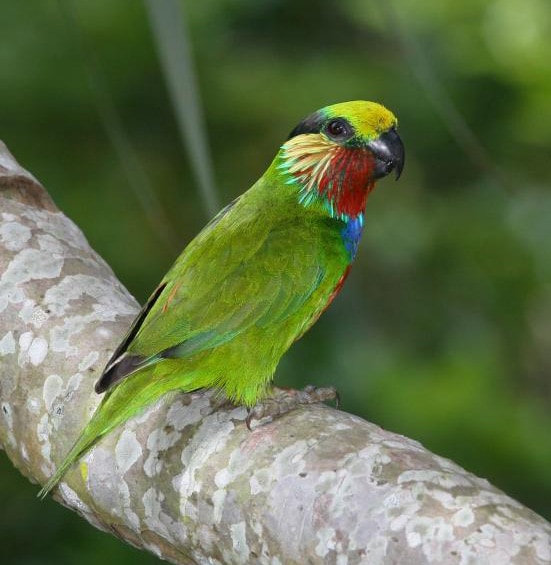
Fig Parrots
Australasia, New Guinea, Indonesia, Papua New Guinea, Australia
Tropical Rainforests, Subtropical Rainforests
Short, Wedge-Shaped Tails, Proportionately Large, Broad Bills
Figs, Other Fruits, Berries, Nectar, Pollen, Insects, Larvae
About Cyclopsittini
Fig Parrots
Fig parrots, scientifically classified under the tribe Cyclopsittini, represent a small group of Australasian parrots found primarily on and around the island of New Guinea. This tribe encompasses seven distinct species distributed across two genera, Cyclopsitta and Nannopsittacus, and is part of the larger Psittaculidae family. Their natural range extends to the territories of Indonesia, Papua New Guinea, and tropical Australia.
Physical Characteristics
These parrots are noted for their small, stocky build and arboreal lifestyle. They possess short, wedge-shaped tails and disproportionately large, broad bills, complemented by smooth tongues. A key characteristic of most fig parrot species is pronounced sexual dimorphism, where males and females exhibit visible differences in appearance, though Coxen's fig parrot (Cyclopsitta diopthalma coxeni) stands as an exception to this trait. Species within the genus Cyclopsitta are generally smaller than those found in Psittaculirostris.
Habitat and Diet
Fig parrots predominantly inhabit tropical and subtropical rainforests, though they can also be observed foraging in adjacent biomes. They are typically seen flying swiftly in straight lines, often at considerable heights above the tree canopy. Their diet is largely frugivorous, with a strong emphasis on figs, which gives them their common name. This diet is further supplemented by a variety of other fruits and berries, as well as nectar, pollen, insects, and larvae. Notably, fig parrots appear capable of identifying and targeting figs that have been implanted with developing fig wasps, likely to obtain their enhanced nutritional content. They demonstrate a remarkable ability to remember specific fruit trees and will repeatedly visit them over extended periods, spanning months and years.
Taxonomy and Relationships
The classification of fig parrots has evolved over time, with the group first proposed at family rank in 1891 as Cyclopsittacidae. This was subsequently downgraded to its current status as a tribe within the family Psittaculidae. Molecular phylogenetic studies suggest a close evolutionary relationship between fig parrots (Cyclopsittini) and other parrot groups such as budgerigars (Melopsittacini) and lories and lorikeets (Loriini), placing them together within the subfamily Loriinae. Further detailed research is ongoing to fully elucidate the relationships between the various tribes and within the genera Cyclopsitta and Psittaculirostris.
Source: Wikipedia ↗
Frequently Asked Questions
What is the scientific name for fig parrots?
The scientific name for the fig parrot group is Cyclopsittini. This tribe is part of the family Psittaculidae and comprises seven species across two genera: Cyclopsitta and Nannopsittacus.
Where are fig parrots found in the wild?
Fig parrots are found on and around the island of New Guinea. Their natural range extends to the territories of Indonesia, Papua New Guinea, and tropical Australia.
What do fig parrots eat?
The diet of fig parrots consists mainly of figs, which are their namesake. They also supplement their food intake with a variety of other fruits and berries, nectar, pollen, insects, and larvae. They are known to target figs that have been implanted with developing fig wasps for added nutrition.
Are fig parrots sexually dimorphic?
Sexual dimorphism is typically pronounced in fig parrots, meaning males and females have distinct visual differences. However, Coxen's fig parrot (Cyclopsitta diopthalma coxeni) is an exception to this general rule.
What kind of habitats do fig parrots prefer?
Fig parrots prefer tropical and subtropical rainforests as their natural habitat. They can also be observed foraging in biomes adjacent to these forests.
Related Parrot species

Alexandrine parakeet
The Alexandrine parakeet is a large, predominantly green parrot native to South and Southeast Asia, distinguished by its prominent red shoulder patch and massive red beak with yellow tips. Named in honor of Alexander the Great, who introduced these birds to Europe, they are known for their intelligence, vocal abilities, and long lifespan, making them popular in aviculture. Despite their established presence in some areas, they face conservation challenges due to habitat loss and illegal trade.

Australian king parrot
The Australian king parrot is a striking parrot species native to the humid, forested eastern regions of Australia. It is distinguished by the vibrant red plumage of the adult male, contrasting with the predominantly green female. These parrots are known for their relatively quiet nature and devotion to their human companions when kept as pets.

Baudin's black cockatoo
Baudin's black cockatoo is a species of parrot endemic to the southwest of Australia, named in honor of French explorer Nicolas Baudin. It is distinguished by its mostly greyish-black plumage, prominent white cheek patches, and a white tail band, with males and females exhibiting differences in beak color and eye-ring coloration.