
Eastern bluebonnet
The eastern bluebonnet is a medium-sized Australian parrot native to the interior of southeastern and central-southern Australia. It is characterized by its olive-grey to brown upper body, blue forehead and face, and a distinctive crest-like head feather arrangement. This species is adapted to semi-arid regions but can also thrive in areas with moderate rainfall.
Key Facts
- ›Medium-sized parrot found in inland southeastern and central-southern Australia.
- ›Features a predominantly olive-grey to brown body with a blue forehead and face.
- ›Possesses prominent crest-like head feathers.
- ›Inhabits arid and semi-arid zones, including open woodlands and grassy plains.
- ›Feeds primarily on seeds, but also consumes fruits, berries, insects, and nectar.
- ›Typically found in pairs or small social groups.

Greater Bluebonnet
Australia
Arid and Semi-Arid Zones, Open Woodlands, Grassy Plains, Scrub, Trees Bordering Watercourses, Mallee Remnants
Olive-Grey, Brown, Blue, Yellow, Red
Prominent Crest-Like Head Feathers, Blue Forehead and Face, Brownish-Orange Bill In Juveniles
Seeds, Fruit, Berries, Vegetable Matter, Flowers, Nectar, Insects and Larvae, Saltbush Seeds and Fruit
Noisy, Aggressive
Harsh 'Chack Chack' Call, Flute-Like 'Cloote' Call, Loud 'Yak-Yak-Yak' Call, Whistling Call Notes On the Wing
Hollow in the trunk or limb of a tree, Nest cavity with a small entrance hole, Lined with decaying wood dust
About Eastern bluebonnet
The eastern bluebonnet (Northiella haematogaster), also known as the greater bluebonnet, is a distinctive Australian parrot endemic to the interior of southeastern and central-southern Australia. Previously classified within the genus Psephotus, ornithologists Christidis and Boles reclassified it into its own genus, Northiella, in 1994, recognizing its unique physical and behavioral traits.
Habitat and Distribution
This medium-sized parrot is well-adapted to arid and semi-arid environments. Its range extends from northern Victoria and southern Queensland in the east to southeastern Western Australia in the west. They inhabit open woodlands dominated by various native trees, open grassy plains, scrub, and trees along watercourses. Remnant mallee areas in northern Victoria also serve as important habitats.
Physical Characteristics
The eastern bluebonnet typically measures between 26 and 35 cm in length, with males generally larger than females. Their plumage is predominantly olive-grey to brown on the upper body, foreneck, and breast. A striking blue coloration adorns the forehead and face, with the outerwing also being dark blue. A prominent crest-like arrangement of head feathers is a key distinguishing feature. The bill is pearl grey, and the eyes are brown-grey. Juvenile birds are duller than adults and have a characteristic brownish-orange bill that changes to pearl grey within two months of fledging.
Diet and Behavior
Eastern bluebonnets are primarily ground feeders, consuming seeds from native and introduced grasses, herbaceous plants, trees, and shrubs. Their diet is supplemented with fruit, berries, vegetable matter, flowers, nectar, and insects. They are known to be cautious when approaching water sources, typically drinking at dawn and dusk. Socially, they are usually found in pairs or small groups. Pairs separate for breeding and rejoin the flock with their young after the nesting season.
Breeding
The breeding season generally spans from August to January, though this can be influenced by rainfall. Eastern bluebonnets form monogamous pairs. Nests are typically located in tree hollows, with the entrance hole size being a significant factor. The nest cavity is lined with decaying wood dust. A clutch usually consists of four to seven white, oval eggs. Incubation lasts approximately 19 days, with the female undertaking the incubation while being fed by the male. Chicks hatch covered in white down and fledge around 30 days old, remaining dependent on their parents for about 12 days post-fledging.
Aviculture
While moderately common in the wild, the eastern bluebonnet is less frequently kept in captivity. They are often regarded by aviculturists as being drab, noisy, aggressive, and challenging breeders.
Source: Wikipedia ↗
Frequently Asked Questions
What is the scientific name of the eastern bluebonnet?
The scientific name of the eastern bluebonnet is Northiella haematogaster. It was previously included in the genus Psephotus but was reclassified into its own genus, Northiella, due to significant physical and behavioral differences.
Where does the eastern bluebonnet live?
Eastern bluebonnets are found in the interior of southeastern and central-southern Australia. Their range extends from northern Victoria to southern Queensland in the east, and across to southeastern Western Australia in the west.
What are the main physical characteristics of the eastern bluebonnet?
They are medium-sized parrots with an olive-grey to brown upper body, foreneck, and breast. Notable features include a blue forehead and face, dark blue outerwing, and prominent crest-like head feathers. Their bill is pearl grey, and their eyes are brown-grey.
What do eastern bluebonnets eat?
Their diet consists mainly of seeds from native and introduced grasses, as well as herbaceous plants, trees, and shrubs. They also forage for fruit, berries, vegetable matter, flowers, nectar, insects, and larvae. They are cautious when approaching water sources to drink, usually at dawn and dusk.
How do eastern bluebonnets behave socially?
Eastern bluebonnets are usually observed in pairs or small groups of under ten birds. Pairs separate to breed in late winter and rejoin the flock with their young in late spring. When startled, they will fly to a nearby tree, fall silent, and adopt an erect posture to assess the situation before returning to the ground.
What is the breeding behavior of the eastern bluebonnet?
Breeding typically occurs between August and January, influenced by rainfall. They form monogamous pairs. The female incubates the eggs, which are laid on decaying wood dust in tree hollows. Both parents feed the chicks, which fledge around 30 days old and remain dependent for about 12 days after fledging.
Are eastern bluebonnets common in captivity?
Eastern bluebonnets are moderately common in the wild but not as common in captivity. They are often perceived as drab, noisy, aggressive, and not particularly good breeders in aviculture.
Related Parrot species

Naretha bluebonnet
The Naretha bluebonnet (Northiella narethae) is a bird species native to a remote, arid region of Australia, specifically the border area of Western and South Australia. It is distinguished by its unique call notes, characteristic jerky bobbing movements, and plumage where the male and female coloration is similar, unlike the pronounced sexual dimorphism seen in related genera.

Blue-crowned racket-tail
The blue-crowned racket-tail is a species of parrot endemic to the Philippines, found in various islands including Luzon, Mindanao, and Visayas. It inhabits tropical moist lowland forests and is distinguished by the amount and placement of blue on its head. While not currently endangered, its population is declining due to habitat loss and the pet trade, leading to legal protections under Philippine law.
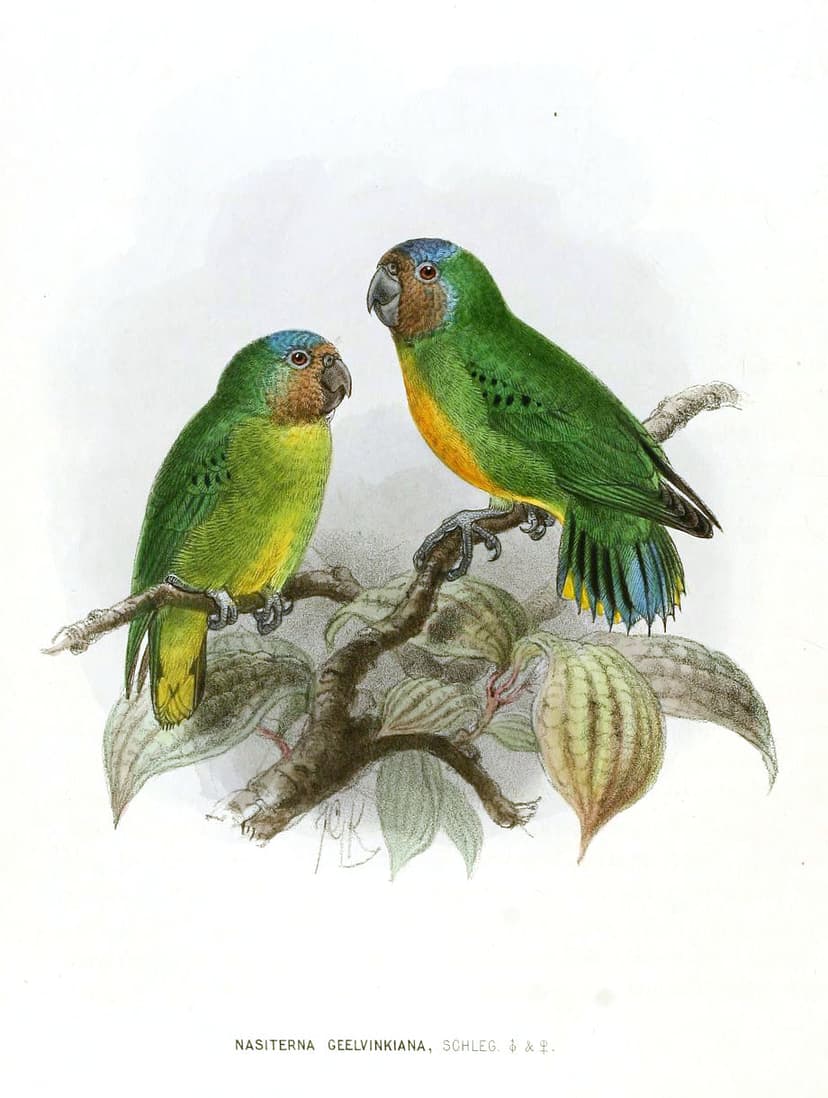
Geelvink pygmy parrot
The Geelvink pygmy parrot is a small parrot species found exclusively on Biak and Numfoor islands in Western New Guinea. Its distinctive plumage includes a brown head, blue crown, yellow breast, green body, and blue tail, with red eyes. The species is threatened by habitat loss in its natural lowland forest and garden environments.