
Ground parrot
The ground parrot (Pezoporus wallicus) is a distinctive parrot species endemic to Australia, notable for being one of the few parrots that live primarily on the ground. Its grass-green plumage, marked with black and yellow barring, provides camouflage in its heathland and sedgeland habitats. The species is often identified by its unique whistling call, as it tends to fly low and swiftly when disturbed.
Key Facts
- ›Endemic to Australia, with three recognized subspecies: eastern, western (Kyloring), and Tasmanian.
- ›Characterized by grass-green plumage with black and yellow barring, pale yellow wing bars, and a red band above the cere.
- ›One of only four ground-dwelling parrot species globally.
- ›Nests on the ground under dense vegetation, unlike most parrots that use tree hollows.
- ›Its presence is often detected by its distinctive whistling call at dusk and dawn.
- ›The western subspecies (P. w. flaviventris) is critically endangered, with fewer than 150 individuals remaining in the wild.
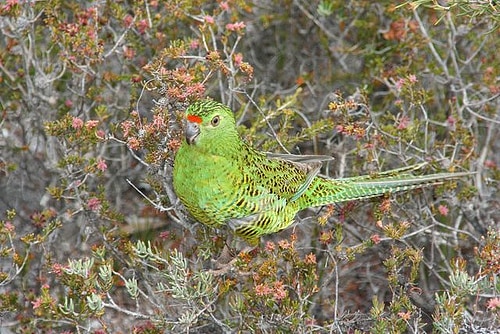
Kyloring
Australia
Coastal Heathland, Sedge Land, Dry Heathland, Swampy Heathland
Grass Green, Yellowish Green, Black, Pale Yellow
- Grass green plumage with darker barring
- Pale-yellow wing bars
- Black and yellow barring on abdomen, thighs, and under-tail coverts
- Bright red band above the cere
- Ground-dwelling habit
- Characteristic whistling call at dusk and dawn
- Call is a clear whistling sequence of notes that rise in pitch before fading
- Silent in flight
- Nests on the ground under dense low vegetation
- Nest is a shallow depression in dry, well-drained earth lined with leaves and stems
About Ground parrot
The ground parrot, scientifically known as Pezoporus wallicus, is a unique parrot species endemic to Australia. It is distinguished by its ground-dwelling lifestyle, a trait shared by only a few other parrot species worldwide, including its close relative, the night parrot. The ground parrot's plumage is predominantly grass green, providing excellent camouflage within its natural habitat. This coloration is further enhanced by black streaking on the head and hindneck, pale-yellow wing bars, and distinct black and yellow barring on its abdomen, thighs, and under-tail coverts. A notable feature is the bright red band located above its cere.
Distribution and Habitat
This species is found across various parts of Australia, with its distribution divided among three recognized subspecies. The eastern ground parrot (P. w. wallicus) inhabits fragmented coastal regions of southeastern Queensland, New South Wales, and Victoria. The western ground parrot, also known as Kyloring by the indigenous Noongar people (P. w. flaviventris), is restricted to two isolated populations in southern Western Australia. The Tasmanian ground parrot (P. w. leachi) is endemic to Tasmania and represents the largest population of the species.
Ground parrots typically inhabit dry or moist coastal heathlands and sedgelands characterized by dense foliage cover and an abundance of favored food plants. The western subspecies, in particular, prefers low, dry or swampy heathlands near the coast that have experienced long periods without burning.
Behavior and Breeding
The presence of a ground parrot is often revealed by its distinctive vocalization, a clear whistling sequence of notes that rises in pitch before fading, typically heard at dusk and dawn. When disturbed, these parrots fly swiftly just above the ground before quickly dropping back into the vegetation, and they are silent in flight. Unlike most Australian parrots that nest in tree hollows, the ground parrot constructs its nest on the ground. The nest is a shallow depression lined with leaves and stems, hidden beneath low, dense vegetation such as sedges, ferns, and shrubs.
The breeding season generally spans from July to December, though eggs have been observed as late as March. The female incubates a clutch of typically 3-4 glossy white, oval-shaped eggs for 21-24 days. If a clutch fails, a second may be laid. The male provides food for the brooding female and the young. After approximately 20-28 days, the chicks fledge and remain near the nest and their father for at least three weeks.
Conservation
While the ground parrot species as a whole is listed as 'Least Concern' by the IUCN due to its wide distribution and overall population size, some subspecies face significant threats. The western ground parrot (P. w. flaviventris) is critically endangered, with an estimated fewer than 150 individuals remaining in the wild, making it one of Australia's rarest parrots. The eastern ground parrot (P. w. wallicus) is listed as 'Vulnerable' in New South Wales and Queensland and 'Endangered' in South Australia, where it is locally extinct. The species is also listed in Appendix I by CITES, indicating its international importance for conservation.
Source: Wikipedia ↗
Frequently Asked Questions
What makes the ground parrot unique among parrots?
The ground parrot is unique because it is one of only four parrot species in the world that lives primarily on the ground. Unlike most parrots, it nests on the ground rather than in tree hollows.
What is the scientific name for the ground parrot?
The scientific name for the ground parrot is Pezoporus wallicus. The genus name 'Pezoporus' comes from Ancient Greek words meaning 'walking, going on foot'.
What are the different subspecies of ground parrot?
There are three recognized subspecies: the eastern ground parrot (P. w. wallicus), the western ground parrot or Kyloring (P. w. flaviventris), and the Tasmanian ground parrot (P. w. leachi).
Where are ground parrots found?
Ground parrots are endemic to Australia. The eastern subspecies is found in coastal areas of southeastern Queensland, New South Wales, and Victoria. The western subspecies inhabits heathlands in southern Western Australia, and the Tasmanian subspecies is found in Tasmania.
What is the conservation status of the ground parrot?
While the species as a whole is listed as 'Least Concern' on the IUCN Red List, the western subspecies (P. w. flaviventris) is 'Critically Endangered' with fewer than 150 individuals. The eastern subspecies is listed as 'Vulnerable' in New South Wales and Queensland, and 'Endangered' in South Australia.
How can you tell if you have seen a ground parrot?
Ground parrots are often heard before they are seen, emitting a characteristic clear whistling sequence of notes at dusk and dawn. When disturbed, they fly swiftly just above the ground before dropping back into cover.
Related Parrot species

Northern rosella
The northern rosella (Platycercus venustus) is a parrot species native to northern Australia, recognized for its distinctive dark head and neck contrasted with pale cheeks. This species inhabits woodland and open savanna, feeding primarily on seeds, flowers, and berries, and occasionally insects. It is known for being shyer and quieter than other rosellas.

Night parrot
The Night Parrot (Pezoporus occidentalis) is a small, critically endangered parrot endemic to Australia, renowned for its extreme elusiveness. Its predominantly yellowish-green plumage, mottled with darker colors, and short tail distinguish it from similar ground parrots. Historically, confirmed sightings were rare, leading to fears of extinction until renewed, though still infrequent, evidence emerged in the late 20th and early 21st centuries.
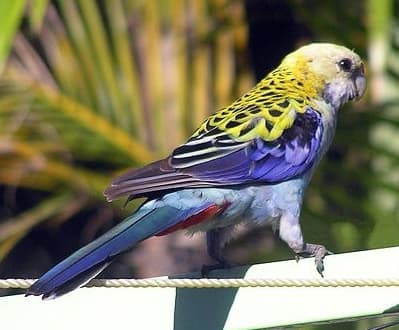
Pale-headed rosella
The pale-headed rosella is a moderately sized parrot native to northeastern Australia, characterized by its pale yellow head, white cheeks, scalloped black and gold back, and pale blue underparts. It inhabits open woodlands and feeds on seeds and fruits, nesting in tree hollows. This species readily adapts to aviculture and is a popular cagebird.