
Orange-fronted hanging parrot
The Orange-fronted hanging parrot is a small parrot species endemic to the forests of New Guinea and nearby islands. It is characterized by its predominantly green plumage, with distinct color differences between males and females on their forecrowns and cheeks, and both sexes featuring a red throat patch and rump. This species is notable for its small size and specific geographic distribution.
Key Facts
- ›Small parrot species found in New Guinea and adjacent islands.
- ›Males have a golden yellow forecrown, while females have a blue-green forecrown.
- ›Both sexes exhibit a red throat patch and red rump with yellow on the sides.
- ›Measures approximately 10 cm in length.
- ›Weighs between 14-16 grams.
- ›Sexually dimorphic, with visible differences between males and females.

Papuan Hanging Parrot
New Guinea
Forest
Golden Yellow Forecrown, Blue-Green Forecrown and Cheeks, Red Throat Patch, Red Rump With Yellow Sides
About Orange-fronted hanging parrot
The Orange-fronted hanging parrot, scientifically known as Loriculus aurantiifrons, is a small species of parrot belonging to the family Psittaculidae. This bird is endemic to the forested regions of New Guinea and its surrounding smaller islands. It is sometimes considered to include the Bismarck hanging parrot as a subspecies.
Description and Characteristics
Individuals of the Orange-fronted hanging parrot are small, typically measuring 10 cm (4 inches) in length and weighing between 14 and 16 grams. The species exhibits sexual dimorphism, meaning there are visible differences between males and females. Both sexes are predominantly green in coloration. However, males are distinguished by a golden yellow forecrown, while females have a blue-green forecrown and blue-green cheeks. Both the male and female birds share a red throat patch and a red rump, with yellow markings present on the sides of the rump.
Distribution and Habitat
The natural range of the Orange-fronted hanging parrot is confined to the forests of New Guinea and adjacent islands. This restricted geographic distribution makes it an endemic species to this region. Its habitat consists of forest ecosystems where it likely forages and roosts.
Source: Wikipedia ↗
Frequently Asked Questions
What is the scientific name of the Orange-fronted hanging parrot?
The scientific name of the Orange-fronted hanging parrot is Loriculus aurantiifrons. This binomial name is used to classify the species within the scientific community.
Where is the Orange-fronted hanging parrot found?
The Orange-fronted hanging parrot is endemic to the forests of New Guinea and its adjacent smaller islands. Its natural habitat is restricted to these specific geographic regions.
What are the main physical differences between male and female Orange-fronted hanging parrots?
The Orange-fronted hanging parrot is sexually dimorphic. Males possess a golden yellow forecrown, whereas females have a blue-green forecrown and blue-green cheeks.
What is the typical size and weight of an Orange-fronted hanging parrot?
Individuals of the Orange-fronted hanging parrot typically measure around 10 cm in length. Their weight generally falls between 14 and 16 grams.
What are the distinctive color markings of the Orange-fronted hanging parrot?
Both male and female Orange-fronted hanging parrots share a red throat patch and a red rump, with yellow coloration on the sides of the rump. The primary difference lies in the forecrown and cheek coloration, which varies between the sexes.
Related Parrot species
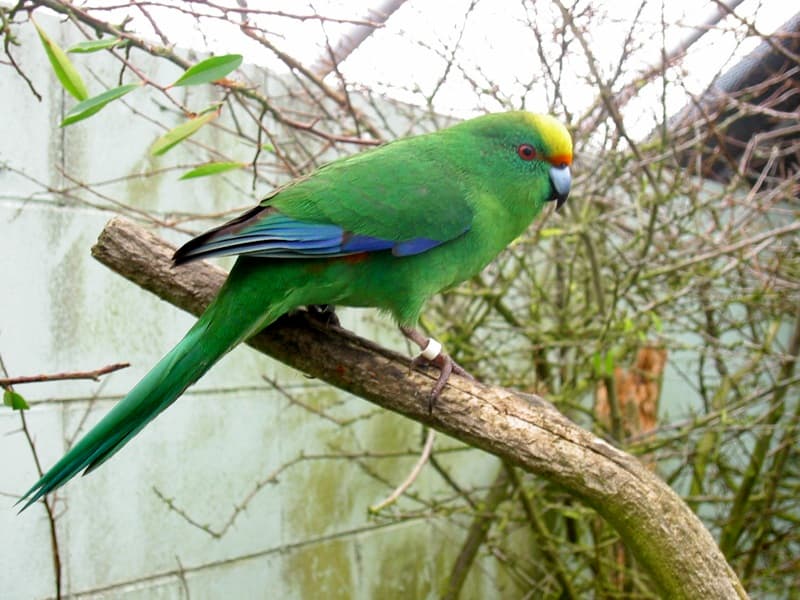
Malherbe's parakeet
Malherbe's parakeet, also known as the orange-fronted parakeet, is a small parrot endemic to New Zealand's South Island. It is distinguished by a vibrant orange frontal band and a lemon-yellow crown, though these are absent in juveniles. This species is critically endangered due to habitat loss and predation by introduced mammals, leading to extensive conservation efforts including translocations to predator-free islands.

Fischer's lovebird
Fischer's lovebird is a small parrot species native to a limited area of east-central Africa, south and southeast of Lake Victoria. Named after German explorer Gustav Fischer, this species is distinguished by its vibrant plumage, featuring a green body, yellow neck, orange chest, and a striking red beak. They are known for their strong pair bonds and are popular in aviculture, though they require specialized care.

Golden-plumed parakeet
The golden-plumed parakeet is a Neotropical parrot species native to the humid temperate highland forests of the Andes in Colombia, Ecuador, and Peru. It is distinguished by its bright green plumage, orange-yellow lores, small golden crests behind the eyes, and a unique ability among parakeets to detect ultraviolet radiation. This species is generally uncommon and faces significant threats from habitat loss due to agricultural expansion.