
Pileated parrot
The South American pileated parrot (Pionopsitta pileata) is a species of bird found in Argentina, Brazil, and Paraguay. It is distinguished by its predominantly green plumage, with males displaying a striking red cap and females having a subtle blue wash on the forehead and breast. This parrot primarily inhabits humid forests but can also be found in more open woodlands.
Key Facts
- ›Found in southeastern Brazil, eastern Paraguay, and Argentina's Misiones Province.
- ›Adults are primarily green with a yellowish abdomen and blue on their wings and tail.
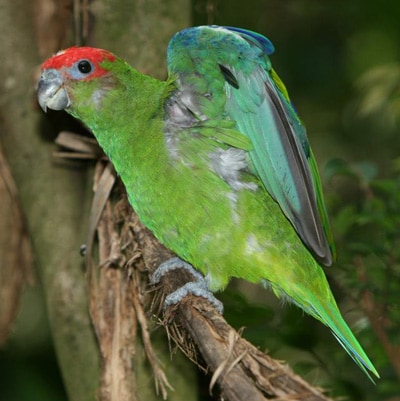
- ›Males have a distinctive red forehead, crown, lores, and upper ear coverts.
- ›In the wild, they nest in tree cavities and lay clutches of approximately two eggs.
- ›Vocalizations include high, piercing shrieks and a distinct flight call.
- ›Assessed by the IUCN as Least Concern, though its population is believed to be decreasing.
Red-Capped Parrot
South America
Humid Forest, Open Forest, Dry Forest, Partially Cleared Landscapes
Red Cap In Males, Blue Wing and Tail Edges, Yellowish Abdomen
Fruits, Seeds, Eucalyptus Bark
High, Piercing Shrieks, 'TjeéReweéT' Call, High 'Tjer-Tjer'Tjer-' Flight Call
Nests In Holes In Trees
About Pileated parrot
The Pileated Parrot
The pileated parrot (Pionopsitta pileata) is a species of bird native to South America, specifically found in parts of Brazil, Paraguay, and Argentina. It belongs to the family Psittacidae, which encompasses African and New World parrots. Historically, it was also known as the red-capped parrot, a name that could cause confusion with an Australian species.
Description and Identification
Adult pileated parrots typically measure between 20 to 22 cm in length and weigh between 98 to 120 grams. Their plumage is predominantly green, with a yellowish abdomen. Notable blue coloration appears on their primaries, primary coverts, and the edges and tips of their tail feathers. The most striking difference between the sexes is seen in adult males, which possess a vibrant red coloration on their forehead, crown, lores, and upper ear coverts. Females, by contrast, lack this red and instead exhibit a subtle blue wash on their forehead and breast. Immature males have a less extensive red marking on the head, while immature females have reduced blue coloration on their wings.
Distribution and Habitat
This species is distributed across southeastern Brazil, from Bahia southward, extending into eastern Paraguay and Argentina's Misiones Province. Its preferred habitat is humid forest, though it can also be found in more open, drier woodlands, particularly those dominated by Araucaria trees, and in partially cleared landscapes. The pileated parrot inhabits elevations ranging from sea level up to 1,500 meters (4,900 feet).
Behavior and Ecology
Observations suggest that the pileated parrot engages in some migratory movements between inland and coastal areas, and it has been described as "strikingly nomadic" in certain regions of Brazil. While detailed information about its diet is limited, it is known to consume fruits and seeds from various plant families, as well as Eucalyptus bark. The breeding season is not fully defined but appears to include November. They nest in tree cavities. In the wild, clutches typically consist of two eggs. Captive breeding records indicate clutches of three to four eggs, with incubation by the female alone lasting approximately 24 days and fledging occurring 52 to 54 days after hatching. Vocalizations are characterized by high, piercing shrieks, such as 'tjeéreweét,' and their flight call is a high 'tjer-tjer'tjer- -.'
Conservation Status
The pileated parrot is currently assessed by the IUCN as Least Concern. Despite possessing a relatively large range, its population size remains unknown and is believed to be decreasing. Although no immediate threats have been specifically identified, extensive habitat loss throughout its range is noted as a significant factor affecting its numbers, though the species continues to persist where suitable cover remains.
Source: Wikipedia ↗
Frequently Asked Questions
What are the primary colors of the pileated parrot's plumage?
Adult pileated parrots have an essentially all-green body with a yellowish abdomen. Their primaries, primary coverts, and the edges and tips of their tail feathers are a dull blue. Males are further distinguished by a red forehead, crown, lores, and upper ear coverts.
Where is the pileated parrot naturally found?
The pileated parrot is found in southeastern Brazil, extending south from Bahia, and into eastern Paraguay and Argentina's Misiones Province. Its habitat primarily consists of humid forests, but it can also be observed in somewhat more open and drier forests.
What is the typical size and weight of a pileated parrot?
Pileated parrots measure between 20 to 22 cm (7.9 to 8.7 inches) in length. Their weight typically ranges from 98 to 120 g (3.5 to 4.2 oz).
What is known about the pileated parrot's diet and feeding habits?
Little is precisely known about the pileated parrot's feeding behavior. However, it is documented to feed on fruits and seeds from various plant families, and it also consumes Eucalyptus bark.
What is the conservation status of the pileated parrot?
The International Union for Conservation of Nature (IUCN) has assessed the pileated parrot as Least Concern. Despite this, its population size is not precisely known and is believed to be declining, with habitat loss being a significant factor.
How does the pileated parrot's appearance differ between males and females?
Adult males possess a distinct red coloration on their forehead, crown, lores, and upper ear coverts. Females lack this red coloring and instead have a faint blue wash on their forehead and breast. Immature males show less red, and immature females exhibit less blue on their wings.
Related Parrot species

Blue-fronted amazon
The blue-fronted amazon, also known as the blue-fronted parrot or turquoise-fronted amazon, is a South American species of parrot recognized for the distinctive blue or turquoise marking above its beak. It is one of the most commonly kept amazon parrots as a pet. This species exhibits significant individual variation in plumage color, particularly in the amount of yellow and red on its head and wings.

Blue-fronted parrotlet
The blue-fronted parrotlet is a small bird found in the cloud forests and mature secondary forests of Colombia, Ecuador, Panama, and Venezuela. Characterized by its predominantly green plumage, it is distinguished by a vibrant blue forehead, a white eye ring, and red markings on its wings. These birds are known for their gregarious nature and can be quite noisy in flight, though they are often overlooked due to their quiet feeding habits.

Green rosella
The Green rosella (Platycercus caledonicus), also known as the Tasmanian rosella, is the largest species in the rosella genus and is native to Tasmania and the Bass Strait islands. It is distinguished by its predominantly yellow head and underparts, violet-blue cheeks, and a red band above its beak. This parrot inhabits a variety of wooded environments and is primarily herbivorous, feeding on seeds, fruits, and flowers.