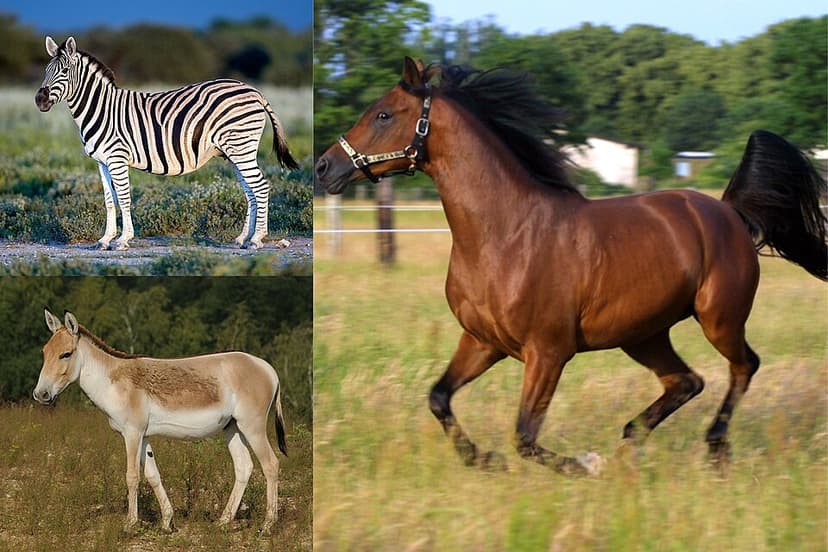
Equidae
Herbivore (browsers on soft plants, later adapted for grinding grasses and tough plant food)·Not applicable to the family; conservation status applies to individual species within the genus Equus.·Perissodactyla·Equus
Equidae, commonly known as the horse family, encompasses horses, asses, zebras, and numerous extinct relatives. This family originated in North America over 50 million years ago, evolving from small, multi-toed ungulates into larger, single-toed animals. All currently existing species belong to the genus Equus, and the family is part of the order Perissodactyla.
Key Facts
- ›The horse family, Equidae, originated in North America over 50 million years ago.
- ›Early equids were fox-sized with multiple toes, evolving to have single-toed feet and teeth adapted for grinding grasses.
- ›Equidae belongs to the order Perissodactyla, which also includes tapirs and rhinoceros.
- ›All living species of Equidae are found within the genus Equus.
- ›Equids are hindgut fermenters, meaning they have specialized digestive systems for processing fibrous plant matter.

Horse Family, Equids, Equines
- Evolved From Small, Multi-Toed Ungulates To Larger, Single-Toed Animals.
- Developed Specialized Teeth For Grinding Grasses and Tough Plant Matter.
- Possess A Body Shape Similar To Modern Horses.
Grasslands, Savannas, Woodlands
North America, Worldwide
Evolution From Multiple Toes To A Single Toe., Hindgut Fermentation Digestive System.
About Equidae
Equidae: The Horse Family
Equidae, commonly known as the horse family, represents a significant group within the odd-toed ungulates (order Perissodactyla). This family includes not only horses but also asses and zebras, along with a rich history of extinct species known primarily from fossil evidence. The evolutionary journey of Equidae began in North America over 50 million years ago, during the Eocene epoch. These early ancestors were small, multi-toed mammals that gradually transformed into the larger, single-toed animals characteristic of the family today.
Evolution and Adaptation
The oldest known equid fossils, dating back to approximately 54 million years ago, reveal small, fox-sized animals with multiple toes on their feet. These early equids were herbivorous browsers, adapted for running and possessing complex brains that suggest alertness and intelligence. Over time, subsequent species within the family saw a reduction in the number of toes, culminating in the single-toed structure seen in modern equids. Concurrently, their teeth evolved to become more efficient at grinding tough plant matter, such as grasses. This adaptation is crucial for their survival as hindgut fermenters, a specialized digestive strategy that allows them to extract nutrients from fibrous diets.
Classification and Modern Diversity
Equidae is classified within the order Perissodactyla, which also includes tapirs and rhinoceroses. The family itself has seen considerable diversification, particularly during the Miocene epoch, with many species developing the typical horse-like body shape. The sole surviving genus within Equidae is Equus, which emerged in the early Pleistocene epoch and rapidly spread across the globe. All extant species—horses, asses, and zebras—belong to this genus. While many species within Equidae have become domesticated and are found worldwide, their evolutionary origins are firmly rooted in the ancient landscapes of North America.
Source: Wikipedia ↗
Frequently Asked Questions
When did the Equidae family first appear?
The earliest known fossils assigned to the Equidae family date back to the early Eocene epoch, approximately 54 million years ago. These ancient ancestors were discovered in North America.
How did early equids differ from modern horses?
Early equids were much smaller, comparable in size to a fox, and possessed multiple toes on both their front and hind feet. They were browsers, feeding on softer plants, and already showed adaptations for running.
What is the evolutionary trend within the Equidae family?
Over millions of years, equids evolved from smaller, multi-toed animals to larger, single-toed species. Their teeth also adapted for grinding tougher plant materials like grasses, and their body shape became more horse-like.
What is the digestive strategy of equids?
Equids are hindgut fermenters, a digestive strategy that allows them to process fibrous plant diets. This adaptation is linked to their evolutionary development as relatively large mammals.
What other animals are in the order Perissodactyla?
The order Perissodactyla, to which Equidae belongs, includes four species of tapir and five species of rhinoceros. It also encompasses several extinct families.
What is the significance of the genus Equus?
The genus Equus is significant because it contains all extant species within the Equidae family, including horses, asses, and zebras. This genus evolved by the early Pleistocene epoch and spread globally.