
Arctocebus
Lorisidae·Africa·Not Specified·Nigeria, Cameroon north of the Democratic Republic of Congo
Angwantibos, also known as golden pottos, are two species of strepsirrhine primates found in tropical Africa. They are characterized by their golden coloration, pointed snouts, and slow, deliberate movements, distinguishing them from other lorids.
Key Facts
- ›Found in tropical Africa, including Nigeria and Cameroon.
- ›Arboreal primates that inhabit the underbrush and lower forest layers.
- ›Primarily insectivorous, with a diet consisting mainly of insects and occasional fruits.
- ›Solitary and nocturnal animals.
- ›Exhibit slow, deliberate movements, typical of lorisids.
- ›Birth a single offspring after a gestation period of 130 days.

Tropical Forest Underbrush, Lower Forest Layers
Insectivore, Frugivore
Arboreal, Quadrupedal
Yellow Or Golden Coloration, Almost No Tail, Pointed Snout, Round Ears, Bear-Like Appearance
About Arctocebus
What is an Angwantibo?
Angwantibos, also referred to as golden pottos, are a genus of strepsirrhine primates comprising two species within the Lorisidae family. These primates are native to the tropical regions of Africa, with their distribution including countries such as Nigeria and Cameroon, extending north of the Democratic Republic of Congo.
Physical Characteristics and Habitat
Angwantibos are relatively small primates, growing to a size between 22 to 30 cm and weighing up to 0.5 kg. They are easily recognizable by their yellow-brown to golden fur, a pointed snout, and round ears, which collectively give them a bear-like appearance. Unlike many other primates, they possess almost no tail. They are solitary, nocturnal, and arboreal, preferring to inhabit the underbrush and lower layers of the forest, spending their daylight hours concealed within vegetation.
Diet and Behavior
Their diet consists primarily of insects, with caterpillars being a common food source, supplemented occasionally by fruits. Angwantibos are known for their slow, deliberate movements, which they employ to stealthily approach their prey. This careful stalking, combined with a good sense of smell, allows them to efficiently catch insects with quick, precise actions. Their locomotion is characterized by slow, steady movements, typical of other lorisids.
Reproduction and Lifespan
Mating behavior involves males mating with any available females whose territories overlap with theirs. Copulation occurs while hanging onto a branch. The gestation period lasts approximately 130 days, after which a single offspring is born. The young primate initially clings to its mother's belly and is later parked on a branch while the mother forages. Weaning occurs within three to four months, and the young leave their mother at around six months of age, reaching full maturity between eight and ten months. The maximum life expectancy for angwantibos is estimated to be 13 years.
Source: Wikipedia ↗
Frequently Asked Questions
What are angwantibos?
Angwantibos are two species of strepsirrhine primates belonging to the genus Arctocebus, also known as golden pottos due to their golden fur. They are native to tropical Africa.
Where do angwantibos live?
Their range extends across tropical Africa, including countries such as Nigeria and Cameroon, and areas north of the Democratic Republic of Congo.
What do angwantibos eat?
The diet of angwantibos consists predominantly of insects, particularly caterpillars, with fruits occasionally supplementing their food intake.
How do angwantibos move?
Angwantibos are characterized by slow, deliberate movements, which they use to stalk their insect prey. They are arboreal and prefer to stay in the underbrush and lower forest layers.
What is the social behavior of angwantibos?
Angwantibos are solitary animals. Males will mate with all available females whose territories overlap with their own.
How long is the gestation period for angwantibos?
The gestation period for angwantibos lasts for 130 days, and they typically give birth to a single offspring.
Related Primate species
Aotus
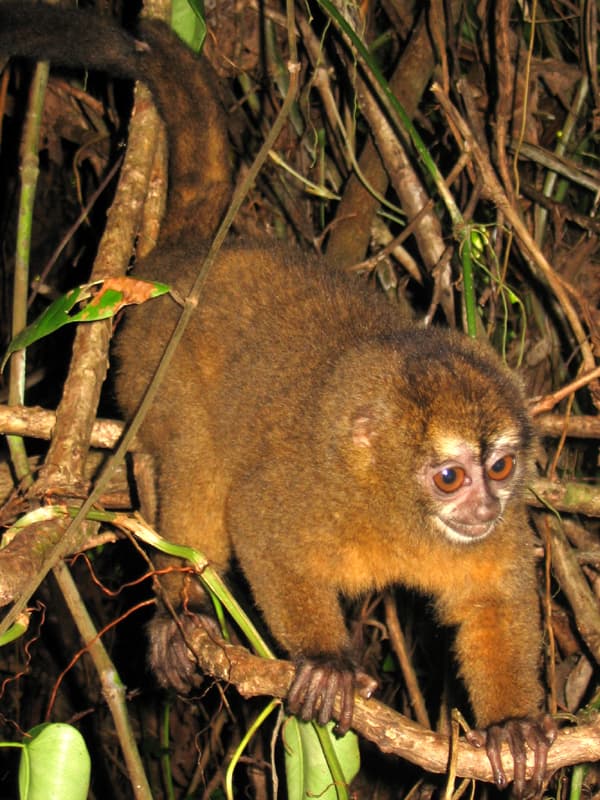
Night monkeys, also known as owl monkeys or douroucoulis, are the sole living members of the Aotidae family and are distinguished as the only truly nocturnal monkeys. Found across Panama and South America, these primates inhabit various forest types and are characterized by their large eyes adapted for low-light vision. They live in small family groups and are known for their complex vocalizations and social monogamy.

Archaeolemur edwardsi
Archaeolemur edwardsi is an extinct species of subfossil lemur that once inhabited Madagascar. As one of the most common extinct giant lemurs, it is distinguished by its large size, approximately 18.2–26.5 kg, and was likely the most frugivorous and terrestrial of Madagascar's fossil primates. Colloquially referred to as a "monkey lemur," its morphology exhibited convergences with anthropoids, leading to early misidentification.

Allenopithecus
Allen's swamp monkey (Allenopithecus nigroviridis) is the sole member of its genus, distinguished by its stocky build and adaptations for both arboreal and terrestrial life, including webbed fingers. Native to the Congo Basin, this diurnal primate inhabits swampy environments and is known for its swimming ability.