
Lepus
Hares, belonging to the genus Lepus, are herbivorous mammals found across Africa, Eurasia, and North America. They are distinguished from rabbits by their generally larger size, longer ears, more prominent eyes, and powerful hind legs, and are known for their speed and solitary nature. Unlike rabbits, hares are not domesticated and their young are born precocial, able to fend for themselves shortly after birth.
Key Facts
- ›Hares are herbivores that typically live solitarily or in pairs.
- ›They nest in shallow depressions on the ground called forms.
- ›Young hares are born fully furred and with eyes open, capable of fending for themselves soon after birth.
- ›Hares are characterized by their speed, with some species reaching up to 80 km/h (50 mph).
- ›They have large ears that help dissipate body heat.
- ›Hares are not domesticated, unlike rabbits.

Generally Larger Than Rabbits, Large Ears That Dissipate Body Heat, Large Eyes, Long, Powerful Hind Legs, Fully Furred At Birth, Eyes Open At Birth
- Herbivorous
- Typically Live Solitarily Or In Pairs
- Nest In Depressions On the Ground Called Forms
- Fast Runners
- Can Be Shy
- May Exhibit Chasing Behavior In Spring For Breeding Competition
- Young Are Precocial
About Lepus
The Genus Lepus: True Hares
Hares, belonging to the genus Lepus, are a distinct group of herbivorous mammals found across Africa, Eurasia, and North America. They are characterized by their generally larger size compared to rabbits, featuring prominent ears that aid in dissipating body heat, large eyes, and powerful hind legs that enable them to be swift runners. A defining characteristic of hares is their solitary or paired lifestyle, and they typically nest in simple depressions on the ground known as forms, rather than in elaborate burrows.
Biology and Reproduction
Unlike rabbits, hares are not domesticated. Their young, called leverets, are born precocial – fully furred and with their eyes open – allowing them to fend for themselves shortly after birth. This adaptation is crucial as they do not have the protection of underground burrows. Hares are known for their speed, with some species capable of reaching speeds up to 80 km/h (50 mph) over short distances. Their diet consists of vegetation, and like other lagomorphs, they practice cecotrophy, re-ingesting specialized droppings (cecotropes) to extract additional nutrients.
Habitat and Adaptability
Hares exhibit remarkable adaptability, inhabiting a diverse range of environments from arid deserts and arctic tundra to temperate grasslands, forests, swamps, mountains, and tropical regions. This adaptability has, in some cases, led to certain hare species becoming invasive when introduced to new areas. Their physical traits, such as coat color changes in some species like the snowshoe hare, aid in camouflage and survival across different seasons and terrains.
Source: Wikipedia ↗
Frequently Asked Questions
What is the genus for hares?
Hares belong to the genus Lepus. This genus is what distinguishes them as true hares, differentiating them from other members of the Leporidae family which include rabbits.
What do hares eat?
Hares are herbivores. They process easily digestible food in their gastrointestinal tract. For harder-to-extract nutrients, they ferment fiber in their cecum and re-ingest the resulting cecotropes to absorb the nutrients.
Where do hares live?
Hare species are native to Africa, Eurasia, and North America. They can be found in a wide variety of habitats, including deserts, arctic tundra, temperate grasslands, forests, swamps, mountains, and tropical regions.
How are hares different from rabbits?
Hares are generally larger than rabbits and possess exaggerated features like large ears, eyes, and hind feet. Additionally, hares have 48 chromosomes, while rabbits have a varying number. Unlike rabbits, no hares have been domesticated.
What is a young hare called?
A hare less than one year old is called a leveret. Young hares are born precocial, meaning they are born fully furred and with their eyes open, allowing them to be independent shortly after birth.
Are hares social animals?
Hares typically live solitarily or in pairs. While European brown hares may exhibit chasing behavior in spring, this is generally related to competition for breeding rather than forming long-term social groups.
Related Rabbits, Hares & Pikas

Pronolagus
Pronolagus, commonly known as red rock hares, are a genus of lagomorphs found in rocky habitats across Africa. They are characterized by their reddish-brown or dark brown coloration, short ears, and a lack of an interparietal bone. All four extant species are classified by the IUCN as least concern, though habitat loss poses a threat.
Bunolagus
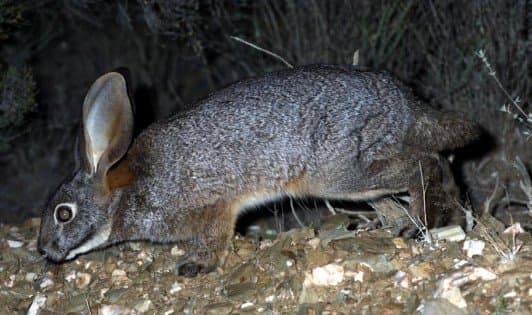
The riverine rabbit (Bunolagus monticularis), also known as the bushman rabbit, is a critically endangered species found in the Karoo region of South Africa. It is distinguished by its unique dark brown facial stripe, a white ring around its eyes, and its habit of digging its own burrows, a trait unusual for rabbits in Africa.