
Bolitoglossa chinanteca
Bolitoglossa chinanteca·Plethodontidae·Males: 33–41 mm SVL; Females: 28–43 mm SVL
The Chinanteca salamander (Bolitoglossa chinanteca) is a species of lungless salamander endemic to the cloud forests of Oaxaca, Mexico. It is distinguished by its relatively small size, with males reaching up to 41 mm and females up to 43 mm in snout-to-vent length. This species is presumed to be arboreal and can be found in the axils of banana plants during the day.
Key Facts
- ›Endemic to the Sierra Mixe and Sierra Juárez of Oaxaca, Mexico.
- ›Inhabits cloud forests at elevations between 670 and 1,500 meters.
- ›Males typically measure 33–41 MM snout-to-vent length, while females range from 28–43 MM.
- ›Often found in the axils of banana plants during daylight hours.
- ›Presumed to be arboreal, similar to its close relatives.

Chinanteca Salamander, Chinanteca Banana Salamander, Salamandra Chinanteca
Cloud Forests, Axils of Banana Plants, Vegetation, Forests
Oaxaca, Mexico
- Males Grow To A Snout–Vent Length of 33–41 Mm .
- Females Grow To A Snout–Vent Length of 28–43 Mm .
- Found In the Axils of Banana Plants During the Day.
- Found On Vegetation At Night.
- Presumably Arboreal.
Small Area of Occurrence
About Bolitoglossa chinanteca
The Chinanteca Salamander (Bolitoglossa chinanteca)
The Chinanteca salamander, scientifically known as Bolitoglossa chinanteca, is a species of lungless salamander belonging to the family Plethodontidae. This species is endemic to the mountainous regions of Oaxaca, Mexico, specifically within the Sierra Mixe and Sierra Juárez.
Habitat and Distribution
Bolitoglossa chinanteca is found in cloud forest environments at elevations ranging from 670 to 1,500 meters (2,200 to 4,920 feet). Its distribution is limited to three known localities within its native mountain ranges. The species is thought to inhabit arboreal environments, with observations placing individuals in the axils of banana plants during the day and on vegetation at night.
Physical Characteristics
This salamander is relatively small in size. Adult males typically measure between 33 and 41 millimeters (1.3 to 1.6 inches) in snout-to-vent length. Females are comparable in size, with snout-to-vent lengths ranging from 28 to 43 millimeters (1.1 to 1.7 inches).
Taxonomy and Naming
Prior to its formal description as Bolitoglossa chinanteca in 2012, specimens of this species were sometimes misidentified. The species is named in honor of the Chinantec people, an indigenous group of Oaxaca. It is placed within the subgenus Nanotriton and its closest relative is Bolitoglossa occidentalis. Common names include the Chinanteca salamander and Chinanteca banana salamander, and in Spanish, it is known as the Salamandra chinanteca.
Conservation Concerns
While not yet formally assessed by the IUCN, Bolitoglossa chinanteca may be classified as 'Near Threatened'. This potential classification stems from its restricted geographic range, which makes it vulnerable to habitat changes and other environmental pressures.
Source: Wikipedia ↗
Frequently Asked Questions
What is the scientific name for the Chinanteca salamander?
The scientific name for the Chinanteca salamander is Bolitoglossa chinanteca. It was formally described in 2012 and is part of the subgenus Nanotriton.
Where is the Chinanteca salamander found?
The Chinanteca salamander is found in three specific locations within the Sierra Mixe and Sierra Juárez mountain ranges in the Mexican state of Oaxaca. It inhabits cloud forests at elevations ranging from 670 to 1,500 meters.
What are the common names for Bolitoglossa chinanteca?
Common names for Bolitoglossa chinanteca include the Chinanteca salamander and the Chinanteca banana salamander. In Spanish, it is known as the Salamandra chinanteca.
What is the size of the Chinanteca salamander?
Male Chinanteca salamanders grow to a snout-to-vent length of 33–41 mm (1.3–1.6 inches), while females are slightly larger, reaching 28–43 mm (1.1–1.7 inches).
What is the habitat of the Chinanteca salamander?
The Chinanteca salamander inhabits cloud forests at elevations between 670 and 1,500 meters. During the day, they may be found in the axils of banana plants, and at night they are found on vegetation.
Related Salamander and Newt species

Bolitoglossa tica
The Tico salamander (Bolitoglossa tica) is a slender, medium-sized salamander endemic to central Costa Rica, distinguished by its large head, long limbs, and reddish-brown coloration with a dark tail and black underside. It inhabits montane and subtropical cloud forests, often found arboreally on ferns and other vegetation at night. Due to limited information, its conservation status is listed as Data Deficient by the IUCN.

Chiropterotriton priscus
The primeval splayfoot salamander (Chiropterotriton priscus) is a species of salamander native to Mexico, found in high-elevation pine and pine-fir forests. It is distinguished by its terrestrial habits, living under fallen logs and bark, and its endemic range on Cerro Potosí and nearby areas.
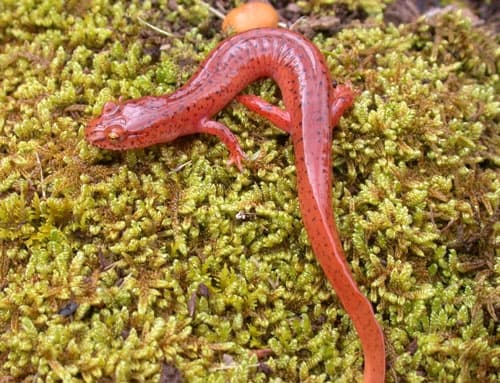
Blue Ridge spring salamander
The Blue Ridge spring salamander, a subspecies of the spring salamander (Gyrinophilus porphyriticus), is found in the southern Appalachian Mountains and adjacent Piedmont regions of the United States. This species is distinguished by a distinctive white line from its eye to its nostril, bordered by a dark line, and its varied dorsal coloration ranging from reddish to orange-yellow with black or brown spots. They inhabit cool springs, mountain springs, and moist forest areas, and are notable for their diet which can include other salamanders.