
Blue Ridge spring salamander
The Blue Ridge spring salamander, a subspecies of the spring salamander (Gyrinophilus porphyriticus), is found in the southern Appalachian Mountains and adjacent Piedmont regions of the United States. This species is distinguished by a distinctive white line from its eye to its nostril, bordered by a dark line, and its varied dorsal coloration ranging from reddish to orange-yellow with black or brown spots. They inhabit cool springs, mountain springs, and moist forest areas, and are notable for their diet which can include other salamanders.
Key Facts
- ›The Blue Ridge spring salamander is a subspecies of the spring salamander (Gyrinophilus porphyriticus).
- ›It is characterized by a white line from eye to nostril, bordered by a dark line, and reddish to orange-yellow dorsal coloration with spots.
- ›Its natural habitats include temperate forests, rivers, swamps, freshwater marshes, springs, karsts, and caves.
- ›The species can be cannibalistic and is known to prey on other smaller salamanders and their eggs.
- ›While the overall spring salamander species is listed as Least Concern by the IUCN, specific state populations and the Canadian population are listed as threatened.
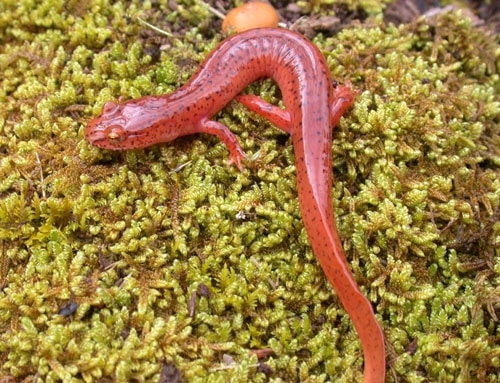
Purple Salamander, Blue Ridge Spring Salamander
- Temperate Forests
- Rivers
- Swamps
- Freshwater Marshes
- Freshwater Springs
- Inland Karsts
- Caves
- Cool Springs
- Mountain Springs
- Wet Depressions Beneath Logs, Stones, Or Leaves
- Canada
- United States
- Southern Quebec
- Northern Alabama
- Northeastern Mississippi
- Southern Ohio
- Eastern Kentucky
- West Virginia
- Western Virginia
- Southern Appalachian Mountains
- Adjacent Piedmont From North Carolina To Alabama
- Southern Portion of the Blue Ridge Province
- Piedmont From Southwest North Carolina To Eastern To Central Alabama
- Possesses A Nasolabial Groove.
- Subspecies G. P. Danielsi and G. P. Dunni Can Be 5–7.5 In Long.
- Record Length For Some Subspecies Is 8.06 In .
- Distinctive White Line From Eye To Nostril, Bordered Below By A Conspicuous Black Or Dark Brown Line.
- May Have A Dark Line Above the White Line.
- Dorsal Coloration Can Be Clear Reddish, Salmon, Or Orange-Yellow Marked With Black Or Brown Spots Or Flecks.
- 17 To 19 Costal Grooves.
- Larvae Are Aquatic and Have Stream-Type Morphology.
- Juveniles Are Typically More Brightly Colored Than Adults.
- Adults Reach Larger Sizes At Higher Elevations Due To Delayed Development.
Insects, Spiders, Mites, Millipedes, Centipedes, Slugs, Snails, Annelid Worms, Other Small Invertebrates, Smaller Stream Dwelling Salamanders, Eggs of Other Salamanders, Cannibalistic
- Spends A Long Period As A Gilled Larva.
- Spends Colder Months In Wet Soil Near Water Sources, Remaining Somewhat Active In Burrows Or Leaf Litter.
- Courtship Involves the Male Sliding His Head Over the Female's Body.
- Courtship Includes A Tail-Straddle Walk.
- Male Deposits A Spermatophore On the Substrate.
- Female Stores Spermatophore For Egg Fertilization.
- Males Undulate Their Tails, Rubbing the Base Over the Female's Chin.
- Females Protect Egg Masses Until Hatching.
- Larvae May Stay Near the Mother After Hatching But Do Not Directly Depend On Her.
- Exhibits Cannibalism of Smaller Individuals.
- Releases A Toxin Through the Skin To Ward Off Predation.
Deforestation, Agriculture, Introduction of Fish For Sport
About Blue Ridge spring salamander
The Blue Ridge spring salamander is a subspecies of the spring salamander, scientifically known as Gyrinophilus porphyriticus. This amphibian is found in the southeastern United States, specifically in the southern Appalachian Mountains and the adjacent Piedmont regions. Its name derives from its habitat preference and the distinctive coloration that can resemble porphyry, a type of stone.
Description and Habitat
Adult Blue Ridge spring salamanders are distinguished by a clear white line running from their eye to their nostril, a feature bordered by a dark line. Their dorsal coloration varies, often appearing reddish, salmon, or orange-yellow, frequently adorned with black or brown spots. They typically range from 5 to 7.5 inches in length, though larger individuals have been recorded. These salamanders require moist environments and are found in cool springs, mountain springs, and damp areas within temperate forests, often sheltering under logs, stones, or leaf litter. They rely on cutaneous respiration, necessitating consistently moist conditions.
Diet and Behavior
The diet of the Blue Ridge spring salamander is diverse, including a variety of invertebrates such as insects, spiders, and worms. However, they are notable for also consuming smaller salamanders and their eggs, and can exhibit cannibalistic behavior. During colder months, they seek refuge in wet soil near water sources, remaining somewhat active in burrows.
Reproduction
Breeding commonly occurs in late summer and fall. The reproductive process involves a courtship ritual including a tail-straddle walk, after which the male deposits a spermatophore. The female fertilizes her eggs internally using this deposit. Females lay sticky egg masses, which they guard until hatching. The larval stage is prolonged, lasting several years, and it takes an additional four years after metamorphosis for the salamander to reach sexual maturity.
Conservation
While the spring salamander species as a whole is classified as "Least Concern" by the IUCN Red List, specific populations, including those in certain regions of the United States and Canada, are listed as "Threatened." Major threats to these populations include deforestation, agricultural development, and the introduction of non-native fish species, which can impact their habitat and survival rates.
Source: Wikipedia ↗
Frequently Asked Questions
What are the distinctive physical features of the Blue Ridge spring salamander?
The Blue Ridge spring salamander has a distinctive white line extending from its eye to its nostril, which is typically bordered below by a conspicuous black or dark brown line. Its dorsal coloration can be a clear reddish, salmon, or orange-yellow, often marked with black or brown spots or flecks.
What kind of habitats does the Blue Ridge spring salamander prefer?
This salamander is found in cool springs and mountain springs. It is also likely to inhabit any wet area under logs, stones, or leaves in the surrounding forest, requiring sufficient oxygen and moisture for cutaneous respiration.
What does the Blue Ridge spring salamander eat?
Its diet includes insects, spiders, mites, millipedes, centipedes, slugs, snails, and other small invertebrates. Notably, it also consumes smaller stream-dwelling salamanders and their eggs, and is known to be cannibalistic.
Where is the Blue Ridge spring salamander geographically distributed?
The Blue Ridge spring salamander, specifically the subspecies G. p. dunni, is distributed through the southern portion of the Blue Ridge Province and the Piedmont, ranging from southwest North Carolina to eastern to central Alabama.
What is the conservation status of the Blue Ridge spring salamander?
The overall species, Gyrinophilus porphyriticus, is listed as Least Concern by the IUCN. However, specific populations, including those in certain US states and Canada, are listed as threatened due to factors like deforestation and habitat alteration.
Related Salamander and Newt species

Austin blind salamander
The Austin blind salamander (Eurycea waterlooensis) is an endangered, fully aquatic salamander found only in Barton Springs in Austin, Texas. Its name originates from Waterloo, the former name of the city. This species is paedomorphic, meaning it retains juvenile characteristics throughout its adult life and does not metamorphose.

Barton Springs salamander
The Barton Springs salamander (Eurycea sosorum) is an endangered lungless salamander endemic to Texas, USA. It is found in Barton Springs and other nearby springs within the Edwards Aquifer, characterized by its clear, constant-temperature waters. This species is distinctive for its neotenic nature, retaining gills throughout its adult life, and its mottled coloration.

Apalachicola dusky salamander
The Apalachicola dusky salamander is a species of salamander found in the Southeastern United States, specifically in Alabama, Florida, and Georgia. It inhabits temperate forests, intermittent rivers, and freshwater springs. This species is currently threatened by habitat loss.