
Xiaozhai Tiankeng
The Xiaozhai Tiankeng, also known as the Heavenly Pit, is recognized as the world's deepest sinkhole, located in Fengjie County, Chongqing, China. This colossal geological formation features a unique doubly nested structure with vertical walls and an underground river system that contributes to its formation and features a seasonal waterfall.
Key Facts
- ›It is the world's deepest sinkhole.
- ›Dimensions: 626 meters long, 537 meters wide, and 511-662 meters deep.
- ›Features a doubly nested structure with upper and lower bowls.
- ›An underground river flows beneath it, forming a waterfall in the rainy season.
- ›Home to 1,285 species of plants and many rare animals, including the clouded leopard.
- ›A 2,800-step staircase has been constructed for tourism.

Xiaozhai Heavenly Pit, Heavenly Pit
World's Deepest Sinkhole, Doubly Nested Structure, Underground River System, Seasonal Waterfall
Freshwater
Ginkgo, Clouded Leopard, Chinese Giant Salamander
About Xiaozhai Tiankeng
The Xiaozhai Tiankeng, also known as the Heavenly Pit, is a monumental geological formation located in Fengjie County, Chongqing Municipality, China. It holds the distinction of being the world's deepest sinkhole, a staggering natural pit with immense dimensions and a unique doubly nested structure.
Dimensions and Structure
This colossal sinkhole measures 626 meters (2,054 feet) in length and 537 meters (1,762 feet) in width, with vertical walls plunging to depths between 511 and 662 meters (1,677 to 2,172 feet). Its volume is estimated at 119,349,000 m³, covering an opening area of 274,000 m². The sinkhole is characterized by a doubly nested design, comprising an upper bowl and a lower bowl, each with its own significant depth. A sloping ledge, formed by trapped soil within the limestone, separates these two bowls. During the rainy season, a dramatic waterfall can be observed at the mouth of the sinkhole, fed by an underground river system.
Geological Formation and Underground River
The formation of the Xiaozhai Tiankeng is intricately linked to a powerful underground river that flows beneath it. This river originates in the Tianjin fissure gorge and travels approximately 8.5 kilometers (5.3 miles), descending 364 meters (1,194 feet) before reaching a vertical cliff above the Migong River. The river's flow rate is substantial, with a median annual flow of 8.77 m³ per second, capable of reaching up to 174 m³/s. The underground river carved out the Difeng cave, which then served as the foundation for the Tiankeng's collapse. The river and cave system were extensively explored and mapped by the China Caves Project in 1994.
Biodiversity and Tourism
The Xiaozhai Tiankeng is not only a geological marvel but also a habitat for a diverse range of flora and fauna. It is home to 1,285 species of plants, including the ancient ginkgo tree, and numerous rare animals such as the clouded leopard and the Chinese giant salamander. The sinkhole has been known to local people since ancient times, with 'Xiaozhai' meaning 'little village' and 'Tiankeng' being a regional term for sinkholes. To facilitate tourism and allow visitors to experience its grandeur, a 2,800-step staircase has been constructed, providing access to this extraordinary natural wonder.
Source: Wikipedia ↗
Frequently Asked Questions
What is the Xiaozhai Tiankeng?
The Xiaozhai Tiankeng, meaning Heavenly Pit, is the world's deepest known sinkhole. It is a massive geological feature located in Fengjie County, Chongqing, China, characterized by its extreme depth and vertical walls.
How deep is the Xiaozhai Tiankeng?
The Xiaozhai Tiankeng has a depth ranging between 511 and 662 meters (1,677 to 2,172 feet). It is a doubly nested structure, with an upper bowl and a lower bowl, each contributing to its overall impressive depth.
What geological processes formed the Xiaozhai Tiankeng?
The sinkhole formed over the Difeng cave, which was created by a powerful underground river. This river continues to flow beneath the Xiaozhai Tiankeng, gradually dissolving and carrying away rock material, leading to its formation.
Is the Xiaozhai Tiankeng a tourist attraction?
Yes, the Xiaozhai Tiankeng is a tourist attraction. A 2,800-step staircase has been built to allow visitors to access and explore the sinkhole, facilitating tourism.
What kind of wildlife can be found in the Xiaozhai Tiankeng?
The Xiaozhai Tiankeng supports a rich biodiversity. It is home to 1,285 species of plants, including the ginkgo, and various rare animals such as the clouded leopard and the Chinese giant salamander.
What is the significance of the underground river?
The underground river is a crucial element in the formation of the Xiaozhai Tiankeng. It flows through the Difeng cave and creates a 46-meter-high waterfall at the mouth of the sinkhole during the rainy season.
Related Sinkholes

Big Basin Prairie Preserve
The Big Basin Prairie Preserve in Kansas encompasses a significant sinkhole system, most notably the mile-wide Big Basin and the water-filled St. Jacob's Well. These geological features, formed by sinkhole activity, are historically notable as resting places for the Northern Cheyenne and landmarks for cattle drives. The preserve is a designated National Natural Landmark, managed to protect its unique landscape and wildlife.
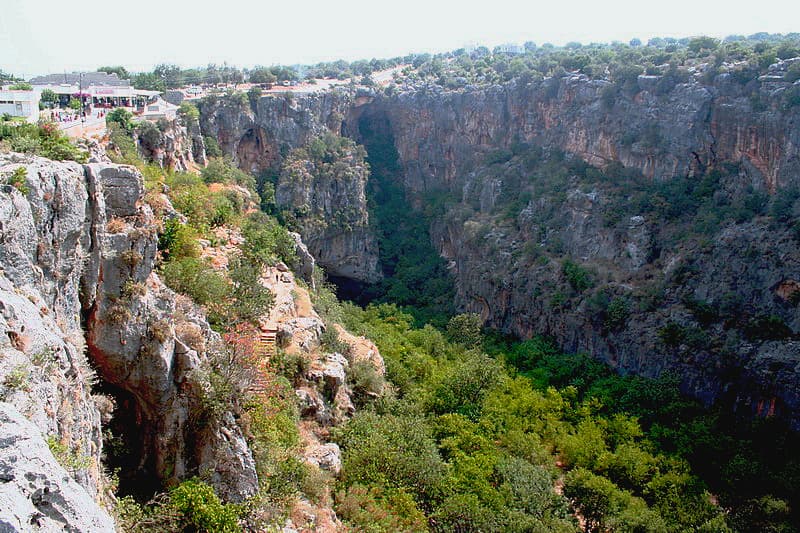
Cennet and Cehennem
Cennet and Cehennem are two large, adjacent sinkholes located in the Taurus Mountains of Mersin Province, Turkey. Cennet, or 'Heaven,' features a large opening and a staircase leading to ruins of a 5th-century monastery, while Cehennem, or 'Hell,' is a deeper, narrower sinkhole with no access to its bottom. They are significant geological formations and tourist attractions, with mythological associations to the Greek god Zeus.

Devil's Millhopper Geological State Park
Devil's Millhopper Geological State Park features a massive sinkhole in Florida, notable for its exposed limestone layers and the unique ecological environments it supports. The sinkhole's formation through limestone dissolution has created a dramatic geological record, making it a significant site for scientific study and public appreciation of karst topography.