
Aipysurus foliosquama
active hunter·Data Deficient
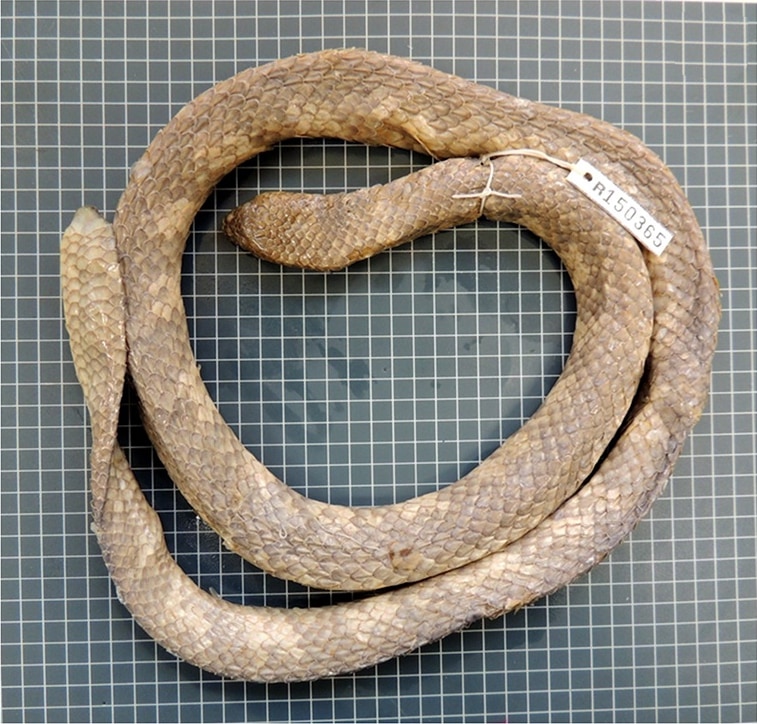
Aipysurus foliosquama, commonly known as the leaf-scaled sea snake, is a venomous elapid snake discovered in the waters off Australia. Once thought extinct from its original habitat in the Ashmore and Cartier Islands, a population was rediscovered in the seagrass beds of Shark Bay, Western Australia in 2015. This species is characterized by its purple-brown coloration and a diet primarily consisting of wrasse and gudgeon fish.
Key Facts
- ›A venomous sea snake belonging to the family Elapidae.
- ›Rediscovered in Shark Bay, Western Australia in 2015 after being thought extinct.
- ›Has a recorded length of approximately 800 millimeters.
- ›Its coloration is described as purple-brown.
- ›Feeds on wrasse and gudgeon fish, pursuing them through coral formations.
- ›The IUCN lists its conservation status as Data Deficient and it is recognized as one of the World's 100 most Threatened Species.
Leaf-Scaled Sea Snake
Australia
Seagrass Beds, Coral Outcrops
Purple Brown
Wrasse, Gudgeon Fish
Must Surface To Breathe
About Aipysurus foliosquama
Aipysurus foliosquama, commonly referred to as the leaf-scaled sea snake, is a species of venomous sea snake belonging to the family Elapidae. This snake was once believed to be endemic to the Ashmore and Cartier Islands off Australia, where it was thought to have become extinct. However, in 2015, a population was rediscovered inhabiting the seagrass beds of Shark Bay, located off the coast of Western Australia.
Description and Habitat
The leaf-scaled sea snake is a poorly understood species, with recorded lengths around 800 millimeters. Its coloration is described as purple-brown. The snake prefers waters at depths up to 10 meters. Like other sea snakes, it is not equipped with gills and must periodically ascend to the surface to breathe air using its lungs.
Diet and Distribution
The diet of Aipysurus foliosquama is known to consist of wrasse and gudgeon fish. The snake actively pursues its prey through coral outcrops and crevices. The distribution range of this species has significantly contracted since its initial identification. It is currently known from a declining population in Shark Bay, a stark contrast to its former, more widespread habitat in the Ashmore and Hibernia Reefs in the Timor Sea, from which it has since disappeared.
Conservation Status
The range of Aipysurus foliosquama has seen a substantial decrease, and its population is significantly declining. Consequently, the International Union for Conservation of Nature (IUCN) lists its conservation status as Data Deficient. Furthermore, the leaf-scaled sea snake has been recognized as one of The World's 100 Most Threatened Species, highlighting the critical need for conservation efforts.
Source: Wikipedia ↗
Frequently Asked Questions
Where does the leaf-scaled sea snake live?
The leaf-scaled sea snake is known to inhabit the seagrass beds of Shark Bay, off the coast of Western Australia. Previously, its known habitats were the Ashmore and Hibernia Reefs in the Timor Sea, though it has disappeared from these locations.
What does the leaf-scaled sea snake eat?
The diet of the leaf-scaled sea snake is known to consist of wrasse and gudgeon fish. These fish are typically pursued by the snake through coral outcrops and crevices.
What is the conservation status of the leaf-scaled sea snake?
The International Union for Conservation of Nature (IUCN) lists the leaf-scaled sea snake as Data Deficient. The species is also recognized as one of The World's 100 Most Threatened Species due to its significantly decreased range and declining population.
What are the physical characteristics of the leaf-scaled sea snake?
The leaf-scaled sea snake has a recorded length of around 800 millimeters. Its coloration is described as purple-brown.
How does the leaf-scaled sea snake breathe?
Like other sea snakes, the leaf-scaled sea snake does not possess gills. It must periodically surface to breathe air using its lungs.
Related Snakes

Ahaetulla prasina
The Ahaetulla prasina, commonly known as the Asian vine snake, is a slender, arboreal snake native to Southern and Southeast Asia. It is characterized by its long, pointed snout and variable coloration ranging from brown to green. While mildly venomous, it is not considered a threat to humans and primarily preys on small reptiles and amphibians.

Aipysurus apraefrontalis
The short-nosed sea snake, scientifically known as *Aipysurus apraefrontalis*, is a venomous sea snake found in reef areas off the northern coast of Western Australia. Distinctive for its small, pointed head and slender brown body with darker bands, this species is long-lived and slow-growing. Its populations are complex, with a potentially extirpated oceanic group and an extant coastal variant that may represent a separate species.

Aipysurus eydouxii
Aipysurus eydouxii, also known as the beaded sea snake or marbled seasnake, is a species of venomous snake found in shallow marine environments across parts of the Indo-Pacific. What makes this species particularly distinctive is its specialized diet, consisting almost exclusively of fish eggs, which has led to significant adaptations such as reduced fangs and greatly diminished venom potency.