
Black-bodied woodpecker
The black-bodied woodpecker is a Near Threatened bird species found in Argentina, Bolivia, and Paraguay, inhabiting woodlands and savannas of the Gran Chaco region. It is characterized by its mostly black plumage, a long pointed crest, and distinct markings that differ between males and females, particularly on the forehead and malar stripe. This species typically forages on tree trunks and large limbs, excavating its nests in dead trees or utility poles.
Key Facts
- ›Found in Argentina, Bolivia, and Paraguay within the Gran Chaco woodland and savanna.
- ›Adults measure 29 to 30 cm in length and possess a prominent pointed crest.
- ›Males have a red forehead and crest, while females have a blackish lower forehead and malar stripe.
- ›Forages by pecking, hammering, and probing tree trunks and main limbs.
- ›Nests are excavated in dead trees or utility poles.
- ›Assessed as near Threatened due to habitat loss and a believed decreasing population.

Schulz's Woodpecker
Argentina, Bolivia, Paraguay
- Long pointed crest
- Red forehead and crest
- Black malar stripe
- White stripe from lores to side of neck
- Faint yellowish barring on flanks and lower belly
Insects
Pecking, Hammering, Probing Trunks and Main Limbs
Dead Trees, Utility Poles
Loud "Wic Wic Wic Wic Wic", Harsh Rattle, "Ti-Chrr", Repeated Descending "Kirrrrrr" When Disturbed, Long Drum Roll
About Black-bodied woodpecker
The black-bodied woodpecker (Dryocopus schulzii), also known as Schulz's woodpecker, is a species of bird recognized for its predominantly black plumage and distinctive crest. This Near Threatened species is found across portions of Argentina, Bolivia, and Paraguay, primarily inhabiting the woodland and savanna ecosystems of the dry Gran Chaco region and its transitional zones with moister forests.
Physical Characteristics
Adult black-bodied woodpeckers typically measure between 29 to 30 centimeters in length. Both sexes possess a prominent, long, pointed crest. Adult males are distinguished by a red forehead and crest, while adult females have a blackish lower forehead and a black malar stripe. Other key features include gray ear coverts, a thin white stripe behind the eye, and a white stripe extending from the lores down the side of the neck. The throat and hindneck are black, and the underparts are mostly black, sometimes with faint yellowish barring on the flanks and lower belly. Their bills are a pale ivory-white chisel shape, and their irises are deep brown to red-brown, with dark gray legs.
Distribution and Habitat
The species' range extends from the southern departments of Santa Cruz and Tarija in Bolivia, south through western and central Paraguay, and into north-central Argentina, reaching as far as Córdoba and San Luis provinces. It favors the dry woodland and savanna environments of the Gran Chaco, as well as the transition zones leading to more humid montane forests. They can be found at elevations up to 1,000 meters.
Behavior and Reproduction
The black-bodied woodpecker is a resident species, remaining in its range year-round. They typically forage alone or in pairs, occasionally in small family groups. Their foraging behavior involves pecking, hammering, and probing into tree trunks and large limbs in search of food. The breeding season generally occurs from October to December, with potential extensions into March. They excavate their nests in dead trees or utility poles. Details regarding their clutch size, incubation period, and parental care are not well-documented.
Vocalizations
The characteristic vocalizations of the black-bodied woodpecker include a frequent, loud call described as "wic wic wic wic wic." They also produce a harsh rattle, "ti-chrr," and a repeated descending "kirrrrrr" when disturbed near their nest. Their drumming pattern consists of a long roll.
Conservation Status
The black-bodied woodpecker is currently assessed as Near Threatened by the IUCN. Its conservation status is attributed to its somewhat limited geographic range and an estimated decreasing population. The primary threats to the species include habitat loss due to the expansion of agriculture and cattle ranching, the establishment of plantations of non-native trees, and the selective logging of valuable trees like quebracho and algarrobo for charcoal production. The species appears to have two main population centers in Argentina and Paraguay, being scarce elsewhere.
Source: Wikipedia ↗
Frequently Asked Questions
What is the scientific name for the black-bodied woodpecker?
The scientific name for the black-bodied woodpecker is Dryocopus schulzii. Some taxonomic systems place it in the genus Hylatomus, but the specific epithet is consistently schulzii or schulzi.
Where can the black-bodied woodpecker be found?
The black-bodied woodpecker is distributed from southern Bolivia, through western and central Paraguay, and into north-central Argentina. Its habitat is the woodland and savanna of the dry Gran Chaco and adjacent transition zones.
What does the black-bodied woodpecker eat?
The specific diet of the black-bodied woodpecker has not been described in detail. However, it typically forages by pecking, hammering, and probing on tree trunks and main limbs, suggesting it consumes insects and their larvae found within wood.
How does the black-bodied woodpecker build its nest?
This woodpecker species excavates its nest holes in dead trees or utility poles. The process involves using its bill to chip away at the wood to create a cavity suitable for nesting.
What are the conservation concerns for the black-bodied woodpecker?
The black-bodied woodpecker is listed as Near Threatened because of its limited range and a population that is believed to be declining. Major threats include habitat loss from agricultural expansion, cattle ranching, plantations of non-native trees, and selective logging.
Related Woodpecker species

Arabian woodpecker
The Arabian woodpecker is a species found exclusively in the Sarawat Mountains of Saudi Arabia and Yemen, making it the sole woodpecker to breed on the Arabian Peninsula. This bird, approximately 18 cm in length, is characterized by its brownish head with a red crown patch in males, olive-grey streaked plumage, and a grey underpart with a red-suffused belly. It inhabits various woodland environments, from sea level up to 2,800 meters, feeding primarily on insect grubs and spiders.
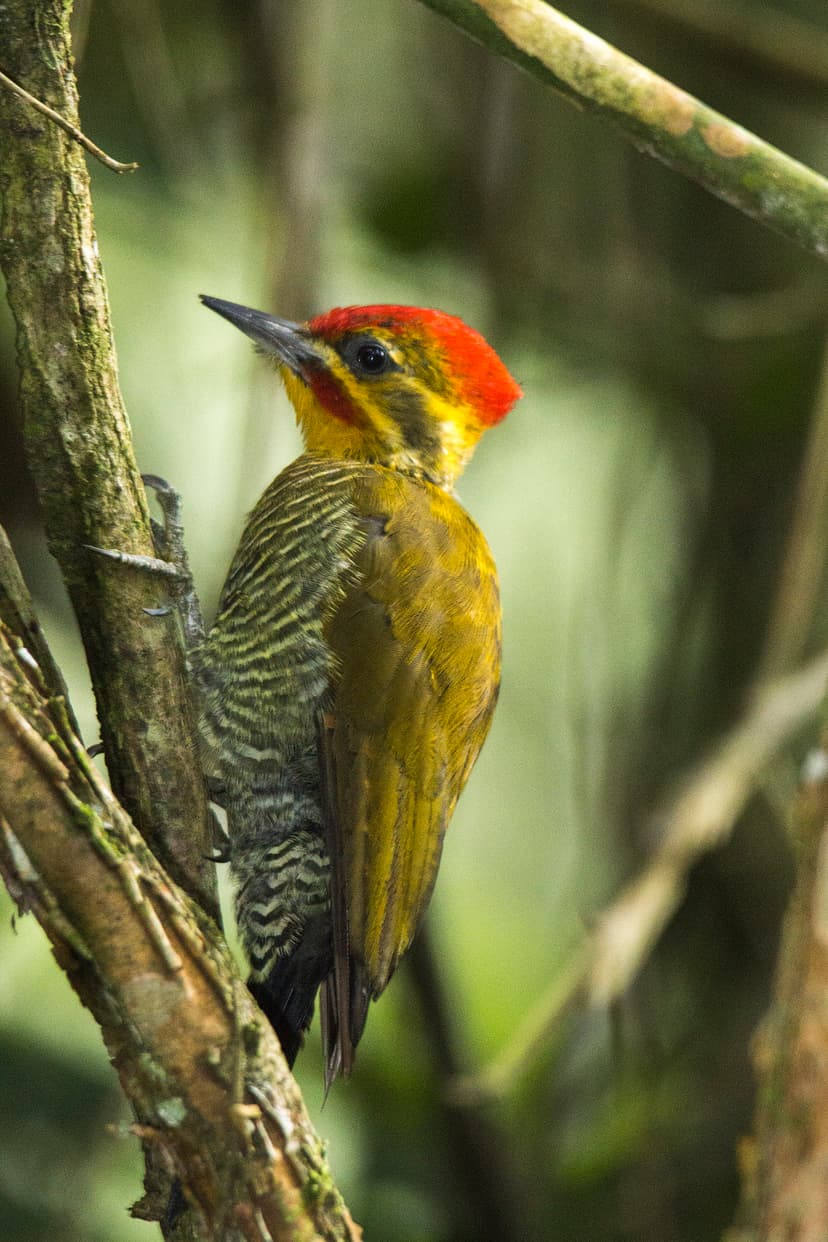
Yellow-browed woodpecker
The yellow-browed woodpecker, also known as the white-browed woodpecker, is a Near Threatened bird species found in Argentina, Brazil, Paraguay, and Uruguay. Measuring between 21 to 22 cm, it is characterized by its olive green upperparts and whitish underparts with dark olive bars, with males and females exhibiting distinct head plumage. This species primarily inhabits humid forests and woodlands, often foraging in the mid-levels for ants and their eggs.

Red-breasted sapsucker
The red-breasted sapsucker is a medium-sized woodpecker found along the west coast of North America, from Alaska down to California and even Baja California in winter. Distinctive for its red head and chest, this species primarily feeds on tree sap, drilling rows of holes into living trees, and also consumes insects attracted to the sap. They are cavity nesters, excavating their homes in dead deciduous trees.