
Golden-cheeked woodpecker
The golden-cheeked woodpecker is a species of bird found exclusively in Mexico. It is characterized by its distinctive golden-yellow cheeks, a prominent feature that helps identify it among other woodpecker species. This bird inhabits a variety of forest types and open landscapes, foraging for insects, fruits, and seeds.
Key Facts
- ›Endemic to Mexico, with two recognized subspecies.
- ›Measures approximately 19 to 22 cm in length and weighs between 55 to 88 grams.
- ›Feeds on a mixed diet of insects, fruits, and seeds.
- ›Forages in the middle to upper levels of trees, using gleaning, probing, and pecking techniques.
- ›Breeding season occurs from may to July, and nests are excavated in trees or cacti.
- ›Assessed as 'Least Concern' by the IUCN due to a large, stable population and wide distribution.

Mexico
Mesophytic Forest, Xeric Forest, Open Landscapes, Savanna With Trees, Plantations
Black, White, Red, Yellow, Gold, Gray-Buff, Orange-Red, Olive-Yellow, Yellowish Orange, Gray
Golden-Yellow Cheeks, Red Crown, White Forehead, Black Area Surrounding the Eye, Barred Black and White Upperparts, Black Flight Feathers With White Bars
Insects, Fruits, Seeds
Gleans, Probes, Pecks, Forages on trees from middle to upper levels
Tree Cavities, Cactus Cavities
- Nasal 'Ki-Di-Dik'
- Loud, Nasal 'Cheek-Oo, Cheek-Oo, Cheek-Oo, Keh-I-Heh-Ek'
- Softer 'Keh-I-Heh' Or 'Kuh-Uh-Uh'
About Golden-cheeked woodpecker
The golden-cheeked woodpecker (Melanerpes chrysogenys) is a species of bird endemic to Mexico, belonging to the woodpecker family Picidae. It is distinguished by its striking golden-yellow cheeks, a feature that gives it its common name. This species is found across a range of habitats, from the interior and edges of mesophytic to xeric forests to more open landscapes such as savannas with trees and plantations.
Distribution and Habitat
The golden-cheeked woodpecker's range is confined to Mexico. The nominate subspecies, M. c. chrysogenys, inhabits western Mexico, specifically between Sinaloa and Nayarit. The subspecies M. c. flavinuchus is found further south along the Pacific coast from Jalisco to Oaxaca, extending eastwards to Puebla. The species occupies elevations from sea level up to approximately 1,500 meters.
Description and Behavior
Adult golden-cheeked woodpeckers measure between 19 to 22 cm in length and weigh between 55 to 88 grams. Their plumage is similar between sexes, with variations primarily in head patterns. Males typically have a red crown and a golden nape, while females have a grayish-buff crown and an orange-red nape. Both sexes share a distinctive black area around the eye and golden-yellow lores. Their upperparts are barred black and white, and their underparts are generally gray-brown with an olive-yellow wash and a yellowish-orange patch on the belly. They are year-round residents in their range. Their diet is omnivorous, including insects like ants and beetles, as well as fruits and seeds. They forage by gleaning, probing, and pecking on trees.
Breeding and Conservation
The breeding season for the golden-cheeked woodpecker occurs between May and July. They excavate their nest holes in trees or cacti, though detailed information on their breeding biology remains scarce. The International Union for Conservation of Nature (IUCN) has assessed the golden-cheeked woodpecker as 'Least Concern'. This classification is based on its large range, an estimated stable population of at least 50,000 mature individuals, and the absence of immediate, identified threats.
Source: Wikipedia ↗
Frequently Asked Questions
What is the scientific name of the golden-cheeked woodpecker?
The scientific name of the golden-cheeked woodpecker is Melanerpes chrysogenys. It belongs to the woodpecker family, Picidae.
Where is the golden-cheeked woodpecker found?
The golden-cheeked woodpecker is endemic to Mexico. Its nominate subspecies is found in western Mexico, while another subspecies ranges along the coast from Jalisco south to Oaxaca and east to Puebla.
What does the golden-cheeked woodpecker eat?
This woodpecker has a varied diet consisting of insects, such as ants and beetles, as well as fruits and seeds. It actively forages for food on trees.
What is the conservation status of the golden-cheeked woodpecker?
The golden-cheeked woodpecker is listed as 'Least Concern' by the IUCN. This is due to its large population, estimated to be stable, and its extensive geographic range.
What are the nesting habits of the golden-cheeked woodpecker?
The golden-cheeked woodpecker excavates its nest hole in a tree or cactus. Information regarding its breeding biology beyond nest excavation is not widely documented.
Related Woodpecker species

Chilean flicker
The Chilean flicker is a medium-sized woodpecker species found in central and southern Chile and southwestern Argentina. It primarily inhabits semi-open to open landscapes and feeds almost exclusively on ants found on the ground. This species is characterized by its dark slate gray head in males, buffish underparts with blackish brown barring, and a white rump.

Black-necked woodpecker
The black-necked woodpecker is a bird species endemic to Peru, measuring 26 to 27 cm in length. It exhibits distinct plumage differences between males and females, particularly on their heads. This species primarily feeds on ants and their larvae, foraging at various levels within its semi-arid to arid habitat.
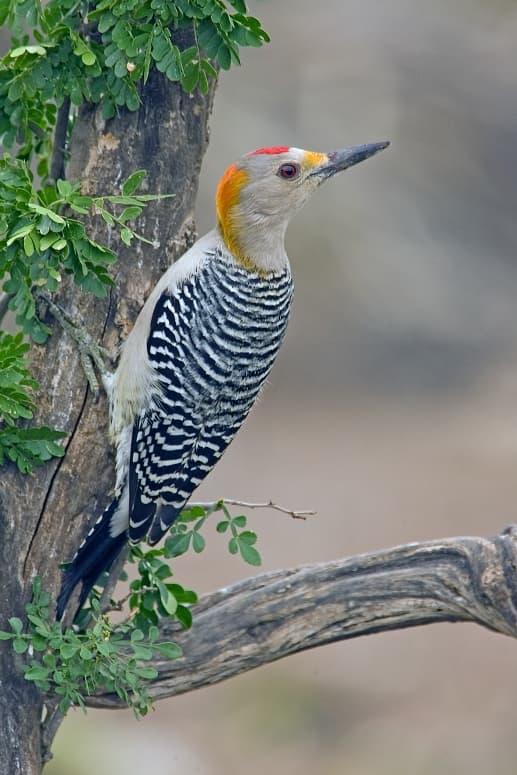
Golden-fronted woodpecker
The golden-fronted woodpecker is a species found in the southern United States, Mexico, and parts of Central America. It is characterized by its barred black and white upperparts, gray underparts, and distinctive head markings, with males having a red crown and golden nape, while females have a grayish crown. This adaptable bird inhabits a variety of landscapes, including mesquite brushlands, riparian woodlands, and urban areas.