
Himalayan woodpecker
The Himalayan woodpecker is a medium-sized, pied bird found in the northern Indian subcontinent, particularly in the Himalayas and surrounding areas. It inhabits boreal and temperate forests and is characterized by its black and white plumage, with males having a red crown and females a black one. This species is assessed as being of least concern by the IUCN.
Key Facts
- ›Found in the northern Indian subcontinent, including the Himalayas, Afghanistan, India, Nepal, Bhutan, and Pakistan.
- ›Inhabits boreal and temperate forests, often with rhododendrons.
- ›Medium-sized, measuring approximately 24 cm in length.
- ›Males have a red crown, while females have a black crown.
- ›Diet includes insects, fruits, seeds, and sap.
- ›Assessed as 'least concern' by the IUCN due to a wide range and stable population.

Afghanistan, India, Nepal, Bhutan, Pakistan
Boreal Forests, Temperate Forests, Upland Forest, Deciduous Trees, Coniferous Trees, Rhododendrons
Black Y-shaped mark on neck and cheeks, Black marks under eyes, Red vent and under-tail coverts, Red crown, Black crown
Insects, Fruits, Seeds, Sap
Forages individually, Forages on trunks and large branches, Forages on the ground, Hammers fir cones on stones to extract seeds
About Himalayan woodpecker
The Himalayan woodpecker (Dendrocopos himalayensis) is a distinctive bird species belonging to the Picidae family. It is primarily found in the mountainous regions of the northern Indian subcontinent, with its range extending across Afghanistan, India, Nepal, Bhutan, and Pakistan. This species favors natural habitats such as boreal and temperate forests, often thriving in upland areas with either deciduous or coniferous trees, and frequently found amidst rhododendrons.
Description and Characteristics
A medium-sized woodpecker, the Himalayan woodpecker typically measures around 24 centimeters in length. Its plumage is characterized by a glossy black upper body contrasted with broad white patches extending from the shoulders to the lower back. It features limited white barring on its flight feathers and clean white edging on its tail. The underparts and head are generally white or a plain pale buff, marked with a notable black Y-shaped pattern on the neck and cheeks. A key sexual dimorphism is present in the crown, which is red in males and black in females. Additional distinguishing marks include unique black markings under the eyes, setting it apart from other species. The vent and under-tail coverts are typically red or pink. Iris color is chestnut, the beak is blackish, and the legs are grey. Juvenile birds are duller, with greyish-black upperparts and less vivid vent and under-tail areas; their crowns are greyish with some red, regardless of sex.
Ecology and Behavior
The Himalayan woodpecker inhabits altitudes ranging from 1,500 to 3,200 meters (4,900 to 10,500 feet). It is an individual forager, typically working its way on tree trunks and large branches, though it is also observed foraging on the ground. Its diet is varied, encompassing insects, fruits, seeds, and sap. A specific foraging behavior observed is its practice of hammering fir cones on stones to extract the seeds.
Conservation Status
The species possesses a wide geographic range and is generally considered common or fairly common within its territories. No significant threats have been identified that would jeopardize its population, and the population trend is believed to be steady. Consequently, the International Union for Conservation of Nature (IUCN) has classified the Himalayan woodpecker as being of 'Least Concern'.
Source: Wikipedia ↗
Frequently Asked Questions
What is the size of the Himalayan woodpecker?
The Himalayan woodpecker is a medium-sized bird, reaching a length of approximately 24 centimeters (9 inches).
Where does the Himalayan woodpecker live?
This species is found in the northern regions of the Indian subcontinent, primarily the Himalayas and adjoining areas, including Afghanistan, India, Nepal, Bhutan, and Pakistan.
What does the Himalayan woodpecker eat?
Its diet is varied and includes insects, fruits, seeds, and sap. It has been observed hammering fir cones on stones to extract seeds.
What are the distinguishing features of the Himalayan woodpecker?
It is a pied woodpecker with glossy black upperparts and broad white patches. Distinctive features include a black Y-shaped mark on the neck and cheeks, unique black marks under the eyes, and a red vent and under-tail coverts. The crown is red in males and black in females.
What is the conservation status of the Himalayan woodpecker?
The International Union for Conservation of Nature has assessed the Himalayan woodpecker's conservation status as 'least concern'.
Related Woodpecker species

Scaly-bellied woodpecker
The scaly-bellied woodpecker is a large, green woodpecker species found in the Indian subcontinent and adjacent regions, including Afghanistan, Iran, India, Nepal, Pakistan, and Turkmenistan. It is characterized by distinct scaling on its underside, a black moustache, and a large pale bill. Males have a red crown, while females have a blackish crown.
Brown-fronted woodpecker
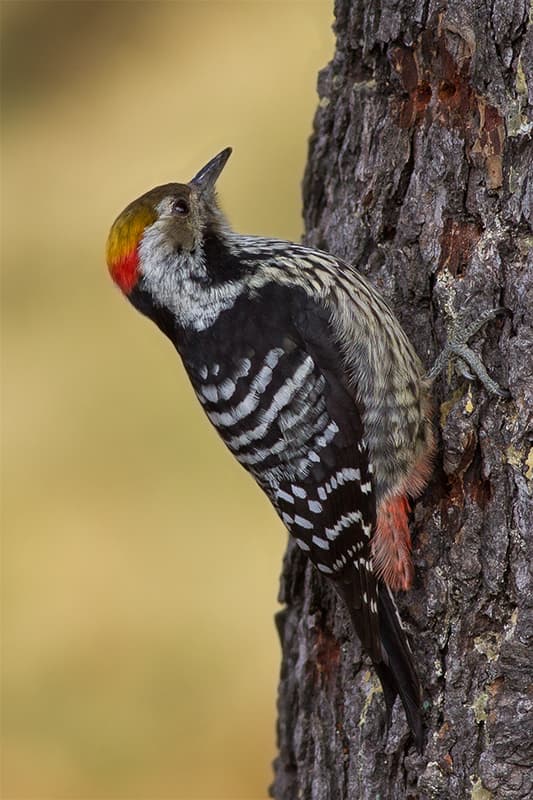
The brown-fronted woodpecker is a medium-sized, pied bird found in the lower-to-middle altitudes of the Himalayas, spanning across Afghanistan, India, Nepal, Pakistan, and Bhutan. Its natural habitats include temperate and moist montane forests. It is characterized by prominent black markings, yellow in its crown, and distinct underpart streaking.

Pileated woodpecker
The pileated woodpecker is a large, crow-sized bird native to North America, distinguished by its prominent red crest and white neck stripe. It inhabits deciduous forests and boreal regions, primarily feeding on insects extracted from trees. Renowned for its large, rectangular carvings into trees, this species plays an important ecological role and is classified as "least concern" by the IUCN due to its large and increasing population.