
Ivory-billed woodpecker
The Ivory-billed woodpecker (Campephilus principalis) is a large woodpecker native to the Southern United States and Cuba, distinguished by its striking black and white plumage and an ivory-colored bill. Once widespread in bottomland hardwood and temperate coniferous forests, its populations have drastically declined due to habitat destruction and hunting, leading to its current status as critically endangered and possibly extinct.
Key Facts
- ›It was the largest woodpecker in the United States and one of the largest globally.
- ›Its plumage is predominantly deep black with white markings, and males possess a red crest.
- ›The diet primarily consisted of large beetle larvae, particularly from the Cerambycidae family.
- ›Habitat loss, especially deforestation of bottomland hardwood forests, severely impacted its population.
- ›The last universally accepted sightings were in 1944 in the us and 1987 in Cuba.
- ›Its conservation status is listed as critically endangered, with strong indications of extinction.
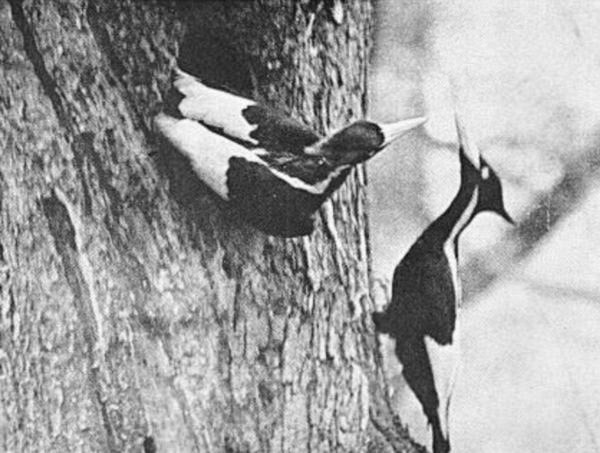
Log Cock, Log God, Lord God Bird, Indian Hen, Kent, Kate, Poule De Bois, Tit-Ka, Holy Grail Bird, Grail Bird
United States, Cuba
Bottomland Hardwood Forests, Dense Swampland, Temperate Coniferous Forests, Upland Pine Forests
Ivory-colored bill in adults, Prominent, ragged crest, Large white patches on wings and lower back, Flattened, chisel-like bill tip
Large Beetle Larvae, Nuts, Fruits
- Wedges bark from dead trees using its bill to expose beetle larvae tunnels
Cavities Excavated In Trees, Living Or Partially Dead Trees, Broken-Off Stumps
Single Or Double Rap Drum, Kent, Kent-Kent-Kent
About Ivory-billed woodpecker
The Ivory-billed Woodpecker
The Ivory-billed woodpecker (Campephilus principalis), historically a magnificent inhabitant of the southeastern United States and Cuba, is one of the most iconic and tragically rare species of North American birds. Renowned for its impressive size, second only to the Imperial Woodpecker of Mexico within its genus, and its striking black and white plumage accented by a vivid red crest in males, this bird was once a powerful symbol of the wild, old-growth forests it called home.
Description and Characteristics
Adult Ivory-billed woodpeckers measured approximately 48 to 53 centimeters (19 to 21 inches) in length, with a wingspan reaching about 76 centimeters (30 inches). Its plumage was predominantly a glossy deep black, distinguished by prominent white lines along the cheeks and neck, and extensive white on the wings. The bill, a defining feature, was ivory-colored in adults, while juveniles possessed a chalky white bill. Males were identifiable by their striking red crests, which were solid black in females and juveniles. The bird's flight was described as strong and direct, often likened to that of a duck.
Habitat and Diet
The Ivory-billed woodpecker favored dense bottomland hardwood forests and swamps, as well as temperate coniferous forests. Its diet consisted primarily of large beetle larvae, particularly those from the Cerambycidae family, which it would extract by skillfully using its powerful bill to peel away bark from dead trees. This specialized foraging technique meant it had few, if any, competitors within its range. The diet was supplemented by various nuts and fruits, including acorns, pecans, wild grapes, and persimmons.
Breeding and Life Cycle
Thought to mate for life, pairs of Ivory-billed woodpeckers typically bred annually between January and May. They excavated nest cavities in trees, often in living or partially dead trees, at heights ranging from 15 to 70 feet. The female typically laid up to three glossy, china-white eggs, though clutches of up to six have been recorded. Both parents shared incubation duties and the care of the young, which learned to fly about seven to eight weeks after hatching and were fed by their parents for an additional two months. The species was not migratory, with pairs often nesting in the same vicinities year after year, though they were not strictly territorial.
Decline and Status
The Ivory-billed woodpecker’s populations were decimated by a combination of extensive habitat destruction, particularly the logging of vast tracts of southern forests, and relentless hunting. The last universally accepted sighting in the United States occurred in 1944, with the last in Cuba documented in 1987. Despite disputed sightings and ongoing interest in its potential survival in the 21st century, the species is listed as critically endangered by the IUCN and presumed extinct by NatureServe. The U.S. Fish and Wildlife Service has proposed its delisting due to extinction, though its final status remains under review, reflecting the profound uncertainty surrounding this magnificent bird's existence.
Source: Wikipedia ↗
Frequently Asked Questions
What is the Ivory-billed woodpecker known for?
The Ivory-billed woodpecker is renowned for being the largest woodpecker in the United States and for its striking black and white plumage, offset by an ivory-colored bill in adults. It was once a prominent resident of southern US forests and Cuba, but is now considered critically endangered and potentially extinct due to severe population declines.
Where did the Ivory-billed woodpecker live?
Historically, the Ivory-billed woodpecker was found in bottomland hardwood forests and temperate coniferous forests across the southeastern United States, ranging from eastern Texas to North Carolina and from southern Illinois to Florida. It also inhabited Cuba.
What caused the decline of the Ivory-billed woodpecker?
The primary drivers of the Ivory-billed woodpecker's population decline were habitat destruction, particularly the extensive deforestation of its preferred forest types, and hunting. These factors drastically reduced the availability of suitable nesting sites and food sources.
Is the Ivory-billed woodpecker still alive?
The status of the Ivory-billed woodpecker is highly uncertain. While the last universally accepted sightings were decades ago, there have been disputed reports in the 21st century suggesting it may still persist in certain areas. However, many experts believe the species is likely extinct, and the U.S. Fish and Wildlife Service has proposed delisting it due to extinction.
What did the Ivory-billed woodpecker eat?
The diet of the Ivory-billed woodpecker mainly consisted of large beetle larvae, especially those from the Cerambycidae family, which it extracted from dead trees. It also supplemented its diet with vegetable matter, including nuts and fruits like acorns, pecans, wild grapes, and persimmons.
How big was the Ivory-billed woodpecker?
The Ivory-billed woodpecker was a very large bird, measuring approximately 48 to 53 centimeters (19 to 21 inches) in length with a wingspan of about 76 centimeters (30 inches). It was the largest woodpecker in North America.
Related Woodpecker species
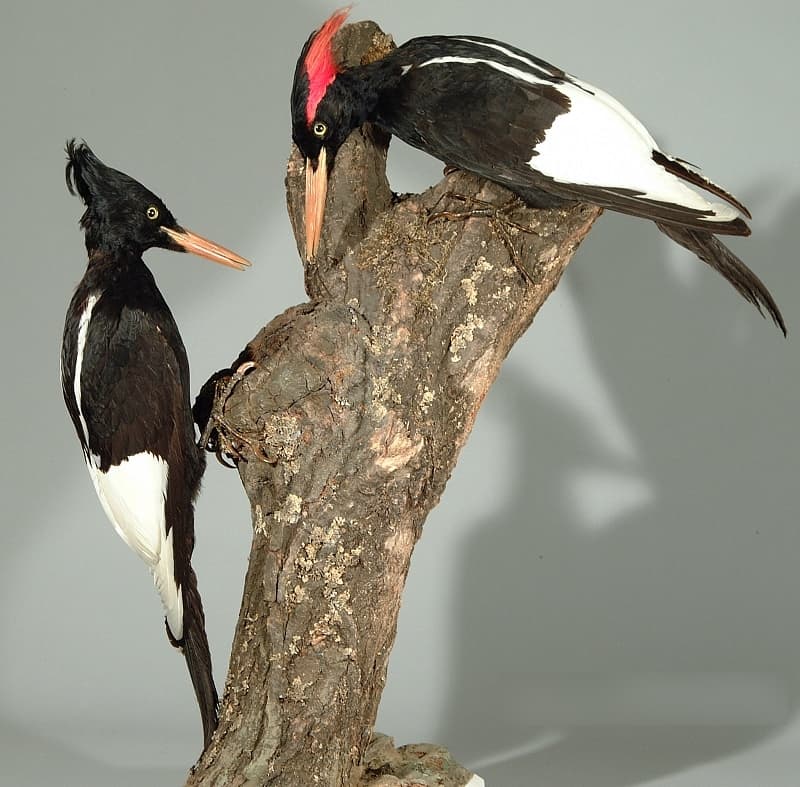
Imperial woodpecker
The Imperial woodpecker (Campephilus imperialis) is a critically endangered, possibly extinct, woodpecker species endemic to Mexico. If extant, it is the world's largest woodpecker, reaching up to 60 cm in length, characterized by its black plumage, large white wing-patches, and a distinctive ivory-colored bill. Its decline is largely attributed to habitat destruction and hunting.

Arabian woodpecker
The Arabian woodpecker is a species found exclusively in the Sarawat Mountains of Saudi Arabia and Yemen, making it the sole woodpecker to breed on the Arabian Peninsula. This bird, approximately 18 cm in length, is characterized by its brownish head with a red crown patch in males, olive-grey streaked plumage, and a grey underpart with a red-suffused belly. It inhabits various woodland environments, from sea level up to 2,800 meters, feeding primarily on insect grubs and spiders.

Arrowhead piculet
The Arrowhead piculet is a small bird belonging to the woodpecker family, characterized by its distinctive plumage and a varied diet. It is found in the Guianas region of South America, inhabiting a range of environments from mangroves to montane forests.