
Lita woodpecker
The Lita woodpecker is a small woodpecker species found in Colombia and Ecuador, inhabiting humid and wet primary and secondary forests. Measuring about 17-18 cm, it exhibits distinct sexual dimorphism in its head plumage, with males having more extensive red coloration than females. Its diet is presumed to consist of insects, and it's known for its hissing calls.
Key Facts
- ›Found in Colombia and Ecuador.
- ›Measures approximately 17-18 cm in length.
- ›Males have red on the forehead, hindneck, and cheeks, while females have red only on the nape and cheeks.
- ›Inhabits humid and wet primary and secondary forests from sea level to 800 meters.
- ›Diet is assumed to be adult and larval insects.
- ›Vocalizations include hissing 'shreeyr' or 'peessh' calls.
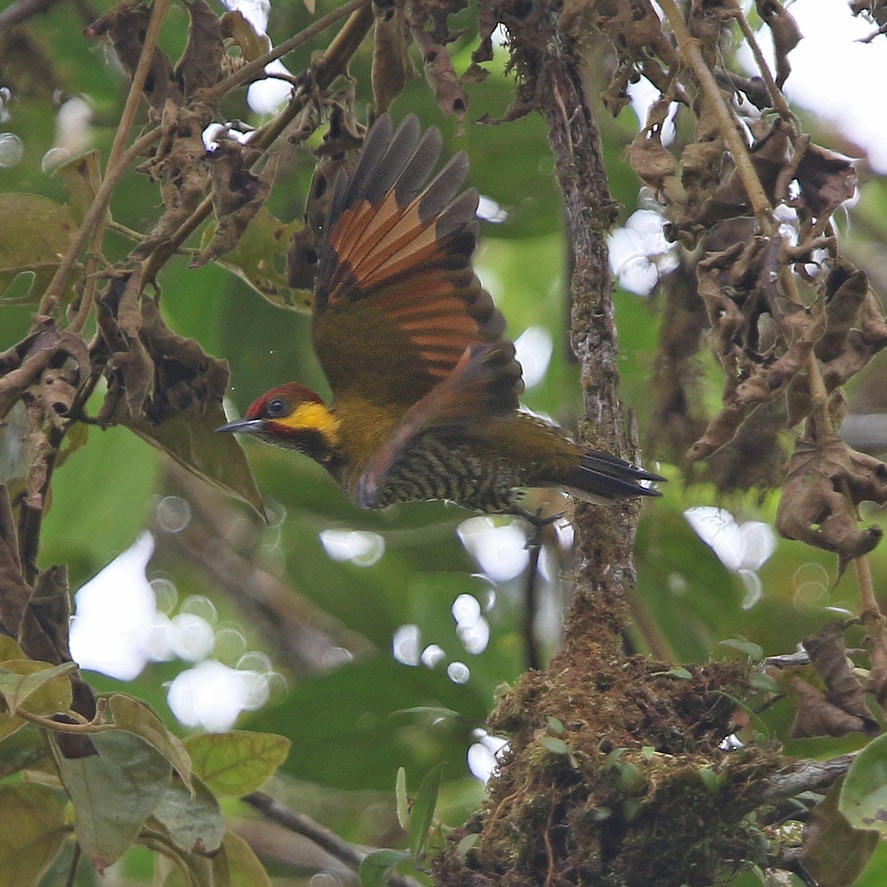
Lita's Woodpecker
Colombia, Ecuador
Humid Primary Forest, Wet Primary Forest, Secondary Forest
Olive-Yellow, Bronze-Green, Red, Golden-Yellow, Dusky Olive, Blackish, Dark Brown, Pale Cinnamon-Rufous, Whitish
- Sexual dimorphism in head plumage
- Dusky olive chin and throat
- Whitish underparts with black wedge-shaped bars
- Light bluish beak with a black tip
Insects
- Forages from middle forest levels to the sub-canopy
- Usually forages alone, sometimes in pairs
Apparent Nest Holes
Hissing 'Shreeyr' Calls, Hissing 'Peessh' Calls
About Lita woodpecker
The Lita woodpecker, scientifically known as Piculus litae, is a species of bird belonging to the woodpecker family, Picidae. This species is primarily found in the tropical regions of Colombia and Ecuador, inhabiting the interior and edges of humid and wet primary forests, as well as secondary forests.
Physical Characteristics
Adult Lita woodpeckers typically measure between 17 to 18 centimeters in length. A notable characteristic is the sexual dimorphism in their plumage, particularly on their heads. Males display red coloration from their forehead to the hindneck and extensively on their cheeks, with the rest of the face being golden-yellow. Females exhibit red coloration only on the nape and cheeks, sharing the same overall plumage otherwise. Both sexes have a dusky olive chin and throat that can appear blackish from a distance. Their upperparts are generally olive-yellow to bronze-green, with a slightly darker rump. Flight feathers are dark brown with olive on the outer webs and pale cinnamon-rufous on the inner webs, culminating in black tips. The tail is blackish with greenish edges. Their underparts are whitish, marked with distinctive black wedge-shaped bars. The beak is relatively short, bluish in color with a black tip, complemented by dark brown irises and dark slate blue legs. Juveniles are duller and greener than adults, with red markings limited to the nape and a streaked throat.
Distribution and Habitat
The Lita woodpecker's range extends across Colombia, specifically within the middle Magdalena River Valley and along the Pacific slope of the western Andes. Its distribution continues south into northwestern Ecuador, reaching as far as Pichincha Province. The species thrives in humid and wet primary forest environments, as well as secondary forests, and is found at elevations from sea level up to approximately 800 meters (2,600 feet).
Behavior and Ecology
As far as is known, the Lita woodpecker is a year-round resident within its established range. Its foraging behavior involves searching for food from the middle forest levels up to the sub-canopy, typically foraging alone or occasionally in pairs. While the specifics of its diet have not been extensively studied, it is presumed to consist of adult and larval insects. The breeding biology of the Lita woodpecker remains largely unknown, although observations of nest hole excavation and attendance have been recorded during July and August.
Vocalizations
The characteristic vocalizations of the Lita woodpecker include hissing calls described as 'shreeyr' or 'peessh'. These sounds are noted to be very similar to the calls produced by other species within the Piculus genus.
Conservation Status
The International Union for Conservation of Nature (IUCN) currently assesses the Lita woodpecker as a species of Least Concern. Despite having a relatively large range, its population size is not precisely known and is believed to be in decline. No immediate threats have been definitively identified. However, extensive deforestation within its range, which appears to be ongoing, raises concerns. Considering the extent of habitat loss and the species' limited range, there is a viewpoint that the Lita woodpecker might warrant consideration as Near-threatened.
Source: Wikipedia ↗
Frequently Asked Questions
What is the scientific name of the Lita woodpecker?
The scientific name of the Lita woodpecker is Piculus litae. It was originally described under the genus Chloronerpes.
Where is the Lita woodpecker found?
The Lita woodpecker is found in Colombia, specifically in the middle Magdalena River Valley and the Pacific slope of the western Andes. It also extends south into northwestern Ecuador.
What kind of habitat does the Lita woodpecker prefer?
This species inhabits the interior and edges of humid and wet primary forests, as well as secondary forests. It can be found from sea level up to elevations of 800 meters.
What does the Lita woodpecker eat?
While its diet has not been extensively studied, it is assumed to consist of adult and larval insects. They forage in the middle to sub-canopy levels of the forest.
What are the conservation concerns for the Lita woodpecker?
The IUCN lists the Lita woodpecker as Least Concern, but its population is believed to be decreasing. Extensive and ongoing deforestation in its range is a significant concern, leading some to suggest it could be considered Near-threatened.
How does the Lita woodpecker differ between males and females?
Males and females share the same plumage except on their heads. Males are red from the forehead to the hindneck and broadly on the cheeks, with a golden-yellow face. Females have red only on the nape and malar region.
Related Woodpecker species

Black-necked woodpecker
The black-necked woodpecker is a bird species endemic to Peru, measuring 26 to 27 cm in length. It exhibits distinct plumage differences between males and females, particularly on their heads. This species primarily feeds on ants and their larvae, foraging at various levels within its semi-arid to arid habitat.
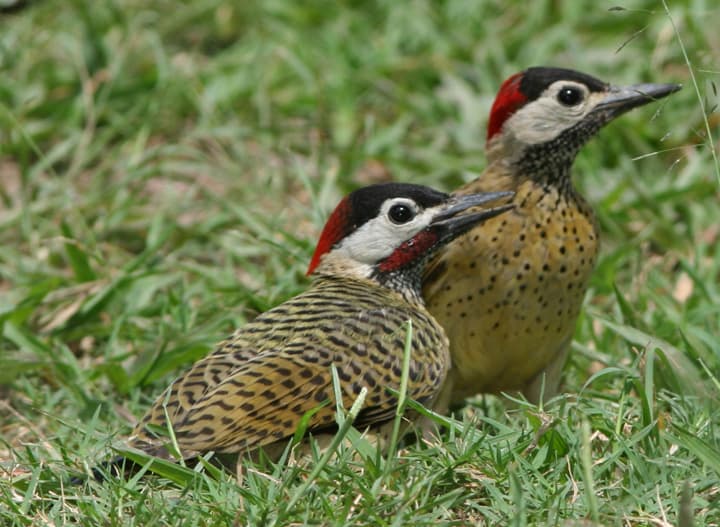
Spot-breasted woodpecker
The spot-breasted woodpecker (Colaptes punctigula) is a bird species found across much of mainland South America and Panama. It is characterized by its distinctive black and white spotted throat and is known for its varied vocalizations and adaptable habitat preferences, inhabiting humid lowland landscapes including forests, savannas, and plantations.

Greater flameback
The greater flameback, also known as the greater goldenback, is a large woodpecker species found across the northern Indian subcontinent, extending to southern China, the Malay Peninsula, and parts of Indonesia and Borneo. This species is characterized by its distinctive golden-yellow to dark brown back and wings, red rump, and a prominent red crown in adult males.