
Middle spotted woodpecker
The Middle spotted woodpecker is a European bird belonging to the genus Dendrocoptes, characterized by its red crown, pink vent, and lack of a moustachial stripe. It primarily inhabits deciduous forests across Europe and parts of West Asia, preferring areas with old trees and varied woodland structures. This species feeds mainly on insects and their larvae, foraging on branches and twigs, and is known for its distinctive song.
Key Facts
- ›Distinctive red crown and pink vent, lacking a moustachial stripe.
- ›Found in deciduous forests across Europe and West Asia.
- ›Feeds on insects and larvae, picking them from branches and twigs.
- ›Excavates nest holes in decaying trees or thick branches.
- ›Known for its nasal song and a fast call, but rarely drums for territorial purposes.

Middle-Spotted Woodpecker
Europe, West Asia
- Deciduous forests
- Areas with old oak, hornbeam, and elm
- Patchwork of clearings, pasture, and dense woodland
Red Crown, Pink Vent, Lack of A Black Moustachial Stripe, Dark Streaks On Flanks, Short, Slender Bill, Rounded, Pale Head
Insects, Insect Larvae, Tree Sap
Picking Insects From Branches and Twigs
Decaying Tree Trunk, Thick Branch
- Nasal Song: Slow, Nasal Gvayk Gvayk Gvayk Gvayk Gvayk
- Call: Fast Kik Kekekekek
About Middle spotted woodpecker
The Middle spotted woodpecker, scientifically known as Dendrocoptes medius, is a primarily European species of woodpecker distinguished by its vibrant red crown and pink vent, contrasting with its black and white plumage. It lacks the prominent moustachial stripe seen in some other woodpecker species. This bird is found across Europe and extends into parts of West Asia, inhabiting deciduous forests. It particularly favors mature woodlands with a mix of old oak, hornbeam, and elm trees, interspersed with clearings and pastures.
Behavior and Ecology
Behaviorally, the Middle spotted woodpecker tends to forage high in the trees, making observation challenging. Its diet consists mainly of insects and their larvae, which it extracts by picking them from branches and twigs rather than excavating them from beneath the bark. The species also supplements its diet with tree sap. While it rarely drums, it uses a distinctive, slow, nasal song to assert its territory, accompanied by a faster 'kik kekekekek' call. During the breeding season, it excavates nest holes, approximately 5 cm wide, in decaying tree trunks or substantial branches, where it lays between four and seven eggs.
Source: Wikipedia ↗
Frequently Asked Questions
What are the main physical differences between the Middle spotted woodpecker and the Great spotted woodpecker?
The Middle spotted woodpecker has a red crown, a pink vent, and lacks the black moustachial stripe found on the Great spotted woodpecker. While similar in size, the Middle spotted woodpecker appears smaller due to its shorter, more slender bill and a more rounded, paler head.
Where is the Middle spotted woodpecker typically found?
This species is found in Europe and parts of West Asia, specifically in the Palearctic region. Its range extends from northern Spain and France eastward to Poland and Ukraine, and southward through Italy, the Balkan Peninsula, Turkey, the Caucasus, and Iran.
What kind of habitat does the Middle spotted woodpecker prefer?
The Middle spotted woodpecker prefers deciduous forest regions. It particularly favors areas with old oak, hornbeam, and elm trees, complemented by a mosaic of clearings, pastures, and dense woodland.
What does the Middle spotted woodpecker eat and how does it forage?
Its diet consists predominantly of insects and their larvae. It finds its food by picking them from branches and twigs, rather than by hacking into bark.
Does the Middle spotted woodpecker drum?
The Middle spotted woodpecker rarely drums, and when it does, it is not for territorial purposes. It asserts its territory through song, which is described as a slow, nasal 'gvayk gvayk gvayk gvayk gvayk'.
How does the Middle spotted woodpecker build its nest?
During the breeding season, the Middle spotted woodpecker excavates a nest hole approximately 5 cm wide. These holes are typically made in decaying tree trunks or thick branches.
Related Woodpecker species

Ground woodpecker
The Ground woodpecker (Geocolaptes olivaceus) is one of the world's few ground-dwelling woodpeckers, distinguished by its large size and terrestrial foraging habits. Found in the hilly and mountainous regions of South Africa, Lesotho, and Eswatini, it inhabits steep, rocky slopes and feeds primarily on ants.
Brown-fronted woodpecker
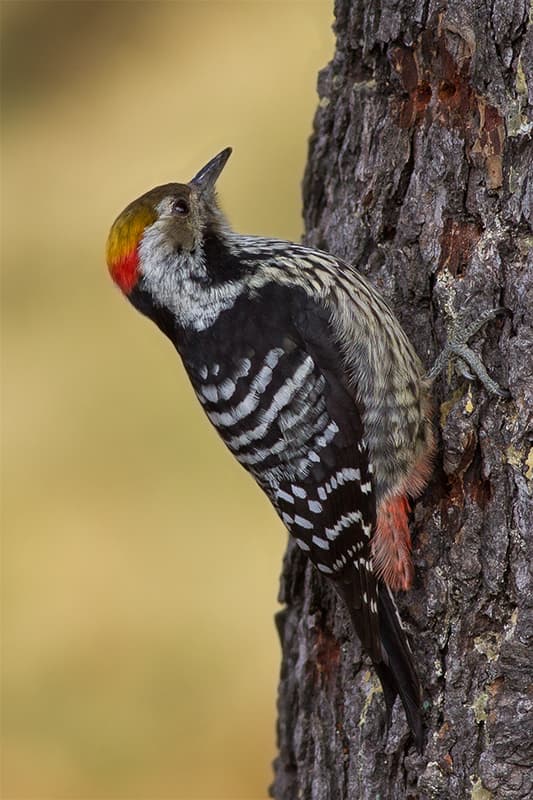
The brown-fronted woodpecker is a medium-sized, pied bird found in the lower-to-middle altitudes of the Himalayas, spanning across Afghanistan, India, Nepal, Pakistan, and Bhutan. Its natural habitats include temperate and moist montane forests. It is characterized by prominent black markings, yellow in its crown, and distinct underpart streaking.

Crimson-naped woodpecker
The crimson-naped woodpecker is a species of bird found in the forests of Bhutan, China, India, Myanmar, and Nepal. It is characterized by its black and white plumage with distinct red markings on the breast and nape, particularly prominent in males. This species inhabits both lowland and montane subtropical and tropical moist forests.