
Olivaceous piculet
The Olivaceous piculet is a small woodpecker found from Guatemala south through Central America and western South America to Peru. It inhabits a variety of forest edges and open woodlands, shunning dense mature forest interiors. Its primary diet consists of ants and termites, which it extracts from drilled holes or gleans from vegetation.
Key Facts
- ›The Olivaceous piculet is a small bird, measuring 8.5 to 10 cm in length.
- ›Its diet primarily consists of ants and termites, including their adults, larvae, and pupae.
- ›It excavates nest holes in rotting wood, typically near the ground.
- ›The species is a year-round resident throughout its extensive range.
- ›The IUCN Red List classifies the Olivaceous piculet as 'Least Concern', despite a decreasing population trend.

Olivaceous Piculet
Guatemala, Central America, Western South America, Peru, Honduras, Nicaragua, Costa Rica, Panama, Colombia, Venezuela, Ecuador
Edges of Rainforest, Edges of Cloudforest, Drier Forest, Open Woodlands, Secondary Forest, Plantations, Gardens
Olive-Brown, Yellow Tinge, Dark Brown, Yellow, Yellow-Green, Buff, Yellowish White, Brownish Streaks
- Red tips on crown feathers
- White spots on crown
- Yellowish to yellow-green edges on flight feathers
- Brownish streaks on belly and flanks
Ant Adults, Ant Larvae, Ant Pupae, Termite Adults, Termite Larvae, Termite Pupae, Beetles, Cockroach Eggs
- Forages on slender branches, stems, and vines
- Operates from forest undergrowth to mid-storey, occasionally in canopy
- Extracts food from drilled holes
- Gleans food from twigs and leaves
- Joins mixed-species foraging flocks
Rotting Wood, Fence Posts
- High thin chippering trill, often descending in pitch
- Sharp sibilant 'Sst, Ssip-Ssip' or 'Peep'
About Olivaceous piculet
Olivaceous Piculat
The Olivaceous piculet (Picumnus olivaceus) is a small bird belonging to the woodpecker family Picidae, specifically within the subfamily Picumninae. This species is distributed across a broad geographic area, ranging from Guatemala southward through Central America and into western South America, with its southern limits reaching Peru. It is not a migratory species, remaining within its range year-round.
Habitat and Distribution
This piculet inhabits a diverse array of environments, favoring the transitional zones such as the edges of rainforests and cloud forests, as well as drier woodlands, more open wooded areas, secondary forests, plantations, and even gardens. It notably avoids the deep interiors of mature, undisturbed forests. While generally a bird of the lowlands, the Olivaceous piculet can be found at considerable elevations, with recorded occurrences reaching up to 2,300 meters in Venezuela and 1,800 meters in Colombia, depending on the region.
Description and Behavior
Adult Olivaceous piculets measure between 8.5 and 10 centimeters in length and weigh between 10 and 15 grams. Male adults of the nominate subspecies, P. o. olivaceus, typically exhibit a black crown and nape adorned with red-tipped feathers at the front and top, complemented by white spots on the remainder of the crown. Their facial features are predominantly brown with white feather tips. The upperparts are olive-brown with a yellowish hue, and flight feathers are dark brown with yellow to yellow-green edges. The underparts transition from yellowish-brown on the breast to a buffish-white or dull yellowish on the belly, often marked with variable brownish streaks on the belly and flanks. Females are similar but possess white spots across the entire crown and lack the red feather tips. Juveniles are generally duller and browner.
The Olivaceous piculet's diet is primarily insectivorous, with a strong preference for ants and termites, including their adults, larvae, and pupae. They also consume beetles and cockroach eggs. Foraging occurs on slender branches, stems, and vines, typically within the undergrowth to mid-storey of the forest, though they may ascend to the canopy. They are often observed alone, in pairs, or in small family groups and frequently associate with mixed-species foraging flocks. Their feeding technique involves extracting prey from holes they drill into wood or by gleaning them from surfaces.
Reproduction
Breeding seasons vary across the species' range, with examples including December to May in Costa Rica and February to September in Colombia. Both sexes participate in excavating nest cavities in decaying wood, such as fence posts, usually situated within 2 meters of the ground. Clutch sizes typically range from two to three eggs. Incubation and provisioning of the young are shared by both parents. The incubation period lasts approximately 13 to 14 days, with fledging occurring 24 to 25 days after hatching.
Vocalizations
The vocalizations of the Olivaceous piculet are characterized by a high, thin, chippering trill that often descends in pitch. They also produce sharp, sibilant calls, described as 'sst, ssip-ssip' or 'peep'.
Conservation Status
The International Union for Conservation of Nature (IUCN) has assessed the Olivaceous piculet as a species of 'Least Concern'. Despite possessing a very large range and an estimated population of over half a million mature individuals, the population is considered to be decreasing. However, no immediate threats have been identified, and the species is considered uncommon to fairly common throughout most of its range. It is also present in several protected areas.
Source: Wikipedia ↗
Frequently Asked Questions
What is the scientific name of the Olivaceous piculet?
The scientific name of the Olivaceous piculet is Picumnus olivaceus. This binomial nomenclature classifies it within the woodpecker family, Picidae.
Where can the Olivaceous piculet be found?
The Olivaceous piculet has a wide geographic distribution. It is found from Guatemala south through Central America and into western South America, reaching as far as Peru.
What does the Olivaceous piculet eat?
The primary diet of the Olivaceous piculet consists of ants and termites, including their various life stages such as adults, larvae, and pupae. They also supplement their diet with beetles and cockroach eggs.
How does the Olivaceous piculet build its nest?
Both male and female Olivaceous piculets excavate nest holes in decaying wood. These can include fence posts and are usually located within about 2 meters of the ground, though occasionally higher.
What are the common vocalizations of the Olivaceous piculet?
The Olivaceous piculet is known to make a high, thin, chippering trill that often descends in pitch. It also produces sharp, sibilant calls described as 'sst, ssip-ssip' or 'peep'.
Related Woodpecker species
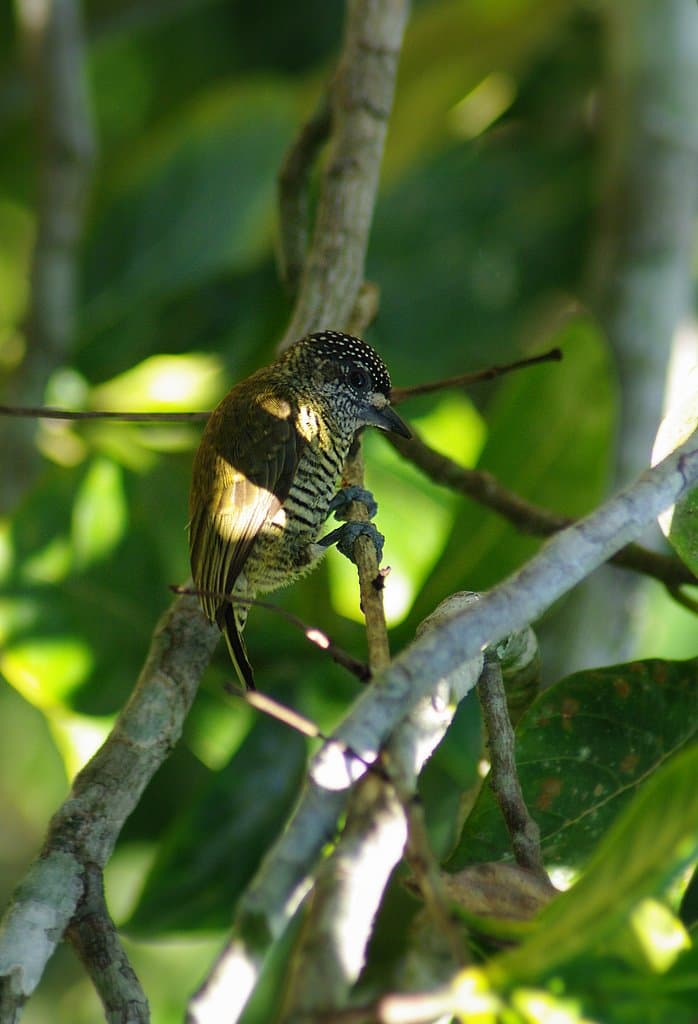
Golden-spangled piculet
The golden-spangled piculet is a small bird found across several South American countries, inhabiting diverse wooded environments from rainforests to savannas. It is characterized by its distinctive plumage, with males and females exhibiting variations in their spotted caps, and is known for foraging in the lower strata of forests and nesting in soft wood.

Black-necked woodpecker
The black-necked woodpecker is a bird species endemic to Peru, measuring 26 to 27 cm in length. It exhibits distinct plumage differences between males and females, particularly on their heads. This species primarily feeds on ants and their larvae, foraging at various levels within its semi-arid to arid habitat.

Spot-throated flameback
The Spot-throated flameback is a species of bird endemic to the Philippines, primarily found in the Palawan province and surrounding islands. It inhabits moist lowland forests, including primary and secondary growth, as well as plantations with standing trees. This species is closely related to the Common flameback, differing in specific plumage details and eyestripe markings.