
Golden-spangled piculet
The golden-spangled piculet is a small bird found across several South American countries, inhabiting diverse wooded environments from rainforests to savannas. It is characterized by its distinctive plumage, with males and females exhibiting variations in their spotted caps, and is known for foraging in the lower strata of forests and nesting in soft wood.
Key Facts
- ›Found in Brazil, Colombia, French Guiana, Guyana, Suriname, and Venezuela.
- ›Measures 9 to 10 cm in length and weighs 8.5 to 10 g.
- ›Adult males have red spots on the forehead and white spots on the crown, while females have white spots on the entire crown.
- ›Inhabits a variety of wooded areas including rain forest, cloud forest, secondary forest, bamboo tracts, mangroves, and open woodland.
- ›Diet is not fully defined but includes ants.
- ›Nests are excavated in soft wood, such as in stumps.
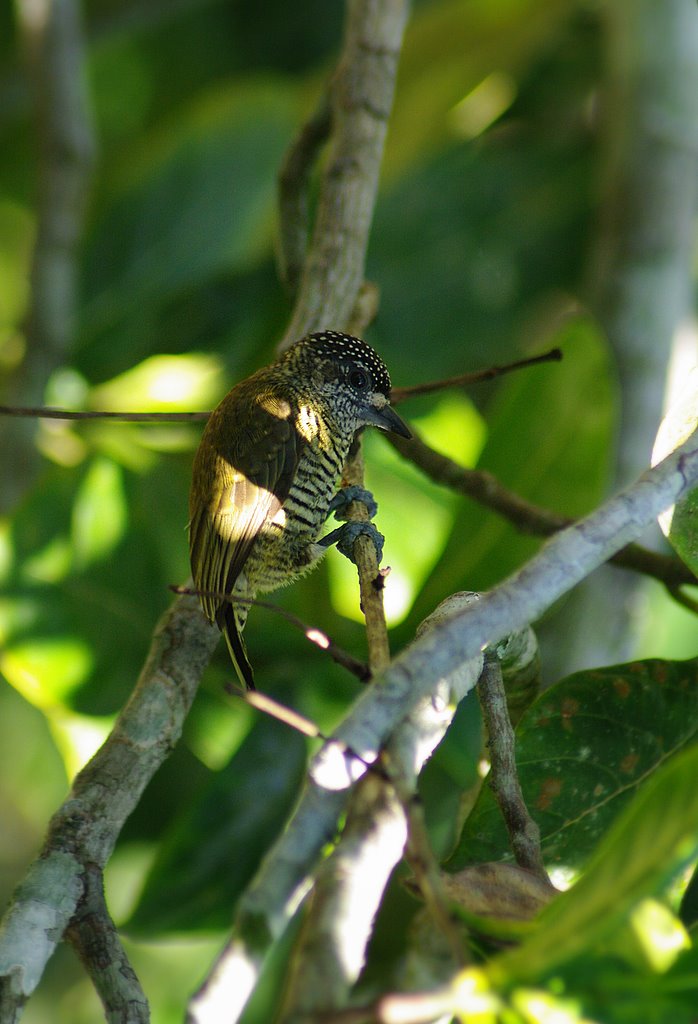
Golden-Spangled Woodpecker
South America
Rain Forest, Cloud Forest, Secondary Forest, Bamboo Tracts, Mangroves, Open Woodland, Edges of Savanna
Red Spots On Forehead, White Spots On Crown, Bare Grayish Skin Around the Eye, Pale Stripe Behind the Eye, Black Maxilla, Silvery Base On Mandible
Ants
Forages In the Forest's Lower Strata, Takes Food From Small Branches, Sometimes Hangs Upside Down, Forages Alone Or In Pairs, Sometimes Joins Mixed-Species Foraging Flocks
Soft Wood
"Tsilit, Tsirrrr", "Extr. High, Thin 'See See Suw.'"
About Golden-spangled piculet
The golden-spangled piculet (Picumnus exilis) is a small bird belonging to the woodpecker family, Picidae, specifically within the subfamily Picumninae. This species is widely distributed across several South American countries, including Brazil, Colombia, French Guiana, Guyana, Suriname, and Venezuela. Its presence spans a diverse array of wooded environments, from dense rain and cloud forests to secondary growth, bamboo thickets, mangroves, and even the edges of savannas.
Description and Characteristics
Measuring between 9 to 10 cm in length and weighing between 8.5 to 10 grams, the golden-spangled piculet exhibits subtle sexual dimorphism in its plumage. Adult males are distinguished by a black cap and nape adorned with red spots on the forehead and white speckles on the crown, while adult females display white spots across their entire crown. Both sexes share yellowish-white faces with dark speckles and a pale stripe behind the eye. Their upperparts are typically olive green, with darker centers to the feathers, and their wings feature brownish-green primaries and secondaries with yellow-green edges. The underparts are a pale yellowish hue, marked with blackish bars that become more spot-like on the belly. The beak has a black upper mandible and a black lower mandible with a silvery base, and their legs are grayish, sometimes with a green or blue tinge.
Distribution and Habitat
The golden-spangled piculet inhabits a broad geographic range and can be found in various elevations, from sea level up to approximately 1,900 meters in the tepui region where Venezuela, Guyana, and Brazil converge. The species is a year-round resident throughout its range, with no known migratory behavior.
Behavior and Ecology
Information regarding the golden-spangled piculet's diet is not fully detailed, but it is known to consume ants. Foraging primarily occurs in the lower strata of the forest, typically below 5 meters, where individuals often forage from small branches, sometimes adopting an upside-down posture. They are generally observed foraging alone or in pairs, occasionally joining mixed-species foraging flocks. The breeding biology of this species is not extensively documented. However, nesting has been recorded between December and March in Venezuela and Suriname, with nests being excavated in soft wood, such as in stumps. Vocalizations are described as a "tsilit, tsirrrr" and an "extr. high, thin 'see see suw.'"
Conservation Status
The International Union for Conservation of Nature (IUCN) has classified the golden-spangled piculet as Least Concern. While the species possesses a very large range, its population size is unknown and is believed to be decreasing. No immediate threats have been identified, and the species is known to inhabit several protected areas. It is noted that due to its tendency to occupy more open and sometimes disturbed habitats, human activities might potentially lead to an expansion of its range. The species is considered poorly known by researchers.
Source: Wikipedia ↗
Frequently Asked Questions
What is the scientific name of the golden-spangled piculet?
The scientific name of the golden-spangled piculet is Picumnus exilis. This binomial nomenclature is used to classify the species within the woodpecker family.
Where is the golden-spangled piculet found?
This species is distributed across South America, with confirmed sightings in Brazil, Colombia, French Guiana, Guyana, Suriname, and Venezuela. Its range covers a variety of habitats within these regions.
What does the golden-spangled piculet eat?
While its diet is not completely defined, ants are known to be a part of the golden-spangled piculet's food sources. It forages in the lower parts of the forest to find its sustenance.
How does the golden-spangled piculet build its nest?
The golden-spangled piculet excavates its nest holes in soft wood, often utilizing stumps. This behavior is typical for many cavity-nesting birds.
What is the conservation status of the golden-spangled piculet?
The golden-spangled piculet is currently assessed as Least Concern by the IUCN. Despite a large range, its population is believed to be decreasing, though no immediate threats have been identified.
Related Woodpecker species

Lafresnaye's piculet
Lafresnaye's piculet is a small bird belonging to the woodpecker family, found across parts of South America, including Brazil, Colombia, Ecuador, and Peru. This species is characterized by its olive-brown plumage, distinctive spotting on its head, and barred underparts, with slight variations among its four subspecies.

Guatemalan flicker
The Guatemalan flicker is a species of woodpecker found in Middle America, ranging from southern Mexico to Nicaragua. It is characterized by its distinct facial markings, barred back, and a white rump. This species primarily forages on the ground for insects and also consumes fruits and seeds, nesting in excavated cavities in dead trees.
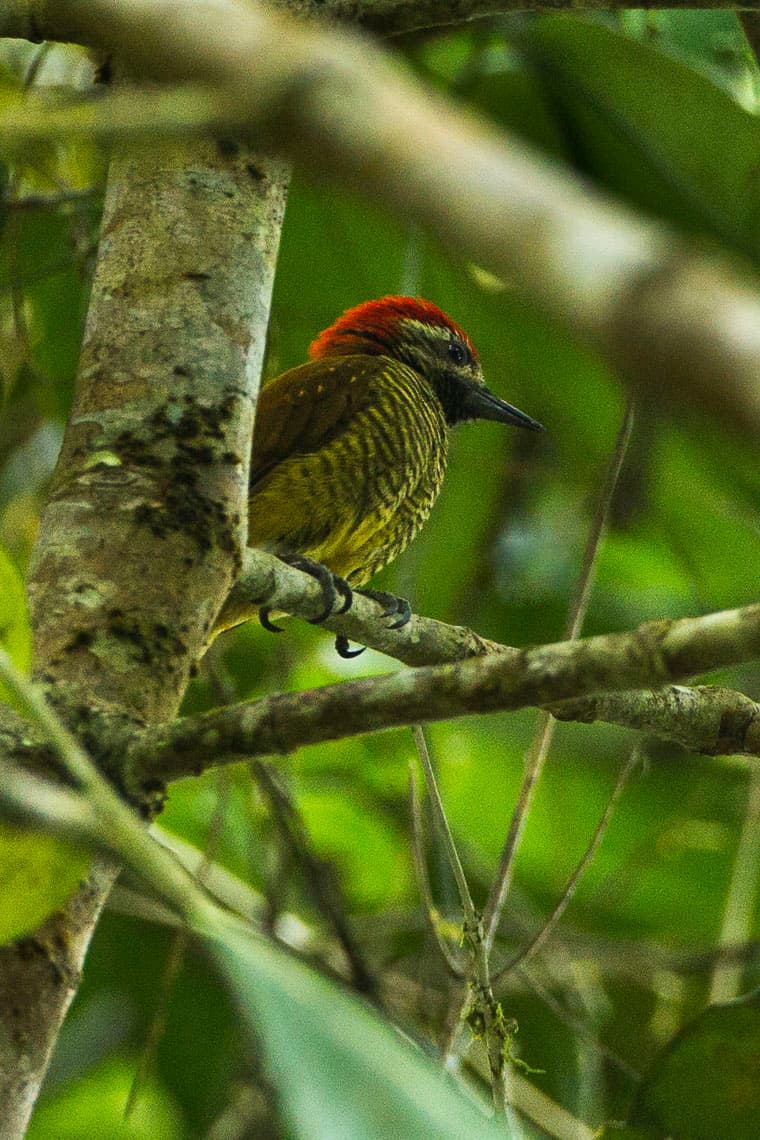
Yellow-vented woodpecker
The yellow-vented woodpecker is a species found in the montane forests of Colombia, Ecuador, Peru, and Venezuela. It is characterized by its yellow flanks and belly, and males have a red crown while females have a black crown. This species primarily inhabits humid cloud forests and is known for its relatively quiet nature.