
Pale-crested woodpecker
The pale-crested woodpecker is a bird species found in parts of South America, inhabiting semi-deciduous forests, cerrado woodlands, and dry Chaco woodlands, often near palms. It is characterized by its pale blond to buffish head and crest, rufous-black upperparts, and a primary diet of ants.
Key Facts
- ›Found in Argentina, Bolivia, Brazil, and Paraguay.
- ›Primarily feeds on ants, including adults, larvae, and pupae.
- ›Forages at the middle level of forests by probing, gleaning, and pecking into dead wood and ant tunnels.
- ›Nests are excavated in trees or arboreal ant/termite nests, typically 4 to 10 meters above ground.
- ›Its song is described as a high, slackening, fluted 'twee-twee-tee-tee-tee'.
- ›Assessed by the IUCN as Least Concern, though its population is believed to be decreasing.

Argentina, Bolivia, Brazil, Paraguay
Semi-Deciduous Forest, Cerrado Woodland, Dry Chaco Woodland, Areas With Palms
Blond, Buffish, Rufous-Black, Cinnamon, Blackish Brown, Dark Sooty Rufous, Creamy
- Long pointed crest
- Bright red malar area and cheek in males
- Barred or scaly brown malar area and cheek in females
Ants
Probing, Gleaning, Pecking Open Dead Wood and Ant Tunnels, Forages At Mid-Level of Forest
Excavated Nest Cavity In A Tree, Arboreal Ant Nest, Arboreal Termite Nest
- Song: 'A Very High, Slackening, Fluted 'Twee-Twee-Tee-Tee-Tee''
- Drums Weakly
About Pale-crested woodpecker
The pale-crested woodpecker (Celeus lugubris) is a species of bird belonging to the woodpecker family Picidae, found in the diverse landscapes of South America. Its range encompasses Argentina, Bolivia, Brazil, and Paraguay, where it inhabits semi-deciduous forests, cerrado woodlands, and dry Chaco woodlands, frequently associating with areas that feature palms.
Description and Identification
Adult pale-crested woodpeckers typically measure between 23 to 24 cm in length. A striking characteristic is their pale blond to buffish head, which includes a prominent, long, pointed crest. The upperparts are a deep rufous-black, contrasted by a blond to cream-buff lower back and rump. The flight feathers are blackish brown with rufous barring, and the tail feathers are black with rufous and black spots on the outermost pair. Their underparts are a dark sooty rufous, with creamy rear flanks and thighs that may exhibit dark barring. Males are distinguished by a broad, bright red malar area and cheek, whereas females display a barred or scaly brown pattern in the same region. Juveniles are similar but possess blackish coloration on the head and irregular barring on their upperparts. The bill is grayish to horn-colored, the iris is dark red to red-brown, and the legs are gray.
Distribution and Habitat
The nominate subspecies, C. l. lugubris, is found in central and eastern Bolivia and the western part of Brazil's Mato Grosso state. The subspecies C. l. kerri inhabits most of Paraguay, southern Mato Grosso, Mato Grosso do Sul state in Brazil, and northeastern Argentina. They favor somewhat open landscapes, preferring woodland environments.
Behavior and Ecology
Diet and Foraging
The pale-crested woodpecker's diet primarily consists of ants, including their adults, larvae, and pupae. They typically forage at the mid-level of the forest, employing methods such as probing, gleaning, and pecking into dead wood and ant tunnels to access their prey.
Breeding
The breeding season for this species generally spans from September to November, though it may extend later in the southern parts of its range. They excavate nest cavities in trees or within arboreal ant or termite nests, usually at heights of 4 to 10 meters above the ground. Little additional information is documented regarding their breeding biology.
Vocalizations
What is believed to be the song of the pale-crested woodpecker is described as a very high, slackening, fluted call, transcribed as 'twee-twee-tee-tee-tee'. While they do drum, this activity is noted as being weak.
Conservation Status
The pale-crested woodpecker is classified as Least Concern by the IUCN. Although it possesses a large geographic range and is considered fairly common in many areas, its population size is unknown and is thought to be decreasing. No immediate threats have been identified, and the species is present in several protected areas. However, further research is considered necessary to better understand its ecology and breeding behavior.
Source: Wikipedia ↗
Frequently Asked Questions
What is the scientific name of the pale-crested woodpecker?
The scientific name of the pale-crested woodpecker is *Celeus lugubris*. This binomial name is used in scientific classification to distinguish it from other woodpecker species.
Where is the pale-crested woodpecker found?
The pale-crested woodpecker is distributed across several South American countries, including Argentina, Bolivia, Brazil, and Paraguay. It inhabits specific types of woodlands and forests within these regions.
What does the pale-crested woodpecker eat?
The primary food source for the pale-crested woodpecker consists of ants. It consumes ants in all their life stages, including adults, larvae, and pupae.
What are the nesting habits of the pale-crested woodpecker?
Pale-crested woodpeckers excavate their nests in trees or in arboreal ant or termite nests. These nesting sites are typically situated between 4 to 10 meters above the ground.
What is the conservation status of the pale-crested woodpecker?
The International Union for Conservation of Nature (IUCN) has classified the pale-crested woodpecker as Least Concern. Despite this, its population is thought to be declining, and further research into its ecology is recommended.
Related Woodpecker species

Chilean flicker
The Chilean flicker is a medium-sized woodpecker species found in central and southern Chile and southwestern Argentina. It primarily inhabits semi-open to open landscapes and feeds almost exclusively on ants found on the ground. This species is characterized by its dark slate gray head in males, buffish underparts with blackish brown barring, and a white rump.

Chestnut piculet
The chestnut piculet is a small bird found in Colombia and Venezuela, known for its rufous-brown plumage and active foraging habits. It inhabits a variety of landscapes, from rainforests to arid scrublands, and is often seen in small groups or mixed-species flocks. While its diet is presumed to consist of small insects, much of its breeding biology remains undocumented.
Helmeted woodpecker
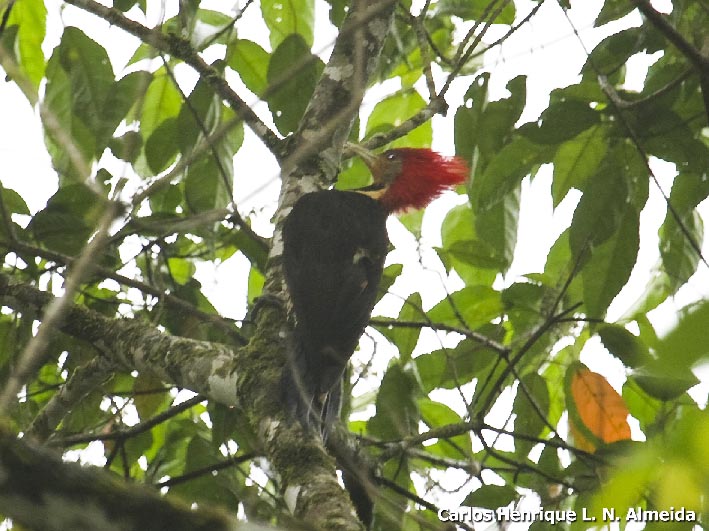
The helmeted woodpecker (Celeus galeatus) is a Vulnerable species found in Argentina, Brazil, and Paraguay, primarily inhabiting the Atlantic Forest. This medium-sized woodpecker is distinguished by its cinnamon face, long red crest, and black and buff plumage, with males exhibiting a distinctive red malar patch. It primarily forages by probing soft decaying trees rather than hammering, and its limited vocalizations include a distinctive long call.