
Helmeted woodpecker
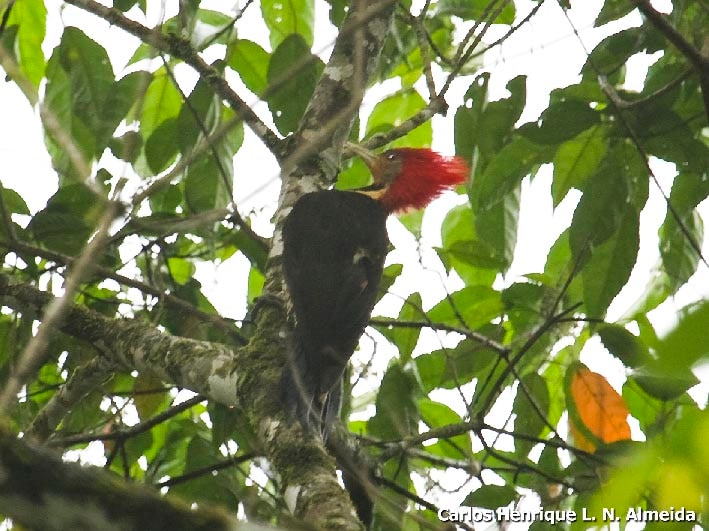
The helmeted woodpecker (Celeus galeatus) is a Vulnerable species found in Argentina, Brazil, and Paraguay, primarily inhabiting the Atlantic Forest. This medium-sized woodpecker is distinguished by its cinnamon face, long red crest, and black and buff plumage, with males exhibiting a distinctive red malar patch. It primarily forages by probing soft decaying trees rather than hammering, and its limited vocalizations include a distinctive long call.
Key Facts
- ›Found in Argentina, Brazil, and Paraguay.
- ›Inhabits the Atlantic Forest, including semi-deciduous and mixed deciduous-coniferous forests.
- ›Characterized by a cinnamon face, long red crest, and black and buff plumage.
- ›Males have a red malar patch, while females do not.
- ›Primarily forages by probing soft decaying trees.
- ›Assessed as Vulnerable by the IUCN due to habitat loss and fragmentation.
Argentina, Brazil, Paraguay
Atlantic Forest, Semi-Deciduous Forest, Mixed Deciduous-Coniferous Forest, Disturbed Forest, Plantations of Introduced Tree Species, Small Forest Fragments
Long Red Crest, Cinnamon Face, Red Malar Patch, Vertical White Stripe On Neck
Insect Larvae, Ants, Berries
- Probing soft decaying trees
- Gentle probing
- Less hammering and bark flaking
- Forages in all forest levels, primarily mid-storey
Excavated In Dead Branches, Excavated In Dead Trunks
- Long call: 'A strident, fairly drawn out kwee-kwee-kwee-kwee with four to ten notes'
- Mournful, descending call: 'Tu-du-du-du-du-du-du'
- Drumming: 'Fairly soft, uniform in pattern, and rather short'
About Helmeted woodpecker
The helmeted woodpecker (Celeus galeatus) is a Vulnerable species of bird belonging to the woodpecker family Picidae. It is primarily found in the Atlantic Forest of northeastern Argentina, southern Brazil, and eastern Paraguay.
Description and Identification
This medium-sized woodpecker measures approximately 25 cm (9.8 inches) in length. Both male and female helmeted woodpeckers share a distinctive cinnamon-colored face and a prominent, long red crest. The primary difference between the sexes lies in their head markings: adult males possess a red malar patch extending down the sides of the throat and connecting to the crest, while females lack this additional red coloration on their head. Both sexes feature a black throat and hindneck, separated by a vertical white stripe on the side of the neck. Their upper back is black or brownish-black, transitioning to buff or creamy on the lower back. The uppertail coverts are a cream-buff color and extend over half the length of the tail. Wings are brownish-black with some flight feathers showing cinnamon bases, and the tail is black. The lower throat and upper breast are black with cinnamon spots, and the rest of the underparts are buffy white marked with black bars, which are widest on the breast. The bill is ivory with a gray or blue-gray base, the iris is brown, and the legs are dark gray. Juveniles are generally browner with less red on the crown, gray ear coverts, and more extensive barring than adults.
Distribution and Habitat
The helmeted woodpecker is predominantly found in large tracts of Atlantic Forest, encompassing both semi-deciduous and mixed deciduous-coniferous types. While its primary habitat is these mature forests, it can also be found, though rarely, in disturbed forest areas, plantations of non-native tree species, and small forest fragments. Its elevation range spans from sea level up to approximately 1,000 meters (3,300 feet).
Behavior and Ecology
This species is a year-round resident throughout its known range, indicating it does not undertake long-distance migrations. Its foraging behavior is characterized by gentle probing into soft, decaying trees, with less emphasis on hammering or bark-flaking compared to other woodpecker species. It utilizes all levels of the forest for foraging, though it is most often observed in the mid-storey. While specific dietary details are limited, observations include consumption of insect larvae, ants, and berries. Helmeted woodpeckers are typically seen singly or in pairs, but have occasionally been observed participating in mixed-species feeding flocks.
Reproduction
The egg-laying season for the helmeted woodpecker appears to commence in late September, though the full duration of the nesting season is not precisely known. Known nests have been found excavated in dead branches or trunks, at heights ranging from 2.3 to 5 meters (8 to 16 feet) above the ground. Information regarding clutch size, incubation period, time to fledging, and details of parental care remains largely unknown.
Vocalizations
The helmeted woodpecker is not particularly vocal. Its characteristic "long call" is described as a strident, drawn-out series of 'kwee' notes, which can carry for over 500 meters (1,600 feet). It also produces a mournful, descending call that sounds like 'tu-du-du-du-du-du-du'. Its drumming pattern is relatively soft, uniform, and short.
Conservation Status
The helmeted woodpecker is currently assessed as Vulnerable by the International Union for Conservation of Nature (IUCN). Its limited geographic range, coupled with an estimated population of 3600 mature individuals that is believed to be declining, contributes to its conservation concern. Significant threats include the clearing and fragmentation of its Atlantic Forest habitat for timber, agriculture, ranching, and pine plantations. Its reliance on large, dead trees for both nesting and feeding further exacerbates its vulnerability.
Source: Wikipedia ↗
Frequently Asked Questions
What is the scientific name of the helmeted woodpecker?
The scientific name of the helmeted woodpecker is Celeus galeatus. It was first described by Coenraad Jacob Temminck in 1822 and has been reclassified into different genera before settling into its current placement within the genus Celeus.
Where is the helmeted woodpecker found?
The helmeted woodpecker is found in the southern Brazilian states of São Paulo, Paraná, and Santa Catarina, as well as the eastern half of Paraguay and Misiones Province in northeastern Argentina.
What does the helmeted woodpecker eat?
Details of the helmeted woodpecker's diet are not extensively known, but it has been observed eating insect larvae, ants, and berries. It tends to forage by gently probing soft decaying trees.
What are the distinctive features of the helmeted woodpecker?
The helmeted woodpecker is about 25 cm long and has a cinnamon face with a long red crest. Males have a red malar patch, while females lack this feature. Both sexes have a black throat and hindneck with a white stripe.
What is the conservation status of the helmeted woodpecker?
The helmeted woodpecker is listed as Vulnerable by the IUCN. Its population is estimated at 3600 mature individuals and is believed to be decreasing due to the extensive clearing and fragmentation of its Atlantic Forest habitat.
How does the helmeted woodpecker forage?
The helmeted woodpecker primarily forages in the forest's mid-storey, using all levels of the forest. Its foraging method involves gentle probing, with less emphasis on hammering and bark flaking, and it often works on soft decaying trees.
Related Woodpecker species

Pale-crested woodpecker
The pale-crested woodpecker is a bird species found in parts of South America, inhabiting semi-deciduous forests, cerrado woodlands, and dry Chaco woodlands, often near palms. It is characterized by its pale blond to buffish head and crest, rufous-black upperparts, and a primary diet of ants.

Ringed woodpecker
The ringed woodpecker is a South American bird found in various forests across the continent, excluding some southern countries. It is characterized by its pale cinnamon head with a rufous tinge and a crest, with males displaying a distinctive red facial patch. The species' conservation status varies by subspecies, with one categorized as Near Threatened due to deforestation threats.
Yellow-eared woodpecker
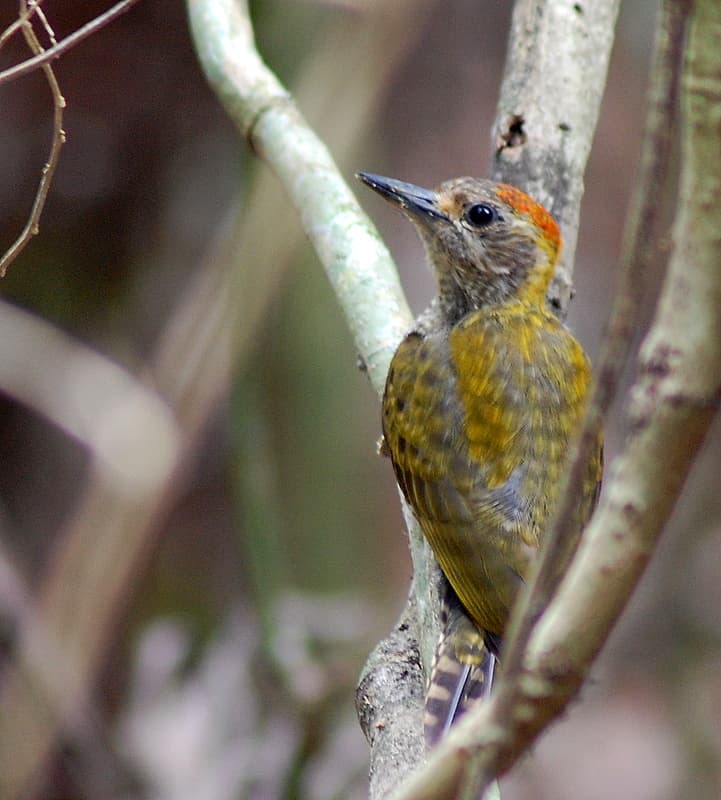
The yellow-eared woodpecker is a species of bird endemic to eastern Brazil, found between the states of Bahia and Rio de Janeiro. This species inhabits lowlands and hills of the Atlantic Forest, including primary and secondary forests, as well as parks. Adults are approximately 15 cm long and are characterized by olive-brown faces with whitish streaks and a pale golden-yellow nape, with males and females differing primarily in their head plumage.