
Speckled piculet
The Speckled Picullet is a bird species found across India, China, and Southeast Asia, inhabiting various forest types including boreal and montane forests. These small woodpeckers are characterized by their olive-green backs, white head stripes, and spotted undersides, with males displaying orange and brown on their forecrown.
Key Facts
- ›The Speckled Picullet is found in the Indian subcontinent and Southeast Asia.
- ›Its natural habitats include boreal forests, moist lowland forests, and moist montane forests.
- ›The species feeds primarily on ants and termites.
- ›Males have distinctive orange and brown markings on their forecrown.
- ›They typically move in pairs and can hang upside-down from branches while foraging.
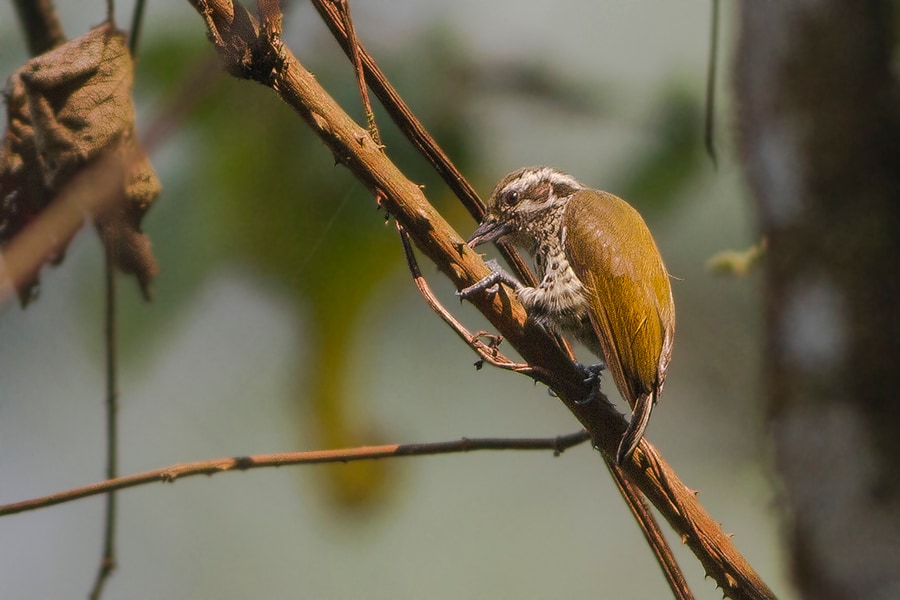
Speckled Piculet
Indian Subcontinent, Southeast Asia, China
Olive-Green, White, Creamy-White, Black
Two white stripes on the side of the head, Orange and brown on the forecrown, Creamy-white underparts with black spots, Dark green band near the eyes
Ants, Termites
Move About In Pairs, Forage On Thin Branches, Hang Upside-Down From Branches
About Speckled piculet
Speckled Picullet
The Speckled Picullet (Picumnus innominatus) is a small bird species belonging to the Picidae family, commonly found across the Indian subcontinent, China, and Southeast Asia. Its natural habitats are diverse, encompassing boreal forests, subtropical and tropical moist lowland forests, and moist montane forests, and it can also be observed in bamboo jungles.
Description and Identification
Both male and female Speckled Picullets exhibit similar appearances. They are characterized by olive-green backs and two distinct white stripes adorning the sides of their heads. A notable feature of the male is the presence of orange and brown coloration on its forecrown. The underparts are a creamy-white, marked with black spots. A dark green band is visible near the eyes, aiding in identification.
Distribution and Habitat
This species has a broad distribution, ranging across countries including Bangladesh, Bhutan, Cambodia, Hong Kong, India, Indonesia, Laos, Malaysia, Myanmar, Nepal, Pakistan, Thailand, Tibet, and Vietnam. In India, it is typically found in the Himalayan foothills, ascending to altitudes of approximately 2500 meters.
Behavior and Diet
Speckled Picullets are usually observed moving about in pairs. Their behavior is notably similar to that of other woodpeckers, including their tendency to hang upside-down from branches while foraging. Their primary diet consists of ants and termites, which they seek out within their forested environments.
Source: Wikipedia ↗
Frequently Asked Questions
What is the scientific name for the Speckled Picullet?
The scientific name for the Speckled Picullet is Picumnus innominatus. This binomial name was given to the species by Edward Burton in 1836.
Where is the Speckled Picullet distributed?
The Speckled Picullet is found in a wide range across the Indian subcontinent and Southeast Asia. This includes countries such as India, China, Vietnam, Thailand, and Malaysia, among others.
What kind of habitats does the Speckled Picullet prefer?
This species prefers natural habitats such as boreal forests, subtropical or tropical moist lowland forests, and subtropical or tropical moist montane forests. They can also be found in bamboo jungles.
What does the Speckled Picullet eat?
The diet of the Speckled Picullet consists mainly of ants and termites. They forage for these insects within their forest habitat.
How can I identify a male Speckled Picullet?
Male Speckled Picullets can be identified by the presence of orange and brown coloration on their forecrown. Both sexes share olive-green backs and two white stripes on the sides of their heads.
Related Woodpecker species
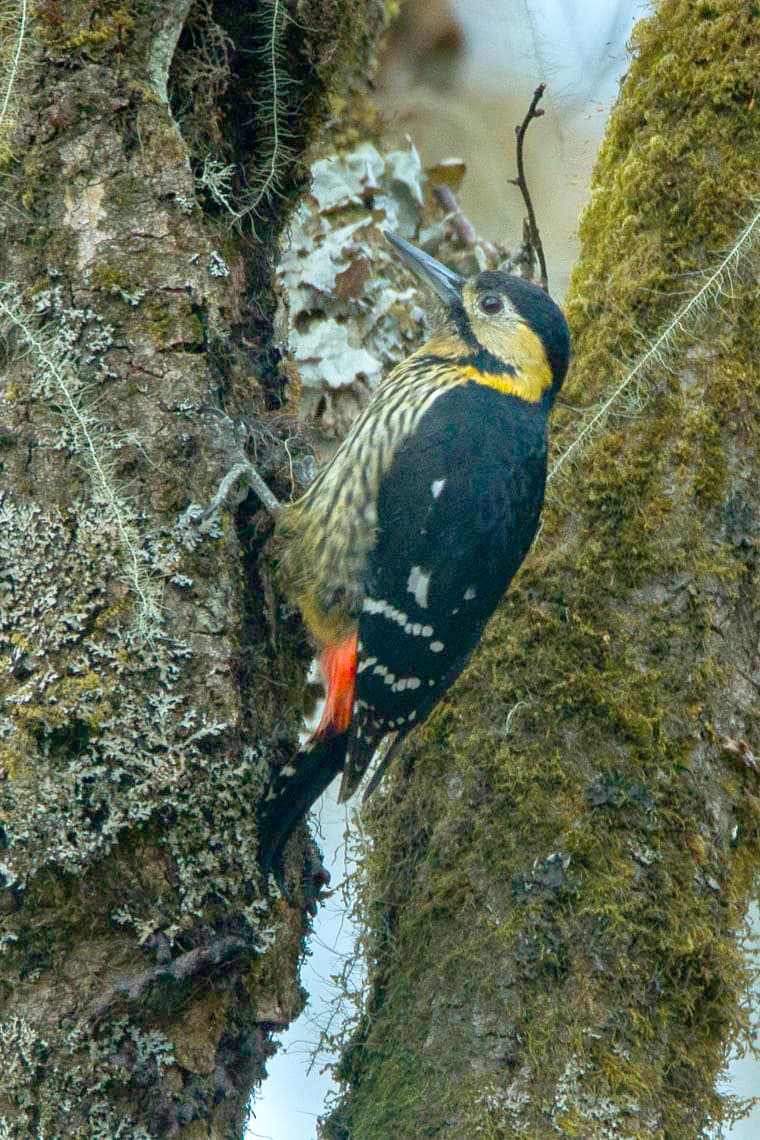
Darjeeling woodpecker
The Darjeeling woodpecker is a medium-sized pied bird found in the northern Indian subcontinent, primarily inhabiting the Himalayas and adjacent regions. It is characterized by its black upperparts with white scapular patches, yellow neck sides, and a long bill, with males possessing a red nape patch.

Greater yellownape
The greater yellownape is a large, olive-green woodpecker species found across East Asia, inhabiting moist lowland and montane forests. It is distinguished by a prominent yellow-crested nape and throat, contrasting with its olive-green back, brownish crown, and grey underparts. The species' natural range extends from northern and eastern India to southeastern China and parts of Indochina and Sumatra.

Scaly-bellied woodpecker
The scaly-bellied woodpecker is a large, green woodpecker species found in the Indian subcontinent and adjacent regions, including Afghanistan, Iran, India, Nepal, Pakistan, and Turkmenistan. It is characterized by distinct scaling on its underside, a black moustache, and a large pale bill. Males have a red crown, while females have a blackish crown.