
Sunda pygmy woodpecker
The Sunda pygmy woodpecker is a small bird found in various forests across Southeast Asia, including Malay Peninsula, Borneo, Sumatra, and Java. It is characterized by its greyish-brown capped head, distinctive white bands on its ear covers, and streaked underparts, with males having a reddish-orange crown.
Key Facts
- ›Small woodpecker with an average length of 13 cm.
- ›Found in lowland and montane moist forests, as well as mangrove forests.
- ›Males are distinguishable from females by a reddish-orange crown.
- ›Feeds on insects and larvae found on trees.
- ›Commonly observed in urban areas and forests, often moving rapidly up tree trunks.
- ›Two subspecies are recognized: Y. M. moluccensis and Y. M. grandis.
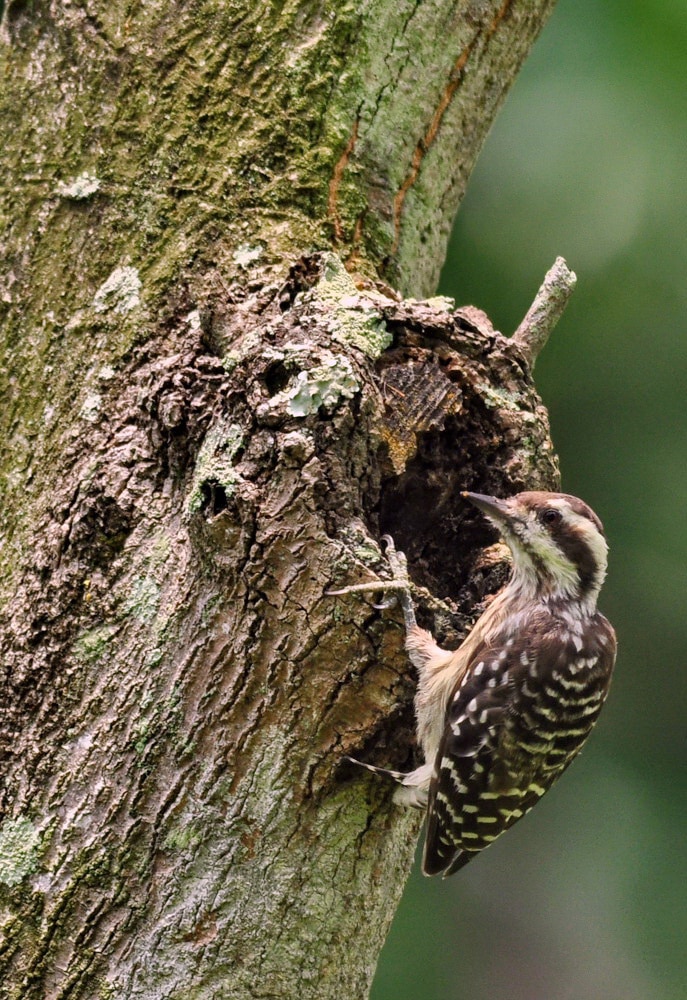
Sunda Woodpecker
Southeast Asia, Malay Peninsula, Borneo, Sumatra, Java, Lesser Sunda Islands
Greyish Brown, Dark Brown, Whitish Grey, White, Blackish, Dirty White, Reddish Orange
- Greyish brown capped head
- Dark brown ear covers with two broad whitish grey bands
- White wings tipped with white
- Reddish orange crown
Insects, Larvae
Rapidly moving up trees, Foraging on dead branches, Found from ground level to topmost branches
About Sunda pygmy woodpecker
The Sunda pygmy woodpecker, scientifically known as Yungipicus moluccensis and also referred to as the Sunda woodpecker, is a small species of bird belonging to the family Picidae. This species is found across a range of Southeast Asian countries, including Brunei, Indonesia, Malaysia, and Singapore.
Description and Identification
This diminutive woodpecker typically measures around 13 centimeters (5.1 inches) in length. Its plumage is characterized by a greyish-brown capped head, with dark brown ear coverts marked by two rather broad whitish-grey bands that narrow towards the neck. The upper parts are greyish-brown with white-tipped wings, giving them a striped appearance. The tail is short and blackish with white bands. Its underparts are a dirty white, becoming streaked with brown on the upper breast, and the underwing coverts are whitish with pale brown markings. A notable feature is sexual dimorphism: males possess a reddish-orange crown, a characteristic absent in females.
Distribution and Habitat
The Sunda pygmy woodpecker's natural habitats are diverse, encompassing subtropical or tropical moist lowland forests, subtropical or tropical mangrove forests, and subtropical or tropical moist montane forests. Its geographic range extends from the Malay Peninsula to Borneo, Sumatra, the Riau Islands, Bangka, Belitung, Java, Bali, and westward through the Lesser Sunda Islands such as Lombok to Alor Island.
Behavior and Ecology
This species is a common visitor to urban areas and forests, particularly noted in Singapore. It is often observed singly or in pairs, exhibiting a behavior of rapidly moving up tree trunks. The Sunda pygmy woodpecker forages from the ground level right up to the topmost branches of trees, frequently found on dead branches.
Source: Wikipedia ↗
Frequently Asked Questions
What is the scientific name of the Sunda pygmy woodpecker?
The scientific name of the Sunda pygmy woodpecker is Yungipicus moluccensis. It was formerly placed in genera such as Dendrocopos or Picoides before being assigned to Yungipicus.
Where can the Sunda pygmy woodpecker be found?
This species is distributed across Southeast Asia, including Brunei, Indonesia, Malaysia, and Singapore. Its range extends from the Malay Peninsula to Borneo, Sumatra, Java, Bali, and the Lesser Sunda Islands.
What does the Sunda pygmy woodpecker look like?
It is a small bird, approximately 13 cm long, with a greyish-brown head, dark brown ear covers marked by whitish-grey bands, and a short, blackish tail with white bands. Its underparts are dirty white and streaked with brown on the upper breast.
Are there any differences between male and female Sunda pygmy woodpeckers?
Yes, the sexes are dimorphic. Males possess a striking reddish-orange crown, which is absent in females.
What kind of habitats does the Sunda pygmy woodpecker prefer?
The Sunda pygmy woodpecker inhabits subtropical or tropical moist lowland forests, subtropical or tropical mangrove forests, and subtropical or tropical moist montane forests.
Related Woodpecker species

Grey-capped pygmy woodpecker
The grey-capped pygmy woodpecker is a small, dark Asian bird belonging to the woodpecker family. It is characterized by its grey crown, red nape in males, and prominent dark streaking on its buff underside. Its range spans from the Himalayas and Manchuria to Southeast Asia, inhabiting various forest types.

Laced woodpecker
The Laced woodpecker (Picus vittatus) is a bird species found across Southeast Asia, inhabiting various forest types including dry, moist lowland, mangrove, and montane forests. It is recognized by its distinctive plumage and is a common sight in its native range.

Fine-barred piculet
The fine-barred piculet is a small bird found in Brazil and Peru, known for its distinctive barring and reddish-orange crown markings in males. It inhabits forests, often near rivers, and forages for insects on branches and vines. While its population size is unknown, it is currently assessed as Least Concern.