
Fine-barred piculet
The fine-barred piculet is a small bird found in Brazil and Peru, known for its distinctive barring and reddish-orange crown markings in males. It inhabits forests, often near rivers, and forages for insects on branches and vines. While its population size is unknown, it is currently assessed as Least Concern.
Key Facts
- ›Found in Brazil and Peru, primarily along Amazonian tributaries.
- ›Adult males have a black crown with reddish-orange tips and white spots, while females have white spots on the entire crown.
- ›Forages on slender branches, stems, and vines, typically in the forest MID-storey to canopy.
- ›Its diet is assumed to be insects.
- ›The breeding season may include June, July, and possibly extend to December.
- ›Assessed as Least Concern by the IUCN, though its population is believed to be decreasing.

Brazil, Peru
Primary Forest, Secondary Forest, Terra Firme Forest Edges
Reddish Orange Tips On Forecrown Feathers, White Spots On Crown, Faintly Barred Appearance On Upperparts, Barred Underparts
Insects
Forages on slender branches, stems, and vines, Found from forest mid-storey to canopy, Seen singly or in pairs, Participates in mixed species foraging flocks
- Descending Series of Sharp, High Notes: "See See See See See See See."
- Soft Tapping Sounds
About Fine-barred piculet
The fine-barred piculet (Picumnus subtilis) is a species of bird belonging to the woodpecker family, Picidae. It is primarily found in the Amazonian regions of Brazil and Peru, inhabiting various forest types, including primary and secondary forests, as well as the edges of terra firme forests. This small woodpecker, measuring about 10 cm in length, exhibits sexual dimorphism in its plumage, with males featuring a black crown adorned with reddish-orange tips and white spots, while females have white spots across their entire crown.
Distribution and Habitat
Historically thought to be endemic to southeastern Peru, the fine-barred piculet's known range expanded to include Acre state in far western Brazil around 2009. In Peru, it is most recognized along the upper Ucayali River, and in Brazil, it has been recorded along the Purus River, both of which are tributaries of the Amazon. The species generally occurs in primary forests adjacent to rivers, but it can also be found in nearby secondary forests. In Brazil, it is observed at the edges of terra firme forests characterized by dense Guadua bamboo growth. Its altitudinal range extends up to 1,100 meters.
Behavior and Ecology
The fine-barred piculet forages on slender branches, stems, and vines, typically occupying the mid-storey to canopy levels of the forest. It is often seen alone or in pairs, and it participates in mixed-species foraging flocks. While its specific diet has not been detailed, it is presumed to consist of insects. The breeding season appears to encompass June and July, with potential to extend into December, though little else is known about its reproductive biology. The bird's vocalization includes a distinctive song described as a descending series of sharp, high notes, and it produces soft tapping sounds while foraging.
Conservation Status
The International Union for Conservation of Nature (IUCN) has assessed the fine-barred piculet as Least Concern. Despite this classification, its population size remains unknown and is believed to be declining. No immediate threats have been identified, and the species is considered "fairly common." Human activities are thought to have minimal short-term direct impact, apart from localized habitat destruction.
Source: Wikipedia ↗
Frequently Asked Questions
What does the fine-barred piculet look like?
Adult males have a black crown with reddish-orange tips and white spots, while females have white spots on their entire crown. Both sexes have yellowish-olive upperparts with a faintly barred appearance and gray underparts with straw yellow tips and bars. They are about 10 cm long.
Where does the fine-barred piculet live?
The fine-barred piculet is found in southeastern Peru, particularly along the upper Ucayali River, and in the Acre state of far western Brazil, along the Purus River. They inhabit primary and secondary forests, often near rivers, and also the edges of terra firme forest with bamboo.
What does the fine-barred piculet eat?
While its diet has not been explicitly detailed, it is assumed to be insects. It forages on slender branches, stems, and vines.
What sounds does the fine-barred piculet make?
Its song is described as a descending series of sharp, high notes, often seven in number, sounding like "SEE see see see see see see." They also make soft tapping sounds while foraging.
What is the conservation status of the fine-barred piculet?
The fine-barred piculet is listed as Least Concern by the IUCN. However, its population size is unknown and is believed to be decreasing, although no immediate threats have been identified.
Related Woodpecker species
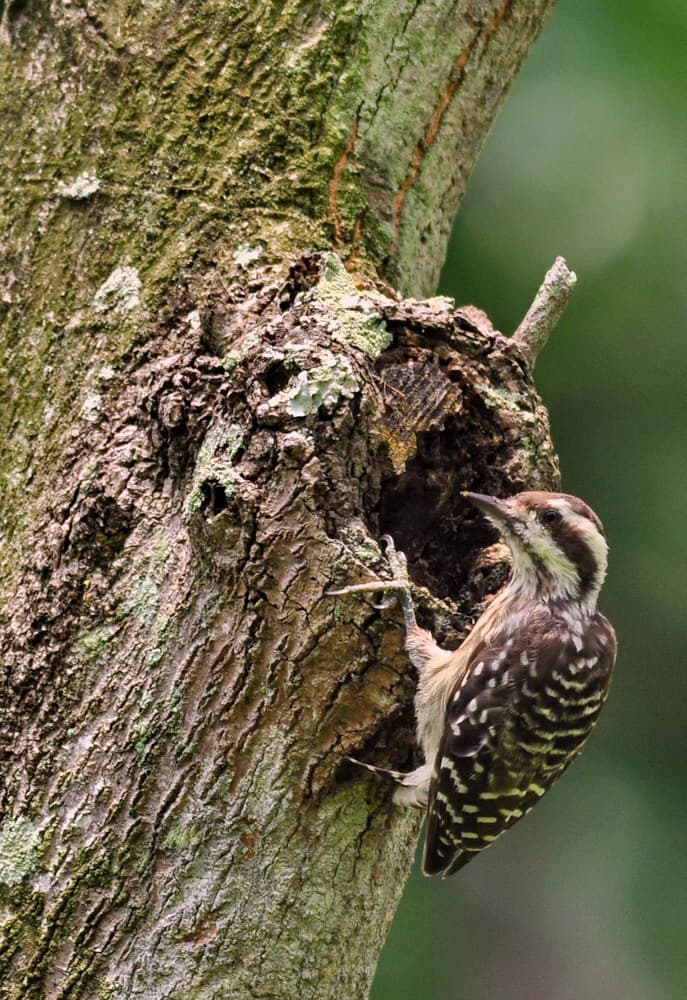
Sunda pygmy woodpecker
The Sunda pygmy woodpecker is a small bird found in various forests across Southeast Asia, including Malay Peninsula, Borneo, Sumatra, and Java. It is characterized by its greyish-brown capped head, distinctive white bands on its ear covers, and streaked underparts, with males having a reddish-orange crown.
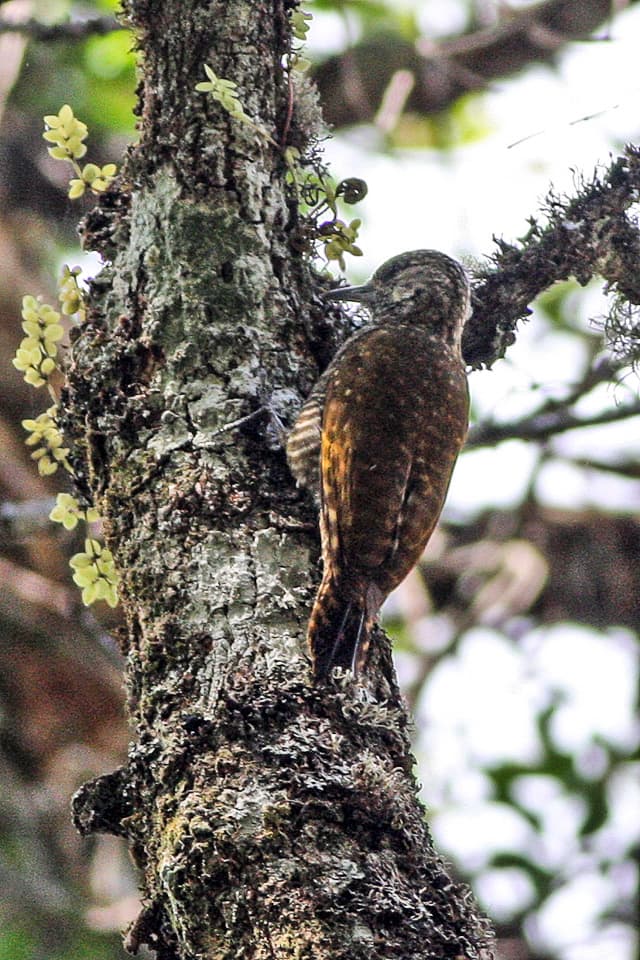
Dot-fronted woodpecker
The dot-fronted woodpecker (Veniliornis frontalis) is a species found in Argentina and Bolivia, inhabiting dry montane woodlands and humid forests. Measuring approximately 16 cm in length, it is characterized by its olive to gray-brown forehead with white spots, and males display red on their crown and nape.

Rufous-breasted piculet
The rufous-breasted piculet is a small bird found in parts of South America, inhabiting riverine areas and forest edges. It is characterized by its rufous-colored underparts and distinctive crown markings, which differ between males and females. This species typically forages close to the ground, feeding on insects.