
White-bellied piculet
The white-bellied piculet is a small bird found in parts of Brazil, Guyana, and Venezuela, inhabiting various wooded landscapes. It is characterized by its distinctive black and white barring and spotting, with males featuring a red patch on their forehead. This species is currently listed as Vulnerable due to threats from deforestation.
Key Facts
- ›Measures 8 to 9.2 cm in length and weighs between 7 to 12 grams.
- ›Adult males have a black cap with a red forehead patch and white spots, while females lack the red forehead.
- ›Found in rainforests, gallery forests, deciduous forests, mangroves, and open woodlands.
- ›It is a year-round resident and not known to migrate.
- ›Its breeding season is likely from September to November, though much of its breeding biology is unknown.
- ›The species is listed as Vulnerable on the IUCN Red List, primarily due to deforestation.

White-Bellied Piculet
Brazil, Guyana, Venezuela
Black, Red, White, Olive Brown, Gray
- Red patch on forehead
- White spots on cap
- Black barring and spotting on breast and belly
Observed Feeding In Pairs
- Very high to extremely high descending, shivering, slow trill.
About White-bellied piculet
The white-bellied piculet (Picumnus spilogaster) is a small bird belonging to the woodpecker family, Picidae, found in the northern regions of South America. It inhabits a variety of wooded environments, including rainforests, gallery forests, deciduous woodlands, mangroves, and open woodlands, typically at lower elevations.
Description and Identification
This species measures between 8 to 9.2 centimeters in length and weighs 7 to 12 grams. Adult males of the nominate subspecies are distinguished by a black cap featuring a red patch on the forehead and white spots across the rest of the cap. Their faces are predominantly dark brown, with some feathers tipped in white. The upperparts are olive brown, marked with diffuse pale grayish barring. Their flight feathers have light buff edges, particularly on the secondaries and tertials. The tail is dark brown, with the innermost feathers showing mostly white inner webs and the outer pairs having mostly white outer webs. The chin, throat, and sides of the neck are whitish with blackish bars. The upper breast is a pale yellowish buff with broad black bars, while the lower breast and belly are creamy white adorned with wide black spots. Adult females share these characteristics but lack the red patch on the forehead. Juvenile birds exhibit more pronounced barring and buffier underparts.
Distribution and Habitat
The white-bellied piculet's range extends across parts of Brazil, Guyana, and Venezuela. The nominate subspecies, P. s. spilogaster, is found in northern Guyana and the Roraima state of Brazil. The subspecies P. s. orinocensis inhabits central Venezuela, along the Rio Meta and Rio Orinoco. P. s. pallidus is located in the Belém area of Brazil's Pará state. The species is adapted to a diverse array of wooded landscapes.
Behavior and Ecology
As far as is known, the white-bellied piculet is a sedentary species, remaining within its range throughout the year without undertaking migrations. Limited observations indicate that they feed in pairs, but specific details regarding their foraging techniques and diet are not well-documented.
Breeding
The breeding season for the white-bellied piculet is thought to occur between September and November, though little else is recorded about their breeding biology. Their vocalization is described as a very high to extremely high, descending, shivering, slow trill.
Conservation Status
Originally assessed as Least Concern, the International Union for Conservation of Nature (IUCN) has since reclassified the white-bellied piculet as Vulnerable. The primary threat to its survival is habitat loss due to deforestation driven by agricultural expansion and ranching activities.
Source: Wikipedia ↗
Frequently Asked Questions
What is the scientific name of the white-bellied piculet?
The scientific name of the white-bellied piculet is Picumnus spilogaster. It belongs to the woodpecker family, Picidae.
Where is the white-bellied piculet found?
The white-bellied piculet is found in northern Guyana, northern Brazil (specifically Roraima and Pará states), and central Venezuela along the Rio Meta and Rio Orinoco.
What does the white-bellied piculet look like?
It is a small woodpecker, 8 to 9.2 cm long. Adult males have a black cap with a red forehead patch and white spots, dark faces, olive-brown upperparts with barring, and a white breast and belly with black spots. Females are similar but lack the red on the forehead.
What is the conservation status of the white-bellied piculet?
The white-bellied piculet is classified as Vulnerable by the IUCN. This status is largely attributed to the ongoing threat of deforestation for agriculture and ranching.
What kind of habitats does the white-bellied piculet prefer?
This species inhabits a range of wooded environments, including rainforests, gallery forests, deciduous forests, mangroves, and open woodlands. They are typically found at elevations near sea level up to about 100 meters.
What is known about the diet and foraging of the white-bellied piculet?
Little is known about the specific diet or foraging techniques of the white-bellied piculet. Observations have noted them feeding in pairs, but detailed information on their food sources and how they obtain them is not recorded.
What is the call of the white-bellied piculet?
The vocalization of the white-bellied piculet is described as a very high to extremely high descending, shivering, slow trill.
Related Woodpecker species
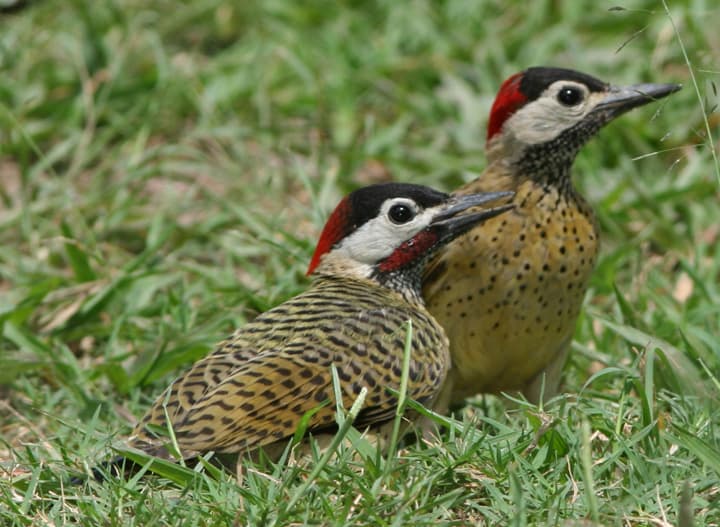
Spot-breasted woodpecker
The spot-breasted woodpecker (Colaptes punctigula) is a bird species found across much of mainland South America and Panama. It is characterized by its distinctive black and white spotted throat and is known for its varied vocalizations and adaptable habitat preferences, inhabiting humid lowland landscapes including forests, savannas, and plantations.

Arrowhead piculet
The Arrowhead piculet is a small bird belonging to the woodpecker family, characterized by its distinctive plumage and a varied diet. It is found in the Guianas region of South America, inhabiting a range of environments from mangroves to montane forests.

Chestnut piculet
The chestnut piculet is a small bird found in Colombia and Venezuela, known for its rufous-brown plumage and active foraging habits. It inhabits a variety of landscapes, from rainforests to arid scrublands, and is often seen in small groups or mixed-species flocks. While its diet is presumed to consist of small insects, much of its breeding biology remains undocumented.