
Yellow-faced flameback
The yellow-faced flameback is a striking woodpecker species found in the Philippine islands of Negros and Panay, though it is now extinct on Guimaras, Masbate, and Ticao. Characterized by its bright yellow head and crimson red back, it inhabits moist lowland forests, including primary and secondary forests, plantations, and clearings with standing trees. This species is considered the rarest woodpecker in the Philippines and faces significant threats due to habitat loss.
Key Facts
- ›Found exclusively on the Philippine islands of Negros and Panay.
- ›Distinguished by its bright yellow head and crimson red back.
- ›Males possess red crests, while females have yellow crests.
- ›Inhabits moist lowland forests, including primary, secondary, and disturbed areas with trees.
- ›Considered the rarest woodpecker in the Philippines and is threatened by habitat loss.
- ›Assessed as Endangered by the IUCN with an estimated 1,100 – 5,500 mature individuals.

Yellow-Faced Flameback
Philippines
Moist Lowland Forests, Primary Forest, Secondary Forest, Plantations, Clearings With Standing Trees, Riparian Vegetation, Mango Groves
Bright Yellow Head, Crimson Red Back, Red Crests In Males, Yellow Crests In Females
Large Caterpillars, Wood-Boring Larvae, Pupae, Ants
Pecking Wood, Hammering Wood
Tree Cavities
About Yellow-faced flameback
The yellow-faced flameback (Chrysocolaptes xanthocephalus) is a visually striking woodpecker species native to the Philippine islands of Negros and Panay. It is recognized for its vibrant plumage, featuring a bright yellow head contrasted with a crimson red back. Males can be distinguished from females by their red crests, while females possess yellow crests.
Habitat and Ecology
This species inhabits moist lowland forests, showing a preference for primary and mature secondary forests. It can also be found in lighter secondary forests with dense undergrowth, dense riparian vegetation, plantations, mango groves, and areas close to human settlements, provided there are still standing trees. The yellow-faced flameback is often observed foraging on larger trees and snags, where it uses its drumming and pecking behaviors to locate insects. While specific dietary details are not extensively documented, it is presumed to feed on large caterpillars, wood-boring larvae, pupae, and ants, similar to other flameback species. They are typically seen in pairs or small family groups, sometimes associating with White-bellied woodpeckers.
Conservation Status
The yellow-faced flameback is considered the rarest woodpecker in the Philippines and faces a critical threat from habitat loss. Extensive deforestation on Negros and Panay has significantly reduced its available habitat. The IUCN has assessed the species as Endangered, with an estimated population of 1,100 to 5,500 mature individuals. Habitat degradation continues due to clearance for agriculture, timber extraction, and charcoal burning. Conservation efforts include conducting surveys to refine population estimates and remaining habitat extent, encouraging reforestation around remaining forests, and enforcing laws against illegal logging.
Taxonomy and Distribution
Previously considered a subspecies of the Greater flameback, the yellow-faced flameback has since been recognized as a distinct species. It is part of a larger species complex that has been divided into eight separate species. The species is now extinct on the islands of Guimaras, Masbate, and Ticao. Its breeding season typically occurs between February and August.
Source: Wikipedia ↗
Frequently Asked Questions
What are the main characteristics of the yellow-faced flameback?
The yellow-faced flameback is a spectacular bird known for its bright yellow head and crimson red back. Males have red crests, while females have yellow crests. It is also noted for its striking coloration compared to other flameback species.
Where is the yellow-faced flameback found?
This species is found on the Philippine islands of Negros and Panay. It has become extinct on the islands of Guimaras, Masbate, and Ticao.
What kind of habitat does the yellow-faced flameback prefer?
The yellow-faced flameback prefers moist lowland forests. This includes primary and secondary forests, as well as plantations and clearings that still have standing trees. It can also be found in dense riparian vegetation and near human settlements.
What is the conservation status of the yellow-faced flameback?
The yellow-faced flameback is classified as Endangered by the IUCN. The primary threat to its survival is habitat loss, with extensive deforestation on its native islands.
What does the yellow-faced flameback eat?
While specific dietary details are not extensively recorded, it is presumed to feed on large caterpillars, wood-boring larvae, pupae, and ants. It forages by pecking and hammering on trees and snags to find insects.
Related Woodpecker species

Red-headed flameback
The red-headed flameback is a striking woodpecker species endemic to the Philippines, specifically found in the Palawan region. Characterized by its vibrant red head and a golden-yellow back, it inhabits moist lowland forests, including primary and secondary forests, plantations, and clearings with standing trees. This species faces threats primarily from habitat loss.

Spot-throated flameback
The Spot-throated flameback is a species of bird endemic to the Philippines, primarily found in the Palawan province and surrounding islands. It inhabits moist lowland forests, including primary and secondary growth, as well as plantations with standing trees. This species is closely related to the Common flameback, differing in specific plumage details and eyestripe markings.
Necklaced woodpecker
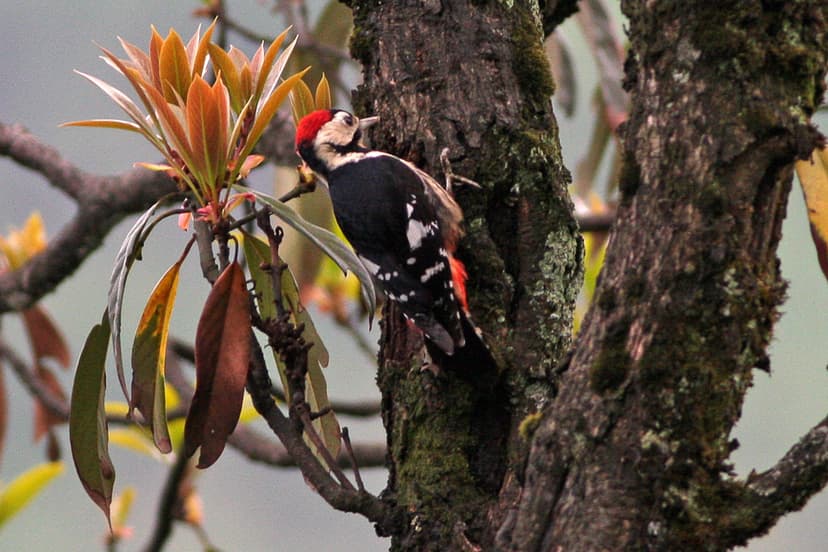
The necklaced woodpecker is a small, stout, black-and-white bird found in lowland and montane forests across Southeast Asia and China. It is characterized by buffy underparts, with males displaying a distinctive fiery orange neck patch and a crimson red crown.