
Slottsskogens djurpark
Slottsskogens djurpark is a historic Swedish zoo located within Gothenburg's Slottsskogen park, serving as the country's oldest zoological institution. It is notable for its focus on Nordic animals and heritage breeds, as well as its free admission policy and membership in the European Association of Zoos and Aquaria (EAZA).
Key Facts
- ›Founded in 1876, making it the oldest zoo in Sweden.
- ›Located in the Slottsskogen park in Gothenburg, Sweden.
- ›Offers free admission to the public.
- ›Features a collection primarily of Nordic animals, including moose.
- ›Includes a pond with seals and penguins.
- ›Operates a children's zoo during the summer season.

Nordic Animals, Seals and Penguins Pond, Children's Zoo
Moose, Swedish Yellow Duck
Conservation of Nordic Heritage Breeds, Swedish Yellow Duck Breeding
About Slottsskogens djurpark
Slottsskogens djurpark is a historic Swedish zoo situated within the expansive Slottsskogen park in the city of Gothenburg. It holds the distinction of being the oldest zoo in Sweden, having partially opened its doors to the public in 1876.
Animals and Focus
The zoo's collection primarily features wild species native to the Nordic countries, with moose being a notable example. Alongside these indigenous animals, Slottsskogens djurpark also exhibits species from further afield, such as penguins. A significant aspect of its mission involves the conservation of traditional heritage breeds of Nordic domestic animals. In 2021, an old pond was specifically renovated to serve as a habitat for the Swedish yellow duck (Sw. Svensk gul anka).
Accessibility and Community Engagement
One of the defining characteristics of Slottsskogens djurpark is its commitment to public access, with no entrance fee charged. During the summer months, a dedicated children's zoo operates, offering young visitors the opportunity to interact with farm animals like goats, sheep, and pigs.
Membership and Criticism
Slottsskogens djurpark is a member of the European Association of Zoos and Aquaria (EAZA), indicating adherence to certain standards of animal welfare and conservation. Despite its long history, the zoo has faced criticism. In August 2022, a spokesperson for the political party Feminist Initiative called for the zoo's closure, citing concerns about inhumane animal conditions.
Source: Wikipedia ↗
Frequently Asked Questions
When was Slottsskogens djurpark established?
Slottsskogens djurpark was partially opened to the public in 1876. This makes it the oldest zoo in Sweden.
Is there an admission fee to visit Slottsskogens djurpark?
No, there is no entrance fee charged to visit Slottsskogens djurpark. It is free for the public to enter and explore.
What types of animals can be seen at Slottsskogens djurpark?
The zoo primarily displays Swedish and Nordic wild animals, such as moose. It also houses species from further afield, like penguins, and features a pond with seals.
Does the zoo focus on any specific conservation efforts?
Yes, Slottsskogens djurpark works to conserve traditional heritage breeds of Nordic domestic animals. In 2021, a pond was remodelled to house the Swedish yellow duck.
Are there any special attractions for children?
During the summer season, a children's zoo is open at Slottsskogens djurpark. Here, children can interact with farm animals like goats, sheep, and pigs.
Related Zoos

Parken Zoo
Parken Zoo is an amusement park and zoo located in Eskilstuna, Sweden. Established with its amusement park component in 1898, the zoo began featuring animal displays in the early 1950s and started charging admission in 1954. It has since developed a focus on feline carnivores and is known for its animal collection.

Skansen
Skansen is the world's oldest open-air museum and zoo, located on the island of Djurgården in Stockholm, Sweden. Founded in 1891 by Artur Hazelius, its primary purpose is to showcase the traditional Swedish way of life prior to the industrial era. The museum features historical buildings, a replica 19th-century town, and a zoo with Scandinavian wildlife.
Borås Djurpark
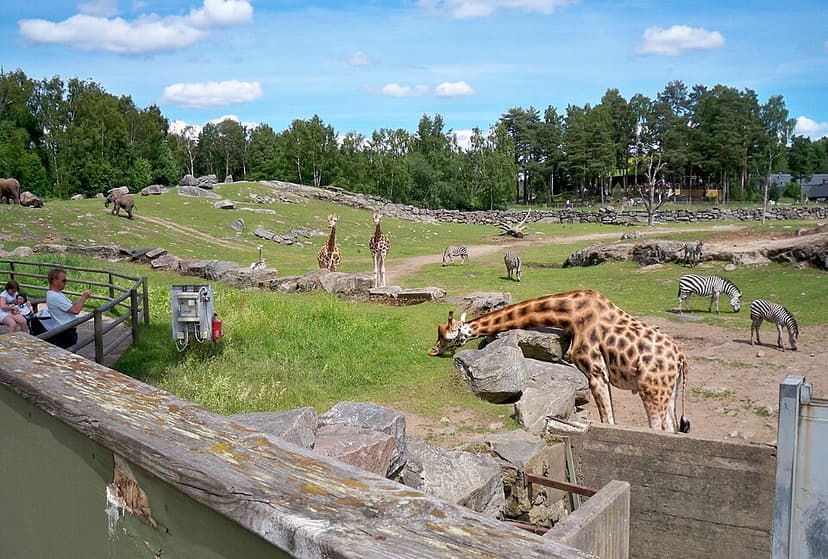
Borås Djurpark is a 40-hectare zoo located in Borås, Sweden, housing approximately 500 animals across 80 species. Founded in 1962, it is notable for being the only zoo in Sweden with African bush elephants and actively participates in European breeding programs for endangered species.