
Hudson Canyon
Submarine Canyon·North America·Hudson River
The Hudson Canyon is a significant submarine canyon extending over 400 miles from the mouth of the Hudson River across the continental shelf. It plays a crucial role in transporting sediment from the river to the deep ocean basin and is also a navigational reference point for shipping entering New York Harbor. Its formation is primarily attributed to river erosion and subsequent oceanic processes.
Key Facts
- ›Extends over 400 miles (640 km) seaward across the continental shelf.
- ›Connects to the deep ocean basin at depths of 1.9–2.5 miles (3–4 km) below sea level.
- ›Begins as a channel several kilometers wide, with an initial depression of 66–131 feet (20–40 M).
- ›Features a deep notch of about 0.62 miles (1 km) depth at the shelf break.
- ›Can be as much as 7.5 miles (12 km) wide across the continental slope.
- ›Serves as a navigational reference for vessels entering New York Harbor.
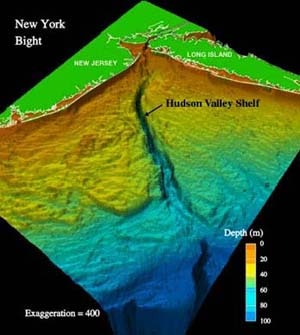
River Erosion, Sediment Transport, Oceanic Processes
Deep Notch At the Shelf Break, Continental Slope Features
About Hudson Canyon
The Hudson Canyon is a prominent submarine canyon located off the coast of New York and New Jersey, extending seaward from the estuary of the Hudson River. It is a vast geological feature that stretches over 400 miles (640 km) across the continental shelf, eventually connecting to the deep ocean basin at depths ranging from 1.9 to 2.5 miles (3 to 4 km) below sea level. The canyon plays a vital role in the marine environment by acting as a conduit for the transport of sediments, including silt, sand, and mud, carried down the Hudson River and out to the deep sea.
Geological Formation and Characteristics
The formation of the Hudson Canyon is primarily attributed to the erosional power of the Hudson River and the subsequent processes acting on the continental shelf. It begins as a natural channel several kilometers wide, with an initial depression of 66–131 feet (20–40 m) south of Ambrose Light. As it progresses, it carves a deep notch approximately 0.62 miles (1 km) in depth at the shelf break and continues down the continental rise. The canyon's dimensions are substantial; over a distance of about 50 miles (80 km), its average floor slope is 1.5 degrees. Across the continental slope, the canyon can reach a width of up to 7.5 miles (12 km) from rim to rim and a depth of 3,600 feet (1.1 km) from rim to floor. The canyon floor itself varies in width, being less than 1,600 feet (500 m) wide in the upper slope and broadening to about 3,000 feet (900 m) at the base of the slope. Tidally associated flows of about 30 cm/s (1.1 km/h) have been recorded moving both up and down the deeper sections of the canyon.
Navigational and Human Significance
Beyond its geological importance, the Hudson Canyon is also designated as a navigational reference point. A specific location marked by a navigational buoy signifies the seaward end of the vessel traffic separation scheme for the Hudson Canyon–Ambrose lanes. These lanes are essential for guiding Atlantic shipping traffic into and out of New York Harbor, underscoring the canyon's practical importance in maritime operations.
Source: Wikipedia ↗
Frequently Asked Questions
How was the Hudson Canyon formed?
The Hudson Canyon was formed by the erosion caused by the Hudson River carrying silt, sand, and mud. These sediments flow from the river estuary out into the canyon and then down into the deep sea. Oceanic processes also contribute to its formation and features.
What are the dimensions of the Hudson Canyon?
The canyon extends over 400 miles (640 km) seaward. At the base of the continental slope, it is 1.4 miles (2.2 km) deep and can be as much as 7.5 miles (12 km) wide. The initial depression at its start is 66–131 feet (20–40 m).
What is the significance of the Hudson Canyon?
It is significant for its role in sediment transport from the Hudson River to the deep ocean. It also serves as a critical navigational reference point, marking the seaward end of shipping lanes for Atlantic traffic entering New York Harbor.
Where is the Hudson Canyon located?
The Hudson Canyon begins at the outlet of the Hudson River estuary and extends seaward across the continental shelf. It is located offshore of New York and New Jersey.
Related Canyons
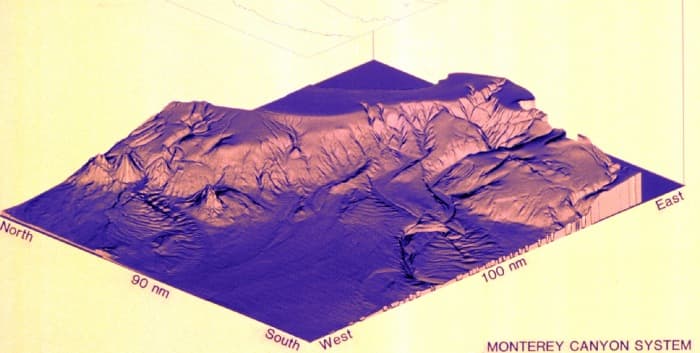
Monterey Canyon
Monterey Canyon, also known as Monterey Submarine Canyon, is the largest submarine canyon on the West Coast of North America, located in Monterey Bay, California. It was primarily formed by turbidity current erosion and features steep walls rivaling the depth of the Grand Canyon. The canyon is a significant area of ongoing geological and marine life research due to questions surrounding its origins and immense scale.

Pribilof Canyon
Pribilof Canyon is a significant submarine canyon situated on the Bering Abyssal Plain in the Bering Sea, southeast of Alaska's Pribilof Islands. It acts as a crucial underwater geological feature, connecting to the larger Bering Canyon at its western extremity. Its formation and geological significance are tied to the dynamic processes shaping the ocean floor.

Avilés Canyon
The Avilés Canyon is a significant submarine canyon system located off the coast of Asturias, Spain, in the Cantabrian Sea. As part of the larger Avilés Canyon System, it extends for approximately 75 kilometers and plunges to depths of nearly 5 kilometers, positioning it among the deepest on the planet. This deep-sea environment is a recognized biodiversity hotspot, supporting a rich array of marine life, including various whale species, numerous starfish, and ancient cold-water coral reefs.