
Alligatoridae
Alligatoridae·The black caiman is noted as near-threatened.
The Alligatoridae family encompasses alligators, caimans, and their extinct relatives, forming a distinct lineage within the crocodilian order. This family is characterized by a bony septum between the nostrils and overlapping bony scutes on their ventral armor, distinguishing them from crocodiles and gharials. Alligatoridae members are found in parts of North and South America, with some species adapted to freshwater environments.
Key Facts
- ›Alligatoridae includes two subfamilies: Alligatorinae (alligators) and Caimaninae (caimans).
- ›Alligators and caimans diverged in North America approximately 53 to 65 million years ago.
- ›True alligators are represented by two living species: the American alligator (Alligator mississippiensis) and the Chinese alligator (Alligator sinensis).
- ›Caimans are distinguished by the absence of a bony septum between their nostrils and by their ventral armor.
- ›The spectacled caiman (Caiman crocodilus) has the widest distribution among caimans, ranging from Mexico to Argentina.
- ›The black caiman (Melanosuchus niger) is the largest member of the Alligatoridae family, capable of reaching lengths of up to 5.7 meters.
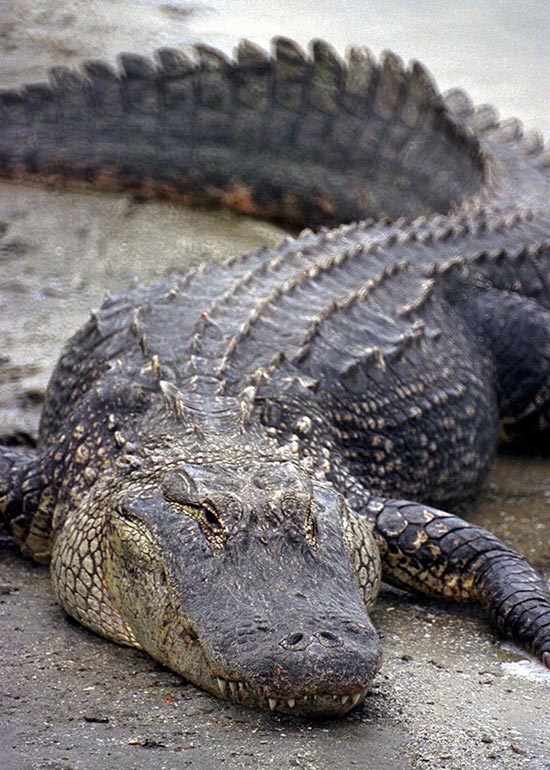
Freshwater Environments, Rivers, Amazon River Basin
- Absence of A Bony Septum Between Nostrils
- Ventral Armor Composed of Overlapping Bony Scutes
- American Alligators Can Grow Up To 4.8 Meters and Weigh 450 kg .
- Chinese Alligators Grow To An Average of 1.5 Meters .
- Spectacled Caimans Grow To About 2.2 Meters .
- Black Caimans Grow To 4.4 Meters , With Unverified Sizes Up To 5.7 Meters .
- Mating Cycles of Caimans Are Linked To Rainfall Cycles and River Levels, Which Increases Chances of Offspring Survival.
About Alligatoridae
Alligatoridae: Alligators and Caimans
The family Alligatoridae is a significant group within the order Crocodilia, comprising alligators, caimans, and their extinct relatives. These reptiles are distinguished by specific anatomical features, including the presence of a bony septum between their nostrils in true alligators, and the absence of this septum in caimans. Furthermore, caimans possess ventral armor made of overlapping bony scutes, a characteristic that sets them apart.
Evolution and Distribution
The evolutionary history of the Alligatoroidea superfamily, which includes Alligatoridae, dates back to the late Cretaceous period. The split between alligators and caimans is estimated to have occurred in North America during the early Tertiary or late Cretaceous, approximately 53 to 65 million years ago. Fossil evidence indicates that alligatoroids were once widespread across Eurasia. Today, living members of the Alligatoridae family are primarily found in the Americas, with true alligators inhabiting parts of the southeastern United States and China, while caimans are distributed throughout Central and South America.
Living Species and Characteristics
The family is divided into two subfamilies: Alligatorinae, containing the two living species of true alligators, and Caimaninae, which includes six species of caimans. The American alligator (Alligator mississippiensis) is known for its size, potentially reaching lengths of up to 4.8 meters and weighing up to 450 kg. In contrast, the Chinese alligator (Alligator sinensis) is considerably smaller, averaging around 1.5 meters. Among the caimans, the spectacled caiman (Caiman crocodilus) has the broadest geographical range, while the black caiman (Melanosuchus niger) is the largest species in the family, capable of reaching impressive lengths and posing a significant danger to humans, comparable to larger crocodile species.
Behavioral Adaptations
While research on caimans is ongoing, scientists have observed that their reproductive cycles are closely tied to environmental factors such as rainfall and river levels. This adaptation is believed to be crucial for enhancing the survival rates of their offspring. The family Alligatoridae represents a fascinating branch of crocodilian evolution, with diverse species adapted to various freshwater environments across the Americas and Asia.
Source: Wikipedia ↗
Frequently Asked Questions
What is the difference between an alligator and a caiman?
Caimans differ from alligators primarily in the absence of a bony septum between their nostrils and the composition of their ventral armor, which is made of overlapping bony scutes. Caimans also tend to be more agile and have longer, sharper teeth.
How many living species are in the Alligatoridae family?
The Alligatoridae family contains eight living species. These are divided into two alligators within the Alligatorinae subfamily and six caimans within the Caimaninae subfamily.
Where are alligators and caimans found geographically?
True alligators are found in the southeastern United States (American alligator) and China (Chinese alligator). Caimans are found in Central and South America, with the spectacled caiman having the widest distribution.
What is the largest species in the Alligatoridae family?
The largest member of the alligator family is the black caiman (Melanosuchus niger), found in the Amazon River basin. It can grow up to 4.4 meters (14.5 ft), with unverified sizes reaching up to 5.7 meters (19 ft).
What are the mating habits of caimans?
While not studied in great depth, scientists have learned that caiman mating cycles are linked to rainfall patterns and river levels. This synchronization is believed to increase the survival chances for their offspring.
Are any members of the Alligatoridae family dangerous to humans?
Yes, the black caiman and the American alligator are noted as members of the alligator family that can pose a danger to humans, similar to the larger species of crocodiles.
Related Crocodilians

American alligator
The American alligator (Alligator mississippiensis) is a large crocodilian reptile native to the Southeastern United States. It is distinguished by its broad, U-shaped snout and darker coloration compared to the American crocodile. These apex predators play a crucial role as ecosystem engineers in freshwater wetlands, creating vital habitats for other organisms.

Caiman latirostris
The broad-snouted caiman (Caiman latirostris) is a large crocodilian native to eastern and central South America, inhabiting freshwater wetlands like marshes and swamps, as well as rivers and lakes. It is distinguished by its unusually broad snout, which is adapted for navigating dense vegetation and crushing shells, and it is known to be an omnivore, consuming invertebrates, fish, birds, mammals, and even fruits.

Caiman yacare
The yacare caiman, also known as the Paraguayan caiman or piranha caiman, is a species of crocodilian found in South America. It is characterized by its brown coloration with dark blotches and can be distinguished by its lower jaw teeth that can poke through holes in the upper jaw. Historically hunted for its skin, its populations have recovered due to conservation efforts and trade restrictions.