
Cycas beddomei
Scrubland and brush-covered hills in dry, hot sites.·Arborescent with erect, solitary stems.·Endangered
Cycas beddomei is a species of cycad native to a small region in the Andhra Pradesh state of India, specifically the Tirumala Hills. It is characterized by erect, solitary stems topped with a crown of stiff, pinnate leaves and is found in scrubland and brush-covered hills. A unique feature is the fleshy layer within its seeds, which is believed to provide a water source, crucial for its survival in arid conditions.
Key Facts
- ›Native to the Tirumala Hills in Andhra Pradesh, India.
- ›Possesses erect, solitary stems with a crown of 20-30 leaves.
- ›Leaves are pinnate, up to 90 cm long, with numerous narrow leaflets.
- ›Seeds have a unique fleshy layer aiding in water retention.
- ›Male cones are used in Ayurvedic medicine for rheumatoid arthritis and muscle pain.
- ›Considered an endangered species due to demand for medicinal purposes.

India
Erect, Solitary Stems.
20-30 leaves in the crown., Each leaf is 90 cm long., Stiff and lanceolate., Pinnate with 50-100 pairs of leaflets., Leaflets are 10–17.5 cm long and 3–4 mm wide., Leaflets angled forward at 45 degrees., Lamina margin is strongly toothed., Acuminate point on leaflets.
- Female cones are open, with sporophylls 15–20 cm long, covered in pink-brown tomentose down, with two ovules.
- Female cones emerge November-December, ripening March-May.
- Male cones are solitary, ovoid, 30 cm long and 7.5 cm broad, with an apical spine and rhomboid sporophyll face.
- Contain a layer of fleshy material between sarcotesta and sclerotesta.
- Fleshy layer thought to provide a source of water.
- Sarcotesta is yellow to brown.
- Male cones used in Ayurvedic medicine for rheumatoid arthritis and muscle pains.
- Demand for medicinal purposes leading to reduction in living populations.
About Cycas beddomei
Cycas beddomei is a species of cycad that is native to a limited geographical area within the Tirumala Hills of Andhra Pradesh, India. It is found growing in scrubland and brush-covered hilly terrains, often in dry and hot conditions. The species is distinguished by its erect, solitary stems, each crowned with a cluster of stiff, pinnate leaves.
Botanical Features
The leaves of Cycas beddomei typically measure up to 90 cm in length and are composed of numerous pairs of narrow leaflets. These leaflets are angled forward and possess strongly toothed margins and an acuminate tip. A unique characteristic of this cycad's seeds is the presence of a fleshy layer between the seed coats, which is believed to serve as a crucial water reservoir, aiding the seed's survival in its arid environment, especially since cycad seeds do not exhibit dormancy.
Reproduction and Conservation
Reproductive structures include female cones with sporophylls that bear ovules, emerging in late autumn and ripening in spring. Male cones are ovoid and possess an apical spine. Cycas beddomei exhibits a degree of fire resistance in its adult stage, though seeds and seedlings are highly susceptible to annual fires. The species is considered endangered, primarily due to over-collection for its use in traditional Ayurvedic medicine to treat conditions like rheumatoid arthritis and muscle pain. The male cones are specifically valued for these medicinal applications.
Source: Wikipedia ↗
Frequently Asked Questions
Where is Cycas beddomei found naturally?
Cycas beddomei is indigenous to a confined area within the Tirumala Hills in the state of Andhra Pradesh, India. It thrives in scrubland and brush-covered hilly terrain.
What are the key physical characteristics of Cycas beddomei?
This cycad typically has erect, solitary stems. Its crown features 20 to 30 leaves, each around 90 cm long, which are stiff, lanceolate, and pinnate with many narrow leaflets. The leaf petioles are adorned with minute spines.
How do the seeds of Cycas beddomei differ from other cycads?
A notable feature of Cycas beddomei seeds is the presence of a fleshy layer situated between the sarcotesta and sclerotesta. This layer is thought to provide a vital water source for the seed, especially in its dry habitat, as cycad seeds lack dormancy.
Are there any traditional uses for Cycas beddomei?
Yes, the male cones of Cycas beddomei are utilized in Ayurvedic medicine. They are traditionally employed as a remedy for rheumatoid arthritis and various muscle pains.
What is the conservation status of Cycas beddomei?
Due to significant demand for its medicinal properties leading to a reduction in its wild populations, Cycas beddomei is classified as an endangered species.
How does Cycas beddomei adapt to fire?
The adult plants of Cycas beddomei exhibit a fair degree of resistance to fire. However, its seeds and seedlings are highly vulnerable to the annual grass fires that occur in its habitat.
Related Cycad species
Ceratozamia hildae
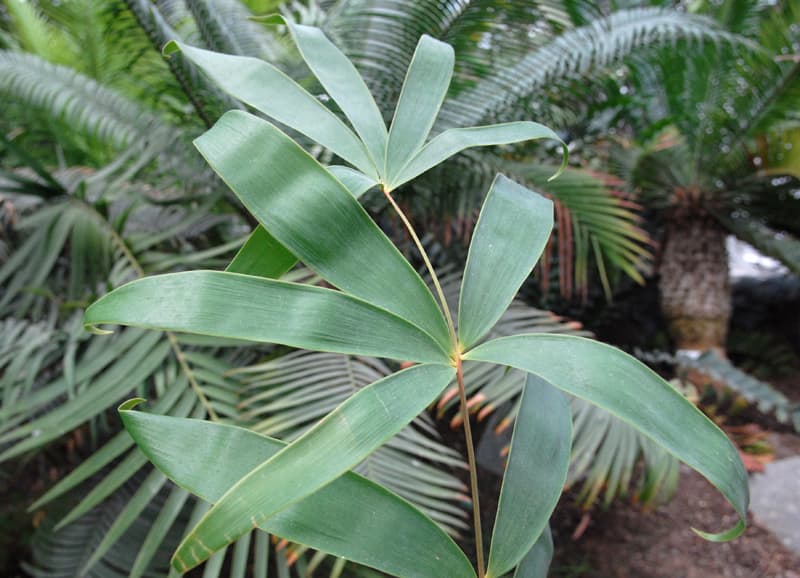
Ceratozamia hildae, commonly known as the Bamboo Cycad, is a species native to Mexico, thriving in moist, humid tropical forests. It is distinguished by its long, papery leaves that cluster at nodes, giving it a bamboo-like appearance, and an underground stem that initially develops a branched root system before producing above-ground stems.

Ceratozamia norstogii
Ceratozamia norstogii is a species of cycad belonging to the Zamiaceae family, native to the Sierra Madre de Chiapas in southwestern Mexico. This endangered plant is characterized by its unique botanical features and faces significant threats primarily from habitat loss.

Cycas angulata
Cycas angulata is the largest Australian species of cycad, distinguished by its tall, often branched stems and numerous grey-green to glaucous leaves reaching up to 1.7 meters in length. Native to the Northern Territory and northwest Queensland, it is occasionally cultivated as an ornamental plant and its seeds were historically used as a food source by Aboriginal Australians after careful detoxification.