
Encephalartos afer
Grassveld and adjacent bushland, typically in the coastal belt and up to 100 km inland.·Subterranean stem with a small portion above ground, typically unbranched.·Insect pollination (recent studies suggest this, though wind pollination was previously considered likely).·Near Threatened (NT)
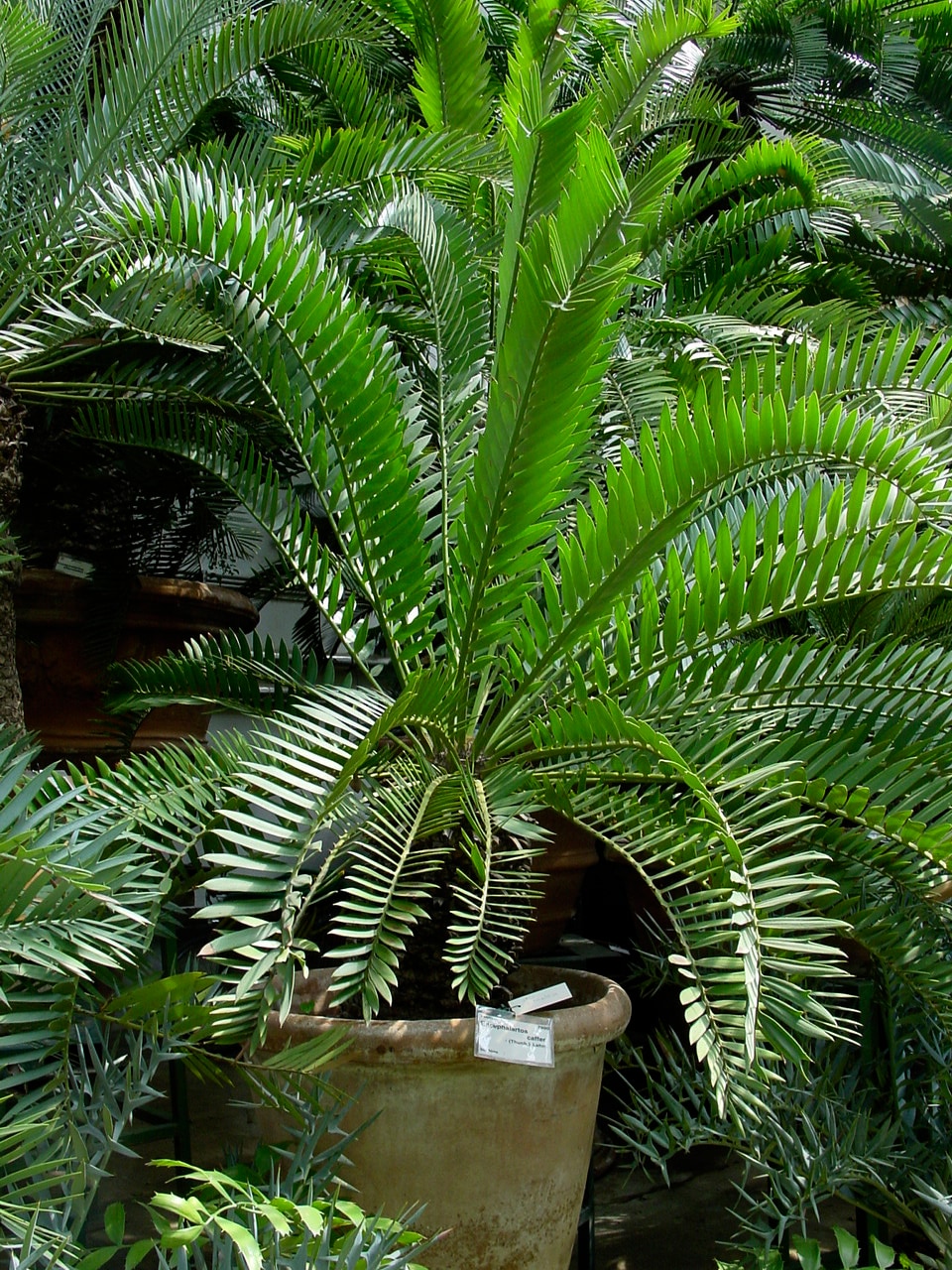
Encephalartos afer, commonly known as the Eastern Cape dwarf cycad, is a species of cycad native to South Africa's Eastern Cape Province. This plant is characterized by its typically underground stem, from which emerge long, pinnate, dark green leaves that often have a distinctive ruffled, feathery appearance due to irregularly twisted leaflets. Both male and female plants produce reproductive cones, with females bearing scarlet-colored seeds.
Key Facts
- ›Native to the Eastern Cape Province of South Africa.
- ›Features long, pinnate leaves with a ruffled, feathery appearance.
- ›Typically has an underground stem, rarely branched.
- ›Dioecious, with separate male and female plants.
- ›Classified as near Threatened (NT) on the IUCN Red List.
- ›Seeds have a fleshy outer coat attractive to animal dispersers.
Eastern Cape Dwarf Cycad
South Africa
Typically Underground, Small Portion Visible Above Ground, Very Rarely Branched, May Be As Much As 40 cm Long
- Long, Pinnate
- Dark Green
- Up To 1 Metre Long
- Distinctive Ruffled, Feathery Appearance
- Numerous, Clustered Leaflets Irregularly Twisted
- New Leaves Are Brown and Woolly, Lose Most Hair When Mature
- Single reproductive cones
- Made up of spiraled scales
- Greenish-yellow when mature
- Female cones have two large, glossy, scarlet-colored seeds on top of each scale
- Two large seeds per cone scale on female plants
- Glossy, scarlet-colored
- Hard, stony layer beneath a fleshy outer coat
Collectors, Conversion of Land To Agriculture
About Encephalartos afer
Encephalartos afer: The Eastern Cape Dwarf Cycad
Encephalartos afer, commonly known as the Eastern Cape dwarf cycad, is a species of cycad native to the Eastern Cape Province of South Africa. It is a distinctive plant characterized by its mostly subterranean stem, from which emerge long, pinnate, dark green leaves that possess a unique ruffled, feathery appearance due to the irregular twisting of their numerous leaflets. New leaves emerge with a woolly texture, which diminishes as they mature.
Botanical Characteristics and Biology
This species typically has an unbranched stem that rarely exceeds 40 cm in length and is often hidden underground. The leaves can grow up to 1 meter long, providing a striking visual element. Encephalartos afer is dioecious, meaning that separate male and female plants exist. Both sexes produce reproductive cones that turn greenish-yellow when mature. Female cones are notable for bearing two large, glossy, scarlet-colored seeds on each scale, which are dispersed by animals attracted to their fleshy outer coat. Recent studies suggest that insects play a role in pollination, although wind pollination was previously considered the primary mechanism. Like all cycads, Encephalartos afer possesses 'coralloid' roots containing symbiotic cyanobacteria that fix atmospheric nitrogen, aiding its survival in nutrient-poor environments.
Distribution and Habitat
Approximately 10,000 mature individuals of Encephalartos afer are found within the Eastern Cape Province of South Africa. Its habitat encompasses the coastal belt and extends up to 100 kilometers inland. It typically thrives in grassveld but can also be found in adjacent bushland, potentially influenced by the shifting boundaries caused by veld fires.
Conservation Status and Threats
Encephalartos afer is classified as Near Threatened (NT) on the IUCN Red List and is listed on Appendix I of CITES. Historically, it was one of the first Cape cycads to be declared endangered. Significant threats to its survival include collection by enthusiasts, which has severely depleted populations in accessible areas, and habitat loss due to the conversion of land for agricultural purposes, particularly in districts like Humansdorp and Albany. While some viable colonies are protected on state land and within reserves, and seedlings are observed to be regenerating, the species remains vulnerable.
Taxonomy and Naming
The scientific name "caffer" was historically linked to the ethnic slur "kaffir." In recognition of this, a vote at the July 2024 International Botanical Congress resulted in the decision to emend "caffer" related names to "afer" related ones, with the implementation occurring by the end of July 2024.
Source: Wikipedia ↗
Frequently Asked Questions
What is the common name for Encephalartos afer?
Encephalartos afer is commonly known as the Eastern Cape dwarf cycad. This name reflects its geographic origin and its relatively small stature compared to some other cycad species.
Where is Encephalartos afer found naturally?
This cycad species is indigenous to the Eastern Cape Province of South Africa. It is found in the coastal belt and extends up to 100 kilometers inland, typically growing in grassland but also found in adjacent bushland.
What are the distinctive features of Encephalartos afer leaves?
The leaves of Encephalartos afer are long, pinnate, and dark green, reaching up to 1 meter in length. They often have a distinctive ruffled, feathery appearance because the numerous leaflets are irregularly twisted and point in different directions from the central stalk.
How does Encephalartos afer reproduce?
Encephalartos afer is dioecious, meaning there are separate male and female plants. Both sexes bear reproductive cones. Female cones produce two large, glossy, scarlet-colored seeds on top of each cone scale.
What is the conservation status of Encephalartos afer?
Encephalartos afer is classified as Near Threatened (NT) on the International Union for Conservation of Nature's Red List. It is also listed on Appendix I of CITES, indicating concerns about its trade and survival.
What are the primary threats to Encephalartos afer?
Major threats to Encephalartos afer include collection by enthusiasts, which has depleted numbers in accessible areas, and habitat destruction due to the conversion of land to agriculture. These factors have contributed to its Near Threatened status.
Related Cycad species

Encephalartos horridus
Encephalartos horridus, commonly known as the Eastern Cape blue cycad, is a distinctive, low-growing cycad native to the Eastern Cape Province of South Africa. It is recognized for its striking blue-gray, spiny leaves and typically develops a subterranean stem. This species thrives in arid shrublands and rocky ridges, exhibiting a slow growth rate and requiring specific conditions for successful cultivation.

Encephalartos ghellinckii
Encephalartos ghellinckii, commonly known as the Drakensberg cycad, is an evergreen species endemic to South Africa, primarily found in the Natal Drakensberg region. It thrives in diverse habitats from foothills to high elevations, including stream banks, steep grassy slopes, and sandstone outcrops, demonstrating remarkable resistance to veldfires, snow, and frost. Distinctive features include its olive to yellow-green fronds, narrow leaflets with revolute margins, and lemon-colored, woolly cones.

Encephalartos lanatus
Encephalartos lanatus, commonly known as the Olifants River cycad, is a slow-growing cycad species native to Mpumalanga and Gauteng in South Africa. Characterized by its bluish-green, woolly leaves and the unique arrangement of leaflets, this species thrives in rocky, prairie-covered slopes and exhibits remarkable resilience to fire and frost.